Vietnam’s cultural initiative wins strong support at UNESCO

Through the proposed initiative, Vietnam sends a strong message to international friends about its aspiration to join hands in building a peaceful, prosperous and humane future for all humanity.

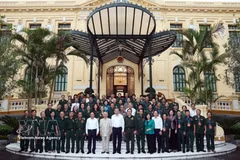
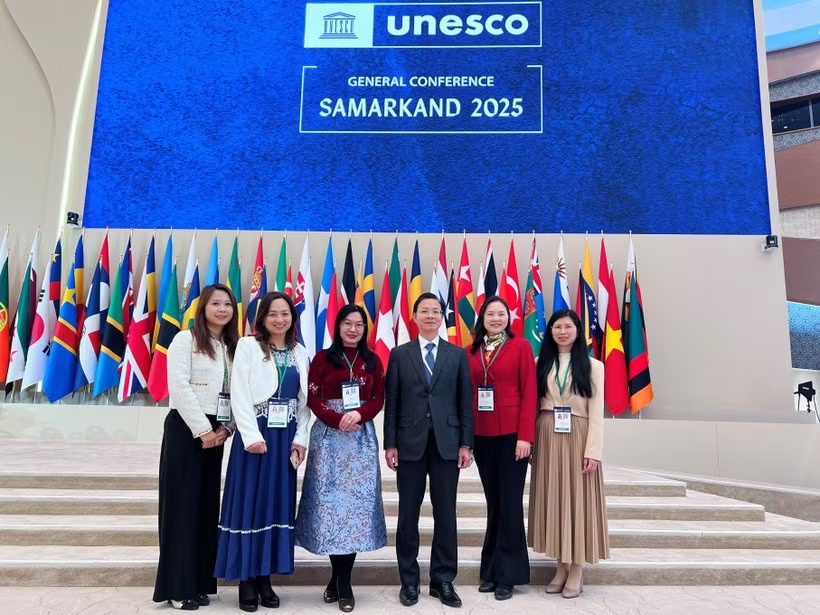
The Vietnamese delegation led by Deputy Foreign Minister Ngo Le Van attended the 43rd session of the UNESCO General Conference. (Photo: MOFA)

Hanoi (VNA) - Through the proposed initiative, Vietnam sends a strong message to international friends about its aspiration to join hands in building a peaceful, prosperous and humane future for all humanity.

At the 43rd session of the UNESCO General Conference in Uzbekistan, member states agreed to adopt a draft resolution initiated by Vietnam, co-sponsored and supported by 71 countries.

The draft recommends that the UN General Assembly consider launching an “International Decade of Culture for Sustainable Development” as soon as possible, prioritising the 2027–2036 period. The initative was highly regarded by the UNESCO’s Director-General and member states as timely and aligned with the organisation’s priorities.

On this occasion, Deputy Foreign Minister Ngo Le Van discussed the content and significance of the initiative.
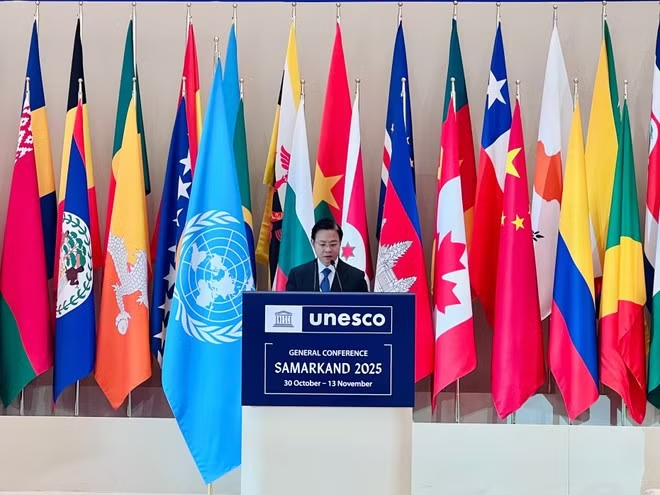
thu-truong-ngo-le-van-phat-bieu-chinh-sach-tai-phien-toan-the-ky-hop-dai-hoi-dong-unesco-lan-thu-43.jpg
Deputy Foreign Minister Ngo Le Van speaks at the Plenary Session of the 43rd UNESCO General Conference. (Photo: MoFA)

A Vietnam–branded initiative

Van said the 43rd General Conference had adopted the resolution calling on the United Nations to launch the initiative, noting that it underscored culture’s essential role as the foundation of identity, a driver of innovation, and a pillar of sustainable development in responding to global challenges.

The resolution calls for a fundamental shift in awareness of culture’s role and urges action at all levels to mobilise resources, increase investment in heritage education, cultural and arts education, cultural industries and the creative economy linked to sustainable livelihoods.

It also highlights the need to enhance equal access to culture, intercultural dialogue, digital culture, the application of cultural knowledge in climate adaptation and environmental protection, and efforts towards a sustainable and prosperous future for all.

He noted that, nearly 40 years after the 1988–1997 World Decade for Cultural Development, this is the first time UNESCO has agreed to initiate a new decade centred on culture. If approved by the UN General Assembly, UNESCO will coordinate the 2027–2036 decade with relevant UN bodies and partners.

According to the Deputy Minister, the initiative reflects Vietnams policy of valuing culture, cultural diplomacy and international integration.

It underscores culture as a foundation, a source of internal strength and a major driver of sustainable social development, supporting the revitalisation of Vietnamese culture in a new era. It also highlights efforts to strengthen cultural diplomacy, promote Vietnamese cultural identity internationally and absorb global cultural values, contributing to human civilisation.

The initiative is said to rest on Vietnam’s consistent foreign policy of independence, self-reliance, and multilateralisation, diversification, reflecting the country’s proactive and deeply integrated approach for the common good of the international community.

He added that the initiative demonstrates Vietnams proactive role in shaping global development priorities, in line with Resolution 59-NQ/TW.

Describing it as the largest initiative Vietnam has proposed at UNESCO in many years, he said it would mark a significant Vietnamese contribution, expressing the country’s commitment to working with the international community for a peaceful and humane future./.
VNA

See more

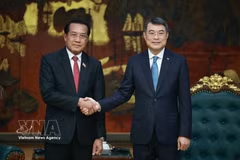
At the talks between Politburo Member and Chairman of the Communist Party of Vietnam (CPV) Central Committee’s Commission for Inspection Tran Sy Thanh and a visiting delegation of the Lao People’s Revolutionary Party (LPRP)'s Inspection Commission led by its Chairman Vanhxay Phongsavanh in Hanoi on August 25, 2026. (Photo: VNA)

Inspection-supervision cooperation helps nurture Vietnam-Laos ties

The Communist Party of Vietnam (CPV) Central Committee’s Commission for Inspection and its Lao counterpart will continue to effectively implement their 2022-2026 cooperation agreement, maintain high-level and professional delegation exchanges, and focus on sharing professional experience in inspection and supervision.

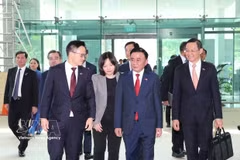
Singaporean Senior Minister of State for Defence Desmond Choo sees Standing Member of the CPV Central Committee’s Secretariat Tran Cam Tu off at Changi International Airport. (Photo: VNA)

Key Vietnamese leader concludes successful official visit to Singapore

Politburo Member and Standing Member of the Communist Party of Vietnam (CPV) Central Committee’s Secretariat Tran Cam Tu and a high-ranking CPV delegation left Singapore on August 25 afternoon, concluding their successful official visit to Singapore and co-chairing of the first Vietnam-Singapore Strategic Dialogue on August 24–25.

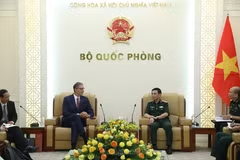
Politburo Member, Deputy Secretary of the Central Military Commission, Deputy Prime Minister, and Minister of National Defence General Phan Van Giang (R) and outgoing French Ambassador to Vietnam Olivier Brochet in Hanoi on August 25, 2026. (Photo: chinhphu.vn)

Vietnam, France boost defence cooperation across multiple areas

Vietnam attaches importance to cooperation with France, an important member of the European Union (EU) and Vietnam’s first comprehensive strategic partner within the EU. Bilateral relations have made effective progress in a wide range of areas, including economy and trade, science and technology, education and training, culture and tourism, as well as defence and security.

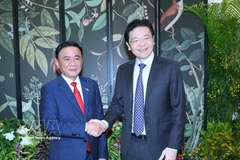
Politburo member and Standing member of the Communist Party of Vietnam Central Committee’s Secretariat Tran Cam Tu (L) meets with Secretary-General of the People’s Action Party and Prime Minister of Singapore Lawrence Wong on August 25. (Photo: VNA)

Vietnamese, Singaporean leaders agree to deepen bilateral ties

The two sides agreed that the dialogue will help establish a direct, regular and strategic channel for exchanges between the two Parties, through which they can conduct in-depth discussions on Party building, policy making, governance and national development, while sharing views on strategic issues of mutual concern, thereby strengthening the Party-to-Party channel’s role in providing strategic orientations for the bilateral ties.

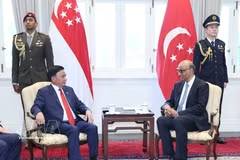
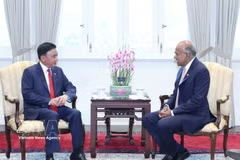
Politburo Member and Standing Member of the Communist Party of Vietnam (CPV) Central Committee’s Secretariat Tran Cam Tu (L) and Singaporean President Tharman Shanmugaratnam in Singapore on August 25, 2026. (Photo: VNA)

Key Vietnamese leader meets Singaporean President

Vietnam consistently attaches importance to its relations with Singapore, one of its top partners in the region. The establishment of the Strategic Partnership in 2013 and its upgrade to a Comprehensive Strategic Partnership in 2025 were important milestones, reflecting the maturity of bilateral ties and the shared vision of the two countries’ leaders for long-term cooperation.

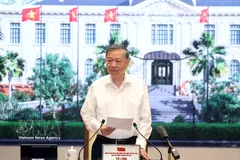
General Secretary of the Communist Party of Vietnam Central Committee and President To Lam speaks at the working session in Hanoi with the Government’s Party Committee and relevant agencies on the implementation of social welfare policies. (Photo: VNA)

Top leader calls for ensuring every citizen access to essential services, development opportunities

According to the top leader, by 2030, Vietnam should basically establish a multi-layer, inclusive and digitalised social welfare system that guarantees minimum social protection for all citizens. By 2045, the system should approach the standards of developed, high-income countries, featuring quality services, sustainable financing, transparent governance and the capacity to respond rapidly to emerging risks.

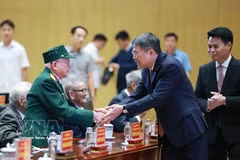
Prime Minister Le Minh Hung (R) with a veteran Party member of the Hai Phong Party Organisation at the event. (Photo: VNA)

Prime Minister calls for better care for veteran Party members

Prime Minister Le Minh Hung affirmed that every badge presented to Party members in Hai Phong on the occasion served as a reminder that the Party has grown from the people, fought for the people, sacrificed for the people, and pursued reform and development for the people.

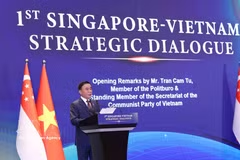
Politburo Member and Standing Member of the Communist Party of Vietnam (CPV) Central Committee’s Secretariat Tran Cam Tu speaks at the first Vietnam-Singapore Strategic Dialogue in Singapore on August 25, 2026. (Photo: VNA)

Vietnam, Singapore pursue resilient shared future

The first Vietnam-Singapore Strategic Dialogue helped translate political trust between the two Parties into practical cooperation orientations and programmes, contributing to substantive and sustainable development of the Vietnam-Singapore Comprehensive Strategic Partnership and meeting the development needs of both countries in the new era.

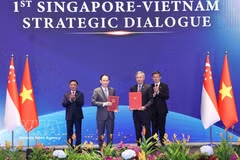
Vietnam's Politburo member and Minister of Foreign Affairs Le Hoai Trung (first row, left) and Singaporean Minister for Foreign Affairs Vivian Balakrishnan exchange the Vietnam-Singapore Joint Statement on Technology Connectivity Strategy. (Photo: VNA)

Vietnam, Singapore issue Joint Statement on Technology Connectivity Strategy

Building on the Plan of Action to Implement the Comprehensive Strategic Partnership between Singapore and Vietnam, signed on October 28, 2025, both countries reaffirm their mutual interest and commitment to deepen cooperation in the areas of science and technology, innovation, connectivity, and the digital economy.

General Secretary of the Communist Party of Vietnam Central Committee and President To Lam speaks at the August 25 meeting that reviews the first year of implementing Resolution No. 71-NQ/TW. (Photo: VNA)

Top leader orders substantive education reform

The sector should reduce rote and exam-oriented learning and promote self-study, practical experience, independent thinking, creativity and problem-solving, while cutting administrative and formalistic burdens on teachers.