Workshop discusses sustainable development of Vietnam-invested bauxite project in Laos

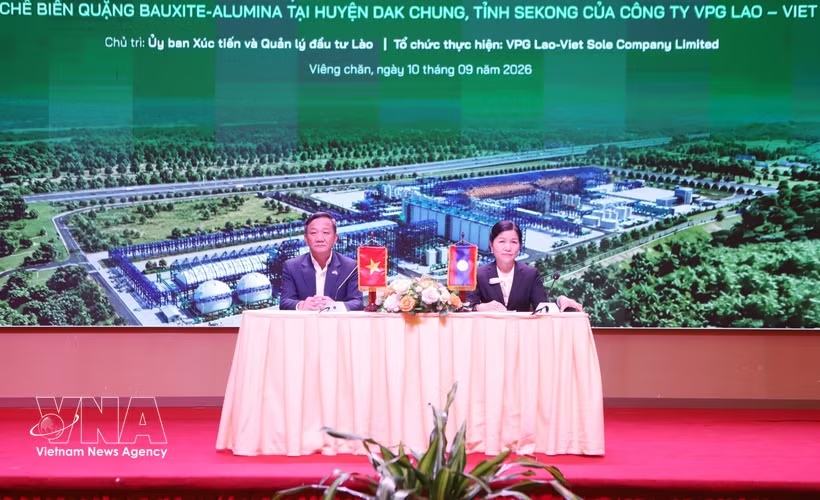
The Dakcheung bauxite mining and alumina processing complex project, developed by VLV, comprises clean-water, tailings and dry-stacked red-mud reservoirs, an ore-processing plant, an alumina plant, a power plant and other industrial infrastructure. Ore will be sourced from mines in Xekong and Attapeu provinces.

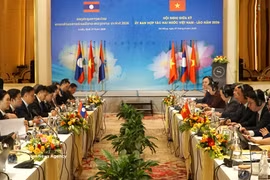
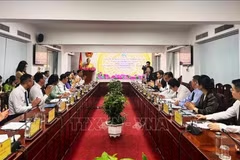
Vietnamese Ambassador to Laos Nguyen Minh Tam (left) and Deputy Minister, Vice Chair and Standing member of the Lao Investment Promotion and Management Committee Phonvanh Outhavong attend the workshop. (Photo: VNA)

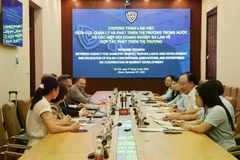
Vientiane (VNA) – A workshop was held in Vientiane on September 10 to discuss the implementation plan, technical solutions for sustainable development, human resource development, and measures to address the impacts of the Dakcheung bauxite mining and alumina processing complex project in Xekong province, Laos.

The event brought together Vietnamese Ambassador to Laos Nguyen Minh Tam, Deputy Minister, Vice Chair and Standing member of the Lao Investment Promotion and Management Committee Phonvanh Outhavong, representatives of Lao ministries, sectors and agencies and authorities of Xekong province and Dakcheung district, and economic and environmental experts.

Addressing the workshop, Tam highlighted the significance of the great friendship, special solidarity, comprehensive cooperation and strategic cohesion between Vietnam and Laos. He said economic, trade and investment cooperation plays an important role, driving development and deepening links between the two economies.

He stressed that the success of an investment project should not be measured solely by investment capital or output, but by its ability to generate added value, contribute to local socioeconomic development, create jobs and livelihoods, and meet environmental requirements.

In this spirit, the Dakcheung bauxite mining and alumina project is significant as it seeks to promote deep mineral processing, increase the value of natural resources and expand development opportunities in southern Laos.

Appreciating support from the Lao National Assembly, Government, ministries, sectors and Xekong authorities, Tam affirmed that the Vietnamese Embassy will continue working with competent agencies of both countries to address policy, tax and procedural issues, facilitating project implementation. He also praised Viet Phuong Group for fulfilling its social responsibilities, including donating the Dakcheung district Sports Complex to local authorities.

Phonvanh Outhavong highly valued the efforts of Viet Phuong Group and VPG Lao-Viet One Member Co., Ltd. (VLV), affirming that the Lao Government attaches importance to quality investment projects featuring advanced technologies and long-term commitments. The committee will continue coordinating with ministries, sectors and Xekong authorities to enable the project become operational soon.

Representing the investor, Nguyen Tien Ngoc, Standing Deputy General Director of VLV, said the workshop provided a forum for agencies, authorities, scientists and investors to discuss the project's scale, technological roadmap and sustainable development solutions.

The complex, developed by VLV, comprises clean-water, tailings and dry-stacked red-mud reservoirs, an ore-processing plant, an alumina plant, a power plant and other industrial infrastructure. Ore will be sourced from mines in Xekong and Attapeu provinces.

Phase one requires about 1.13 billion USD and has a designed capacity of 1 million tonnes of alumina annually, with plans to raise this to 2 million tonnes by 2035.

The project is expected to lay the foundation for a bauxite-alumina-aluminium value chain in Laos, create more than 1,000 direct jobs during its first three years and maintain 1,500-1,800 workers once operational, prioritising local recruitment and training./.
VNA

See more

Vice Chairman of the Hanoi People’s Committee hands over investment policy approval for Moscow House project in Hanoi to the Moscow authorities. (Photo published by VNA)

Hanoi, Russian localities step up cooperation in urban railways, technology

Secretary of the Hanoi Party Committee Tran Duc Thang and the delegation held talks with Moscow authorities to review implementation of the 2025-2027 cooperation programme and discuss key priorities for the new period, including urban transport, science and technology, digital transformation, trade and investment, and cultural exchanges.

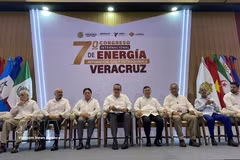
Vietnamese Ambassador to Mexico Nguyen Van Hai (fourth from right) and others attend the seventh Veracruz International Energy Congress. (Photo: VNA)

Vietnam, Mexico strengthen energy, port cooperation

A number of Mexican state Veracruz businesses expressed their wish to organise a delegation to Vietnam to gain first-hand insights into the market, seek partners and explore investment and business opportunities, initially focusing on trade, energy, agriculture and tourism.

At the working session (Photo: VNA)

Can Tho, Guangxi seek collaboration in logistics, supply chains

Chinese investors now back 35 projects in Can Tho with registered capital of nearly 1.2 billion USD. In the first seven months of 2026, Can Tho’s exports to China hit 77.5 million USD, while imports stood at 64.7 million USD. Key exports included rice, seafood, farm produce, processed agricultural products and apparel while main imports comprised agricultural chemicals, veterinary medicines, fertilisers, chemicals, fabrics and other materials and inputs.

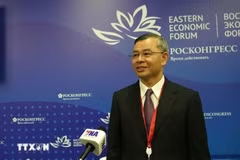
Vietnamese Minister of Finance Ngo Van Tuan grants an interview to the Vietnam News Agency (VNA). (Photo: VNA)

Vietnam, Russia move to boost financial cooperation

On bilateral economic, trade and investment ties, Tuan said two-way trade hit 3.24 billion USD in the first seven months of 2026, up 12% from a year earlier. Vietnam’s exports to Russia totaled 1.33 billion USD, while imports amounted to 1.91 billion USD.

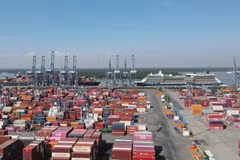
Cai Mep - Thi Vai Port complex in Ho Chi Minh City (Photo: VNA)

Ho Chi Minh City seeks to make seaports new growth driver

To maximise its seaport advantages, Ho Chi Minh City is developing smart and green ports while promoting clean energy, lower emissions and sustainable supply chains. It aims to establish an integrated ecosystem linking seaports with industrial parks, logistics centres, free trade zones, multimodal transport networks and an international financial centre.

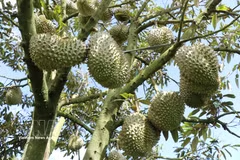
Farmers visit the off-season durian orchard of Cao Chi Dai in Vinh Hanh commune, An Giang province (Photo: VNA)

Vietnam promotes finance for green agriculture

Over the past five years, Vietnam has developed and gradually implemented a green finance system to support low-emission and environmentally friendly production, including agriculture. Based on the State Bank of Vietnam's Directive No. 03/CT-NHNN dated March 24, 2015, banks including BIDV, VCB, HDBank and Agribank have introduced green credit packages for waste treatment, high-tech agriculture, digital transformation, regional linkages and emission reduction across production chains.

An overview of the meeting between representatives from Polish businesses and the Agency for Domestic Market Surveillance and Development. (Photo: Agency for Domestic Market Surveillance and Development)

Polish businesses seek suppliers, partners in Vietnam

MAJAMI, a confectionery manufacturer and trader under Sweet House, is seeking distributors for Polish confectionery products in the Vietnamese market. Meanwhile, GABONA, a distributor and wholesaler of professional cosmetics, hair care and make-up products and beauty accessories, is looking for Vietnamese manufacturers of vegan and natural cosmetics.

Kendra Rinas, Chief of Mission for IOM Vietnam speaks at the event. (Photo: VNA)

Vietnam advances in building, using migrant labour data system: workshop

Data presented in the report reflects effective migration governance in recent years. The average recruitment cost paid by migrant workers dropped by 23.8%, from 164.9 million VND (6,400 USD) in 2021 to 125.7 million VND in 2025. Conversely, average first-month earnings abroad rose by 25.4%, increasing from 22.4 million VND to 28.1 million VND.