ACMECS strengthens tourism ties, promotes “Five Countries, One Destination”

The newly adopted joint action plan on ACMECS tourism cooperation for 2026–2028 focuses on five key pillars: improving connectivity and facilitating travel; promoting digital transformation and smart tourism; developing ecotourism, community-based and cultural tourism; enhancing tourism security and safety; and developing human resources.

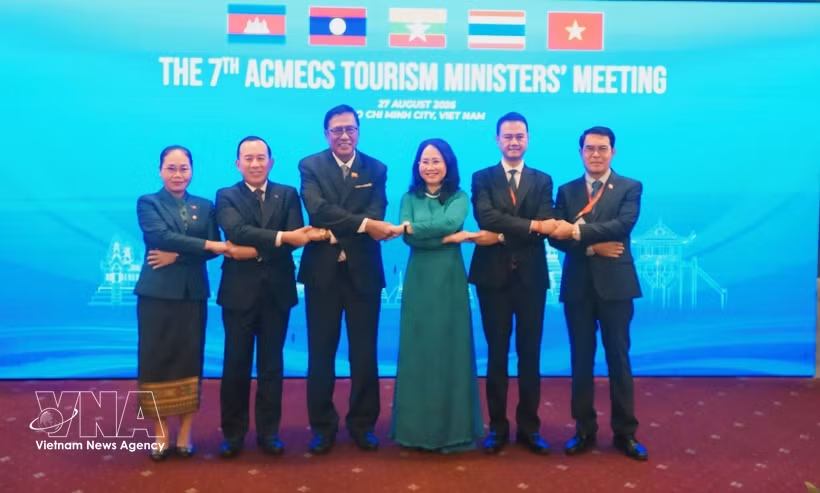
Officials at the 7th ACMECS Tourism Ministers’ Meeting in Ho Chi Minh City on August 27 (Photo: VNA)

Ho Chi Minh City (VNA) – The 7th Ayeyawady–Chao Phraya–Mekong Economic Cooperation Strategy (ACMECS) Tourism Ministers’ Meeting on August 27 adopted the joint action plan on ACMECS tourism cooperation for 2026–2028 to promote the “Five Countries, One Destination” concept and encourage sustainable tourism growth.

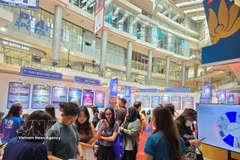
The event was held in Ho Chi Minh City alongside the 20th International Travel Expo Ho Chi Minh City (ITE-HCMC).

It brought together ministers and heads of tourism delegations from Cambodia, Laos, Myanmar, Thailand and Vietnam, with Myanmar Union Minister for Hotels, Tourism and Culture Maung Myint serving as chair. Vietnamese Minister of Culture, Sports and Tourism of Lam Thi Phuong Thanh represented Vietnam at the meeting.

In his opening remarks, Maung Myint stressed the importance of reviewing tourism cooperation and exchanging views on development orientations for the coming period.

He noted that the global tourism sector has demonstrated resilience and growth following the COVID-19 pandemic. Citing UN Tourism figures, he said around 1.52 billion international tourist arrivals were recorded worldwide in 2025, up 4% from 2024. The growth of tourism in the Asia-Pacific region provides a foundation for ACMECS countries to deepen cooperation, strengthen connectivity and jointly develop destinations.

The Myanmar official highlighted the strategic position of the ACMECS region, which links China, India and mainland Southeast Asia and serves as a bridge between economic regions, markets and international tourist sources. Together with the Mekong River, rich cultural resources and expanding connectivity as well as trade and investment, the region has significant potential for deeper tourism cooperation.

Against this backdrop, the “Five Countries, One Destination” initiative was highlighted as a direction for developing multi-country tourism routes, facilitating travel and strengthening joint promotion. Key source markets include China, India, Japan, the Republic of Korea and other international markets.

Besides, there remains considerable room for growth in intra-regional tourism, Maung Myint said, calling on member countries to keep strengthening cross-border connectivity, developing multi-country tourism products and itineraries, and increasing information sharing and coordinated marketing and promotion. Such efforts will help improve destinations' competitiveness and adaptability while creating greater opportunities for investment, employment and local community participation.

At the meeting, officials reaffirmed the orientation on sustainable and resilient tourism development in the region. The newly adopted joint action plan for 2026–2028 focuses on five key pillars: improving connectivity and facilitating travel; promoting digital transformation and smart tourism; developing ecotourism, community-based and cultural tourism; enhancing tourism security and safety; and developing human resources.

According to a report presented at the meeting, the ACMECS sub-region welcomed 65.27 million international visitors in 2025, generating approximately 94.08 billion USD in tourism revenue. In the first six months of 2026, it recorded around 33.08 million international visitors, including 4.25 million intra-regional arrivals, accounting for 13% of total international visitors.

The meeting encouraged member countries to continue sharing experience, effective practices and innovative projects while identifying practical, specific and mutually beneficial areas of cooperation. The joint action plan is expected to provide fresh momentum for ACMECS tourism to recover and grow more strongly, contributing to socio-economic development and elevating the sub-region’s position on the global tourism map.

Thailand will host the 8th ACMECS Tourism Ministers’ Meeting in 2028./.
VNA

See more

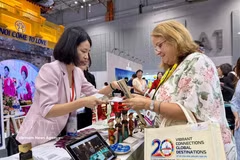
A stall at the 20th International Travel Expo Ho Chi Minh City (Photo: VNA)

International Travel Expo 2026 opens in Ho Chi Minh City

ITE HCMC 2026 features one of its largest and most diverse tourism networks to date, with tourism promotion agencies and businesses from the Republic of Korea, Japan, Malaysia, Thailand, Laos, Cambodia, Bhutan, Russia’s St. Petersburg and Nicaragua.

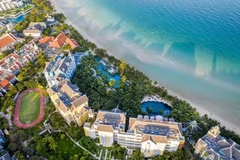
The Shell Pool by the shores of Kem Beach is one of the signature features of JW Marriott Phu Quoc Emerald Bay Resort. (Photo: Sun Group)

Sun Group’s Phu Quoc resort named among the world’s most whimsical stays

Among the hotels featured, JW Marriott Phu Quoc Emerald Bay Resort, developed by Sun Group on Kem Beach in southern Phu Quoc, stands out as the only representative from Vietnam. Travel + Leisure also selected an image of the resort’s iconic Shell Pool, set among coconut palms and white sands, as the lead image for the article.

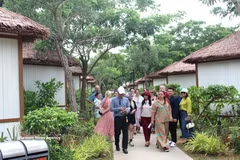
The famtrip delegation surveys and experiences accommodation and dining services in Tien Thanh ward, Lam Dong province. (Photo:VNA)

Lam Dong steps up global tourism push

Lam Dong welcomed around 900,000 international visitors in the first seven months of 2026, up 15% year-on-year, while international tourist-days increased 18% to nearly 2.9 million.

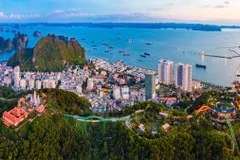
Alongside the wonder bay, Sun World Ha Long is a buzzing entertainment epicenter keeping the fun alive from day to night. (Photo: Sun Group)

US media picks Top 10 destinations to bookmark for Vietnam in 2026

In its updated list published on August 19, American business and lifestyle outlet Quartz highlighted Hanoi, Ha Long, Sa Pa, Ninh Binh, Hue, Da Nang, Hoi An, Ho Chi Minh City, the Mekong Delta, and Phu Quoc as the top bucket-list spots for a 2026 getaway to Vietnam.

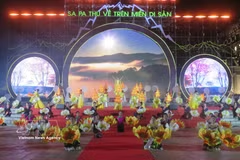
A performance staged as part of the art programme at the opening of the autumn festival of Sa Pa ward in Lao Cai province on August 23, 2026. (Photo: VNA)

Sa Pa autumn festival celebrates heritage, economic corridor cooperation

The event is of particular significance in strengthening their exchanges, connectivity and cooperation in investment, trade, tourism and culture. It also serves as a vivid demonstration of the spirit of collaboration, connectivity and shared development between the Vietnamese localities and Yunnan.

The high-altitude firework displays at the Saigon River tunnel entrance in Ho Chi Minh City - Illustrative image (Photo: VNA)

Tourists shift travel preferences for National Day holiday

With the five-day National Day holiday approaching, tourists are increasingly opting for short, flexible trips rich in cultural, natural and local-life experiences, prompting destinations and businesses to refresh tourism products, expand transport capacity and tighten safety measures.

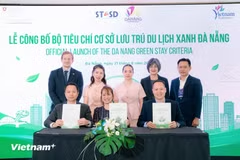
The Da Nang Hotel Association and accommodation establishments sign a commitment to work together to implement the Da Nang Green Stay Criteria. (Photo: VietnamPlus)

Da Nang introduces criteria for green tourism accommodations

The criteria comprise 219 green standards covering environmental protection, human resources and training, green consumption, visitor experiences, energy efficiency, low-carbon emissions, recycling, biodiversity conservation, native plant species, wastewater management, food safety and the reduction of food waste.

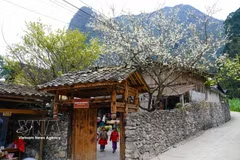
A Lo Lo ethnic minority house in Lo Lo Chai village, Tuyen Quang province. (Photo: VNA)

Tuyen Quang turns cultural heritage into a driver of sustainable tourism

Lo Lo Chai village, beneath the Lung Cu Flag Tower, is a vivid example of how cultural preservation can support tourism development. Traditional rammed-earth houses, costumes, festivals, cuisine and the daily life of the Lo Lo ethnic community have become key elements of the village’s tourism appeal.

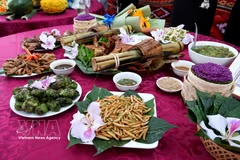
A meal imbued with the distinctive cultural identity of the Thai ethnic community in Dien Bien province. (Photo: VNA)

Cuisine key to boosting Vietnam’s tourism brand

Cuisine should be viewed not merely as food but as a cultural resource, creative asset and driver of economic development amid the country's efforts to promote innovation, digital transformation, private-sector development, tourism and cultural industries.