Sun Group’s Phu Quoc resort named among the world’s most whimsical stays

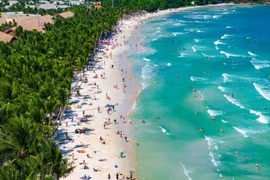
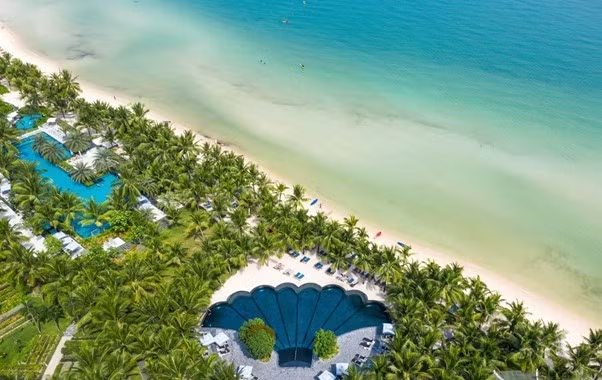
Among the hotels featured, JW Marriott Phu Quoc Emerald Bay Resort, developed by Sun Group on Kem Beach in southern Phu Quoc, stands out as the only representative from Vietnam. Travel + Leisure also selected an image of the resort’s iconic Shell Pool, set among coconut palms and white sands, as the lead image for the article.

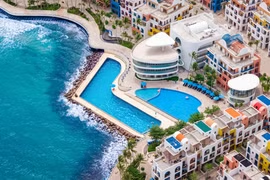
The Shell Pool by the shores of Kem Beach is one of the signature features of JW Marriott Phu Quoc Emerald Bay Resort. (Photo: Sun Group)

Hanoi (VNA) – Travel + Leisure has named JW Marriott Phu Quoc Emerald Bay Resort among the hotels around the world that can transport guests beyond reality and into a world of imagination. Developed by Sun Group on Bai Kem Beach, the resort is the only representative from Vietnam featured on the list.

Stepping through the resort’s doors is like entering another world

“There must be something about the times we’re living in that has us craving hotels that don’t just transport us out of our algorithm-smoothed lives, but entirely pull reality from beneath our feet and sweep us into worlds of chaos, fantasy, and imagination,” Travel + Leisure writes in its introduction to a list of hotels designed to immerse guests in worlds of fantasy and imagination.

The magazine also offers a simple recommendation for travellers seeking an unconventional stay: “When in doubt, book a Bill Bensley-designed hotel.”
picture2.jpg
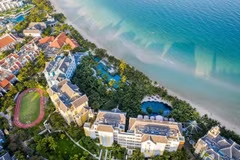
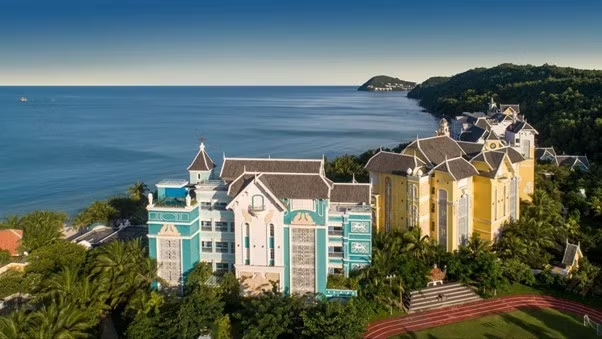
JW Marriott Phu Quoc Emerald Bay Resort features the distinctive architecture of a fictional university. (Photo: Sun Group)

Among the hotels featured, JW Marriott Phu Quoc Emerald Bay Resort, developed by Sun Group on Kem Beach in southern Phu Quoc, stands out as the only representative from Vietnam. Travel + Leisure also selected an image of the resort’s iconic Shell Pool, set among coconut palms and white sands, as the lead image for the article.

The resort’s inclusion on the list recognises not only its distinctive architecture and luxury hospitality, but also the appeal of a tourism concept built around a carefully crafted story. Guests do not simply arrive at a beachfront resort. Instead, they are invited to become “students” of Lamarck University, a fictional institution created by designer Bill Bensley and Sun Group on Phu Quoc Island.

The story draws inspiration from French naturalist Jean-Baptiste Lamarck. From this starting point, Bensley imagined a university founded in the early 20th century and transformed the resort into its campus, complete with 18 faculties ranging from biology, chemistry and zoology to architecture, art and physical education.
picture3.jpg
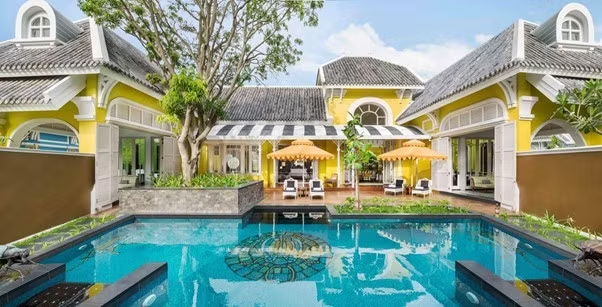
The resort’s villas feature warm tones, classic tiled roofs and private pools. (Photo: Sun Group)

Each building, room and facility plays a role in this fictional world. The Department of Chemistry bar resembles a chemistry laboratory, while the spa and gym reflect the spirit of the Faculty of Physical Education. Restaurants, corridors and guest rooms are filled with details that add to the history of the imaginary university.

Thousands of antiques sourced and collected from different countries further bring Lamarck University to life. Sports trophies, laboratory equipment, maps, old books, signs, illustrations and furniture are not merely decorative pieces, but elements of a larger story. Architecture therefore becomes more than a visual feature of the resort, it becomes part of the guest experience.
picture4.jpg
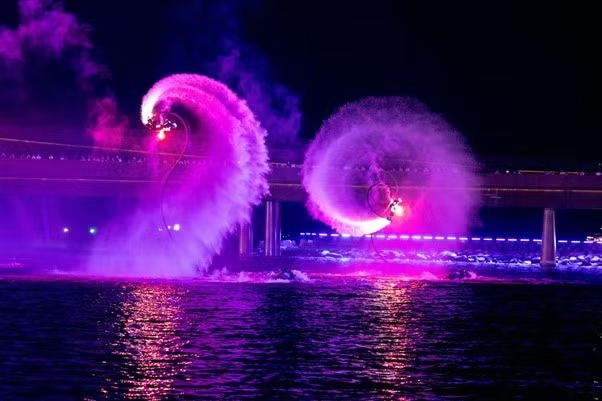
Symphony of the Sea lights up the night with a dazzling spectacle over the sea. (Photo: Sun Group)

This is the spirit of “whimsy,” “fantasy” and “imagination” highlighted by the American magazine. At JW Marriott Phu Quoc Emerald Bay Resort, the concept is not expressed through distant or unfamiliar fantasy, but through Indochine-inspired architecture, tropical colors and a detailed story woven throughout the resort.

From a fantasy university to the wider experience of southern Phu Quoc

Beyond the resort, guests can continue exploring the tourism ecosystem developed by Sun Group in southern Phu Quoc. From Kem Beach, the journey leads to Sunset Town, with its seaside streets, Kiss Bridge and Mediterranean-inspired architecture. Further south lies Hon Thom, accessible via the world’s longest three-wire cable car, where visitors can explore Aquatopia Water Park and its next-generation water slides, as well as Santo Beach Club, featuring two infinity pools overlooking the sea.

After sunset, southern Phu Quoc comes alive with large-scale entertainment productions such as Kiss of the Sea and Symphony of the Sea, combining technology, live performances, water effects and fireworks. A stay at JW Marriott Phu Quoc Emerald Bay Resort therefore extends well beyond the resort itself, connecting accommodation with dining, entertainment and cultural experiences across the destination.
picture5.jpg
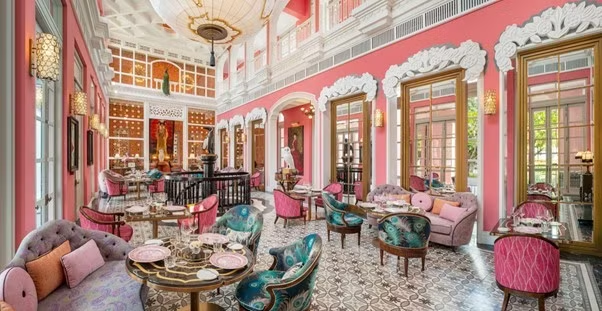
Pink Pearl by Oliver E. stands out with its signature pink palette and highly artistic design. (Photo: Sun Group)

JW Marriott Phu Quoc Emerald Bay Resort’s inclusion by Travel + Leisure further highlights Sun Group’s approach to tourism development in Phu Quoc: creating not only high-end accommodation, but destinations with a distinct identity and story that can become a reason to travel in their own right.

From a “university” that exists on no real map to a vibrant coastal destination in southern Phu Quoc, Sun Group has turned ideas that once seemed possible only in the imagination into physical experiences. At JW Marriott Phu Quoc Emerald Bay Resort, the hotel is more than a place to stay – it becomes a world of its own, inviting guests to step inside and explore./.
VNA

See more

Delegates at the meeting (Photo: VNA)

Vietnam, Laos, Cambodia boost tourism collaboration

The conference adopted a joint action plan for 2026-2028 aimed at realising the “One Journey, Three Destinations” initiative, sharpening competitiveness and developing cross-border tourism products.

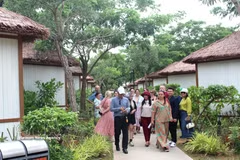
The famtrip delegation surveys and experiences accommodation and dining services in Tien Thanh ward, Lam Dong province. (Photo:VNA)

Lam Dong steps up global tourism push

Lam Dong welcomed around 900,000 international visitors in the first seven months of 2026, up 15% year-on-year, while international tourist-days increased 18% to nearly 2.9 million.

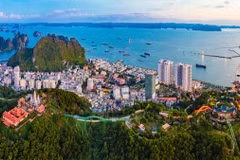
Alongside the wonder bay, Sun World Ha Long is a buzzing entertainment epicenter keeping the fun alive from day to night. (Photo: Sun Group)

US media picks Top 10 destinations to bookmark for Vietnam in 2026

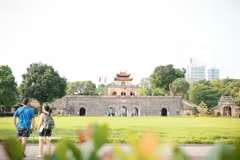
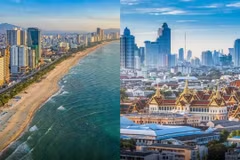
In its updated list published on August 19, American business and lifestyle outlet Quartz highlighted Hanoi, Ha Long, Sa Pa, Ninh Binh, Hue, Da Nang, Hoi An, Ho Chi Minh City, the Mekong Delta, and Phu Quoc as the top bucket-list spots for a 2026 getaway to Vietnam.

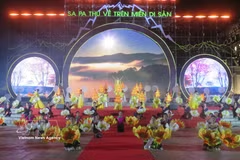
A performance staged as part of the art programme at the opening of the autumn festival of Sa Pa ward in Lao Cai province on August 23, 2026. (Photo: VNA)

Sa Pa autumn festival celebrates heritage, economic corridor cooperation

The event is of particular significance in strengthening their exchanges, connectivity and cooperation in investment, trade, tourism and culture. It also serves as a vivid demonstration of the spirit of collaboration, connectivity and shared development between the Vietnamese localities and Yunnan.

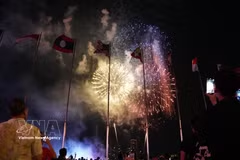
The high-altitude firework displays at the Saigon River tunnel entrance in Ho Chi Minh City - Illustrative image (Photo: VNA)

Tourists shift travel preferences for National Day holiday

With the five-day National Day holiday approaching, tourists are increasingly opting for short, flexible trips rich in cultural, natural and local-life experiences, prompting destinations and businesses to refresh tourism products, expand transport capacity and tighten safety measures.

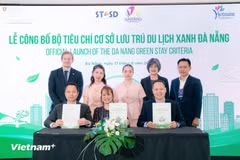
The Da Nang Hotel Association and accommodation establishments sign a commitment to work together to implement the Da Nang Green Stay Criteria. (Photo: VietnamPlus)

Da Nang introduces criteria for green tourism accommodations

The criteria comprise 219 green standards covering environmental protection, human resources and training, green consumption, visitor experiences, energy efficiency, low-carbon emissions, recycling, biodiversity conservation, native plant species, wastewater management, food safety and the reduction of food waste.

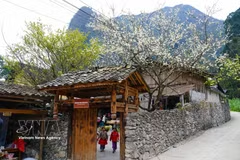
A Lo Lo ethnic minority house in Lo Lo Chai village, Tuyen Quang province. (Photo: VNA)

Tuyen Quang turns cultural heritage into a driver of sustainable tourism

Lo Lo Chai village, beneath the Lung Cu Flag Tower, is a vivid example of how cultural preservation can support tourism development. Traditional rammed-earth houses, costumes, festivals, cuisine and the daily life of the Lo Lo ethnic community have become key elements of the village’s tourism appeal.

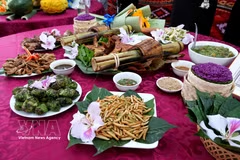
A meal imbued with the distinctive cultural identity of the Thai ethnic community in Dien Bien province. (Photo: VNA)

Cuisine key to boosting Vietnam’s tourism brand

Cuisine should be viewed not merely as food but as a cultural resource, creative asset and driver of economic development amid the country's efforts to promote innovation, digital transformation, private-sector development, tourism and cultural industries.

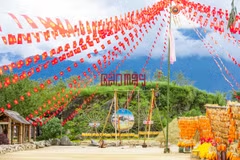
Fansipan dons a vibrant facade to usher in the Northwest's brilliant autumn festival season this September

Immerse in vibrant colours on the Roof of Indochina this autumn

Fansipan has long been a must-visit destination for anyone exploring Vietnam’s Northwest. The journey to conquer the "Roof of Indochina" typically begins with a spectacular cable car ride soaring above the clouds. Nestled at the foot of the cable car station, Ban May Village welcomes visitors as a charming stopover, showcasing a different beauty in every season of the year.

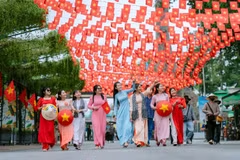
Streets adorned with national flags to celebrate Vietnam's National Day on September 2nd

A journey through southern Vietnam during National Day

In the days surrounding National Day, the red flag with its five-pointed golden star appears across city streets, outside homes and on public buildings. For Vietnamese people, it is one of the most significant occasions of the year. For international visitors, it also offers a rare opportunity to observe, more vividly than usual, the connection between history, national pride and everyday life in contemporary Vietnam.