ADB approves 1.5 billion USD loan to help Philippines mitigate impact of Middle East conflict

The ADB funding will help the Philippine Government secure fuel supplies, maintain access to electricity, healthcare, food, and medicine at affordable prices, and assist Filipino workers abroad in returning home. The loan is provided through ADB’s Countercyclical Support Facility (CSF), a financial instrument designed to provide rapid budget support to member countries in times of economic shocks.

Hanoi (VNA) – The Asian Development Bank (ADB) has approved a 1.5 billion USD loan to support the Philippines in mitigating the socio-economic impacts of the conflict in the Middle East, particularly amid rising fuel prices.

According to a recent ADB announcement, the loan will contribute to financing the Philippine Government's Unified Package for Livelihood, Industry, Food and Transport (UPLIFT) programme.

Through the programme, Manila is implementing financial assistance measures for low-income groups affected by rising fuel prices due to the Middle East conflict. These measures include fare reductions, fuel and fertiliser subsidies, medical assistance, and cash assistance for poor households, vulnerable groups, drivers and public transport operators, small-scale farmers, and fishermen.

The ADB funding will help the Philippine Government secure fuel supplies, maintain access to electricity, healthcare, food, and medicine at affordable prices, and assist Filipino workers abroad in returning home. The loan is provided through ADB’s Countercyclical Support Facility (CSF), a financial instrument designed to provide rapid budget support to member countries in times of economic shocks.

ADB President Masato Kanda said the loan represents support for the Philippines’ efforts to protect its people and maintain resilience against external impacts.

Earlier in May, Kanda proposed an additional 1.75 billion USD in assistance to Philippine President Ferdinand Marcos Jr. to help the country cope with the economic impact of tensions in the Middle East./.


VNA

See more

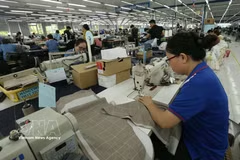
Workers make clothes for export at Nha Be- Hau Giang Garment JSC in Vi Thanh ward, Can Tho city. (Photo: VNA)

Vietnam sustaining exceptional growth: economist

Vietnam is the resilience story. Its projected growth moderates slightly from its exceptional post-2016 pace, but remains around 5% — a rate that would be remarkable for most advanced economies.

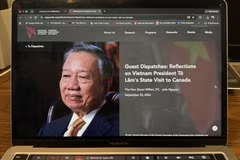
The Asia Pacific Foundation of Canada website published two commentaries by former parliamentarian Bryon Wilfert and researcher Julie Nguyen on the significance of the visit. (Photo: Screenshot of the articles)

Canadian media highlight new milestone in Vietnam–Canada relations

The coverage by Canadian media and researchers shows that the top Vietnamese leader's state visit was seen not only as an important diplomatic milestone but also as an opportunity for the two countries to deepen substantive cooperation, diversify partnerships and seek new drivers of development amid a changing global landscape.

Singaporean labour market sends mixed signals

Singaporean labour market sends mixed signals

About 4,620 workers in Singapore were retrenched in the second quarter of 2026, or about two per 1,000 workers, up significantly from 3,830 in the first quarter. The figure was the highest since the fourth quarter of 2020, when Singapore was heavily affected by the COVID-19 pandemic.

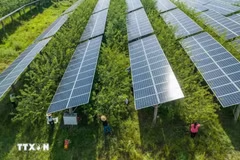
China has remained Thailand’s largest solar panel supplier over the past five years.

Thailand’s solar panel imports surge

China has remained Thailand’s largest solar panel supplier over the past five years. Its exports to Thailand reached a record 649.1 million USD in 2023, out of total imports of 654.2 million USD. The figure subsequently fell to 422.3 million USD in 2024 and 364.1 million USD in 2025.

Timor-Leste encourages women to develop businesses using local resources

Timor-Leste encourages women to develop businesses using local resources

According to a nationwide survey conducted by the Timor-Leste Women’s Business Association (AEMTL) from October 2024 to March 2025, nearly 63% of the women-owned businesses surveyed were operating informally or had not been registered with SERVE, Timor-Leste’s business registration and licensing authority.