ADB official highlights Vietnam’s resilience, outlines reform priorities for long-term growth

ADB remains committed to supporting Vietnam’s development aspirations and reform agenda in the years ahead, said Zhang Nianshan, Director General of ADB’s Southeast Asia Department.

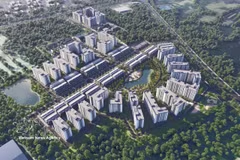
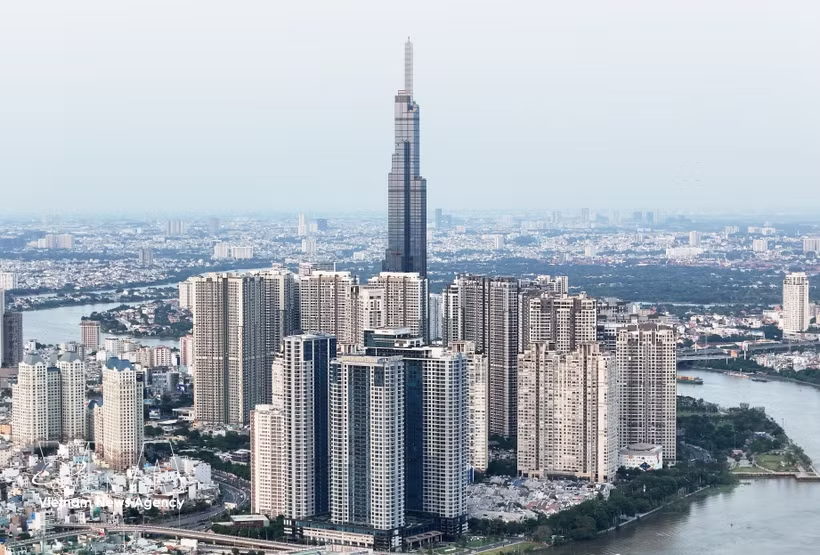
A luxury apartment complex near the centre of Ho Chi Minh City along the Saigon River. (Photo: VNA)

Hanoi (VNA) – An official from the Asian Development Bank (ADB) has expressed confidence in Vietnam’s medium-term economic outlook, describing the country as one of Southeast Asia’s most resilient economies despite mounting global uncertainties.

Speaking to a Vietnam News Agency reporter on the sidelines of the 59th Annual Meeting of the ADB Board of Governors in Samarkand, Zhang Nianshan, Director General of ADB’s Southeast Asia Department, said Vietnam possesses strong structural advantages that will help sustain growth in 2026-2027.

According to Zhang, Southeast Asia as a whole remains vulnerable to external shocks, including prolonged high interest rates, geopolitical conflicts and disruptions to global supply chains. Tensions in the Middle East, in particular, continue to affect shipping activities and energy infrastructure, resulting in tighter supply and elevated energy prices.

Under ADB’s baseline scenario, with crude oil prices averaging 96 USD per barrel this year before easing to 80 USD next year, Southeast Asia’s medium-term growth could slow to 4.2%, while inflation may rise to 4.5% in 2026.

However, the region is still expected to remain resilient in the short term thanks to strong domestic demand, he noted, adding that growth prospects will depend heavily on countries’ ability to manage external shocks while maintaining fiscal and macroeconomic stability.

Against that backdrop, Vietnam stands out for its stable macroeconomic management and strong policy responses, Zhang said.

He highlighted Vietnam’s ample fiscal space and relatively low public debt, which have enabled the Government to cushion the impact of oil market disruptions and stabilise prices effectively. ADB was particularly impressed by the Government’s timely and decisive support measures aimed at reducing negative spillover effects from the global environment.

Public investment, domestic consumption, tourism recovery and digital transformation are expected to continue supporting Vietnam’s growth momentum in 2026, he said.

Meanwhile, export-oriented manufacturing and foreign direct investment (FDI) remain key growth drivers despite external headwinds and the high comparison base of 2025.

Vietnam recorded growth of more than 8% in 2025 and has set an ambitious target of achieving double-digit growth in the 2026-2030 period as part of its goal to become a high-income country by 2045.

To realise those ambitions, Zhang said Vietnam needs to accelerate reforms in three key areas.

First, the country should improve labour productivity and economic resilience by streamlining administrative procedures, improving the business climate, strengthening governance efficiency and enhancing science and technology capacity.

Second, Vietnam needs to further develop its financial sector and capital markets, particularly by expanding the corporate bond market to mobilise long-term funding and reduce dependence on bank credit.

Third, energy security and climate adaptation should be placed at the centre of the growth agenda. Diversifying energy sources and accelerating clean energy deployment will be critical to strengthening Vietnam’s long-term competitiveness, he stressed.

Zhang affirmed that ADB remains committed to supporting Vietnam’s development aspirations and reform agenda in the years ahead./.
VNA

See more

A view of the Government's regular meeting for May on June 3, 2026 (Photo: VNA)

Deputy Minister urges tougher accountability for delayed national target programmes

Speaking at the Government’s regular press conference for May on June 3, the Deputy Minister acknowledged that implementation and disbursement of national target programmes, as well as public investment projects in general, remain slower than expected despite repeated reviews by the Ministry of Finance, relevant ministries and localities.

A graphic image of Song Lo I Industrial Park in Phu Tho province (Photo: VNA)

FDI inflows into Phu Tho surge 3.5-fold in first five months

As of May 20, Phu Tho province had granted investment licences to 15 new FDI projects with total registered capital of 307.2 million USD. Investors from Japan, the Republic of Korea, Taiwan (China) and China continued to select Phu Tho as an investment destination, with China taking the lead in the number of newly licensed projects.

Traders purchase tuna at a fishing port. (Illustrative photo: VNA)

Aquatic products face challenge of maintaining market share in US

According to the Vietnam Association of Seafood Exporters and Producers (VASEP), the US National Oceanic and Atmospheric Administration (NOAA) has recently recognised Vietnam’s crab fishery as equivalent to US standards. Under an updated decision issued in last month, Vietnamese crab and crab products will continue to be eligible for import into the US market.

At the working session (Photo: thoibaotaichinhvietnam.vn)

TikTok interested in investing in logistics, digital finance in Vietnam

Deputy Minister of Finance Cao Anh Tuan commended TikTok’s rapid growth and its contributions to Vietnam’s digital economy. With tens of millions of users, TikTok has become not only a platform for content creation and social interactions but also an effective tool for product promotion, market expansion, and e-commerce.

A view of the business seminar on upgrading Vietnam’s industrial sector through Nordic expertise and partnership held in Ho Chi Minh City on June 3, 2026. (Photo: VNA)

Vietnam to become one of Asia’s leading high-value manufacturing hubs: seminar

Vietnam is now on the threshold of becoming a leading manufacturing hub for both global and ASEAN markets, with the potential to position itself as one of Asia’s foremost high-value manufacturing centres. However, the country is also facing increasing competition from regional economies such as Malaysia, Indonesia and India.

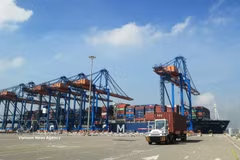
Imports and exports are handled at Lach Huyen container port in Hai Phong city. (Photo: VNA)

Trade turnover exceeds 445 billion USD in five months

In May, Vietnam's trade turnover amounted to 99.07 billion USD, rising 3.2% from the previous month and 25.8% from a year earlier. Exports increased 19.5% year-on-year in the January-May period, while imports surged 30.8%.

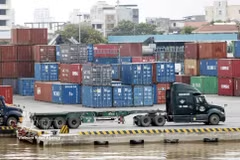
A container truck runs at the Gemalink International Port, part of the Cai Mep port complex, in Tan Phuoc ward, Ho Chi Minh City. (Photo: VNA)

Vietnam seen as ASEAN’s resilient growth bright spot

According to the World Bank (WB), buoyed by impressive GDP growth of 8% in 2025, Vietnam entered 2026 as one of Southeast Asia's strongest-performing economies. In its latest economic update released in May, the WB highlighted Vietnam’s robust fundamentals and favourable growth outlook.

A Xiaomi store in Beijing, China, on January 15, 2021 (Photo: AFP/VNA)

Xiaomi Vietnam fined for violating consumer rights

Xiaomi Vietnam Co., Ltd was fined 290 million VND (about 11,000 USD) for three violations of consumer protection regulations, according to the National Competition Commission (NCC) under the Ministry of Industry and Trade.

Export is one of the important contributors to Vietnam's economic growth. (Photo: VNA)

Vietnam's economy accelerates despite global uncertainties: French report

Vietnam is well positioned to remain among Asia’s fastest-growing economies. Future success will depend on the country’s ability to leverage opportunities from international integration while developing new domestic growth drivers to support its ambition of becoming a high-income economy by 2045.

Hanoi’s consumer price index increased by 0.28% in May compared to the previous month (Photo: VNA)

Hanoi’s May CPI rises 0.28%

The Statistics Office attributed the stable market situation to the city’s efforts to implement Government directives on price governance and inflation control while ensuring adequate supply of goods and services, especially essential ones.