Ho Chi Minh City (VNA) – The US market is presenting mixed signals for Vietnam’s aquatic exports, offering new opportunities for some products while posing growing challenges for others.
According to the Vietnam Association of Seafood Exporters and Producers (VASEP), the US National Oceanic and Atmospheric Administration (NOAA) has recently recognised Vietnam’s crab fishery as equivalent to US standards. Under an updated decision issued in last month, Vietnamese crab and crab products will continue to be eligible for import into the US market.
The decision is particularly significant as the Philippines has not received equivalent recognition for several crab fisheries and is expected to face import restrictions from June 11. This development is likely to create additional opportunities for Vietnamese exporters, alongside suppliers from Indonesia and Sri Lanka, to strengthen their position in the US market.
Le Hang, Deputy Secretary-General of VASEP, said the recognition provides a clear short-term advantage for Vietnam’s crab industry, especially as US buyers seek alternative suppliers that meet regulatory requirements. She noted that this is a favourable time for Vietnamese businesses to secure orders for the second half of the year and step up efforts to inform US partners about the legality and traceability of their products.
In contrast, shrimp exports continue to face considerable headwinds. Preliminary results from the 20th administrative review announced by the US Department of Commerce on May 13 showed provisional anti-dumping duties of 10.76% and 6.3% for two mandatory respondents, while other exporters were assigned a separate rate of 7.56%.
Although the review has not yet reached a final conclusion, the preliminary rates are expected to place additional pressure on price negotiations and purchasing decisions by US importers.
Market demand is also weakening. US statistics indicate that shrimp imports declined by 11% in the first quarter of 2026, with imports in March alone falling 19% year-on-year. The figures suggest that consumption remains subdued amid persistent inflationary pressures and higher costs, prompting buyers to remain cautious.
In this context, competing solely on price is becoming increasingly difficult for Vietnamese exporters. Hang recommended focusing on value-added products and market segments where Vietnam enjoys advantages in quality, processing capabilities and supply stability.
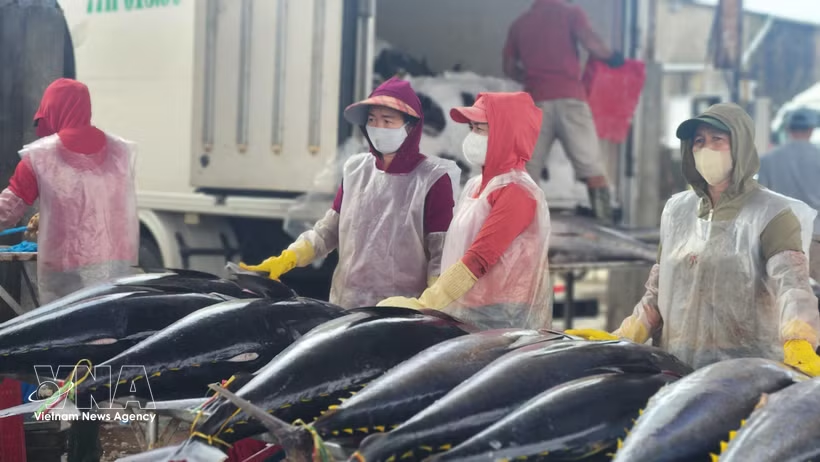
Meanwhile, imports of tuna and other seafood products into the US remain subject to strict controls under the Marine Mammal Protection Act (MMPA). In addition to compliance with dolphin-safe requirements, importers must provide certificates of origin and supporting documentation for frozen and processed tuna shipments.
As a result, maintaining compliance has become a critical factor for preserving market access. Companies capable of managing traceability systems, documentation and regulatory requirements throughout the supply chain are expected to be in a stronger position to retain customers and reduce commercial risks./.

Agro-forestry-aquatic product exports up over 9% in first five months
Vietnam’s agro-forestry-aquatic product exports maintained positive growth momentum in the first five months of 2026, with turnover estimated at 30.69 billion USD, up 9.2% year-on-year.