Hanoi (VNA) – Vietnam’s economy is increasingly cementing its strategic position in global supply chains and emerging as one of ASEAN’s most resilient growth performers despite mounting geopolitical uncertainties and global economic volatility, according to international financial institutions and economic organisations.
According to the World Bank (WB), buoyed by impressive GDP growth of 8% in 2025, Vietnam entered 2026 as one of Southeast Asia's strongest-performing economies. In its latest economic update released in May, the WB highlighted Vietnam’s robust fundamentals and favourable growth outlook.
This optimism was echoed by Zhang Nianshan, Director General for the Southeast Asia Department at the Asian Development Bank (ADB), in an interview with the Vietnam News Agency (VNA). He described Vietnam’s economic outlook for 2026–2027 as relatively resilient and robust compared with regional peers, underpinned by solid macroeconomic fundamentals, ample fiscal space and low public debt.
Meanwhile, Malaysia-based property technology group IQI Global has placed Vietnam among the “Fabulous Five” — a group of five standout economies with the potential to shape the macroeconomic and investment trajectory of ASEAN over the next two decades.
International observers point to Vietnam’s ongoing transformation from a labour-intensive manufacturing base into a technology-driven, value-added economy as a key factor behind its rising profile.
Shan Saeed, chief economist at the Malaysian branch of property technology group IQI Global, described Vietnam as a leading destination in the “China+1” manufacturing diversification strategy pursued by multinational technology corporations, noting that the country possesses increasingly sophisticated export capabilities and is deeply integrated into global manufacturing network.
Vietnam’s strong integration into the global economy is reflected in its trade-to-GDP ratio of nearly 170%, making it one of the world's most open and deeply interconnected economies, he said.
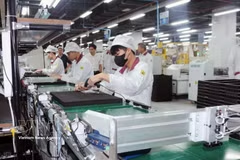
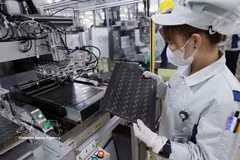
The clearest example of this transformation can be seen in the electronics sector. According to Yun Liu, Senior ASEAN Economist at HSBC, the country’s export structure has undergone a significant shift. While low-value textiles and footwear once dominated exports, electronics have emerged as a key growth driver, now accounting for more than one-third of Vietnam’s total export earnings.
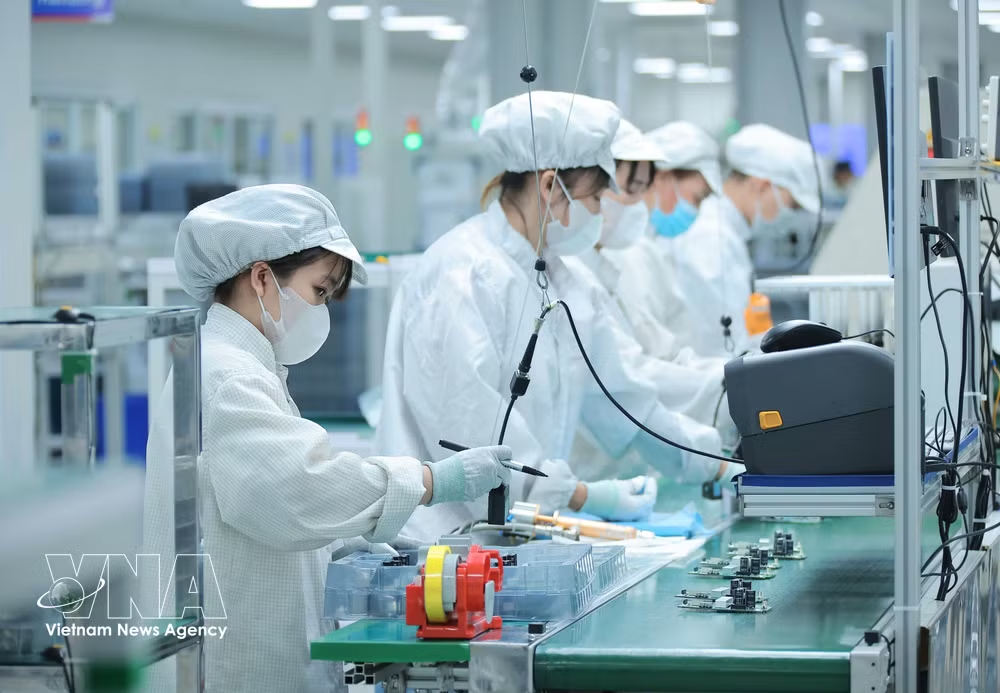
Quang Ninh is an investment destination for many FDI enterprises manufacturing electronic components and high-tech products. (Photo: VNA)
HSBC estimates Vietnam’s share of global consumer electronics exports has risen from nearly zero to almost 15% over the past 15 years. The country is also expanding into higher-value segments, including integrated circuits and semiconductor components.
Resilient foreign direct investment (FDI) inflows remain another major pillar of growth. The WB reported that registered FDI in the first quarter of 2026 surged 36% year-on-year, while disbursed FDI reached its highest level in the last five years.
HSBC's Chief Asia Economist Frederic Neumann noted that although global tariff uncertainties may create short-term caution among investors, Vietnam’s continued ability to attract investment reflects strong confidence in its long-term growth prospects.
Analysts also credit Vietnam’s extensive network of free trade agreements, particularly the EU-Vietnam Free Trade Agreement (EVFTA), for helping diversify export markets and enhance competitiveness.
This position has enabled Vietnam to sustain record export growth despite ongoing energy market disruptions and geopolitical uncertainties. Vietnam’s Manufacturing Purchasing Managers’ Index (PMI) rose to 52.8 in May, the highest level since February. According to Andrew Harker, Economics Director at S&P Global Market Intelligence, the improvement reflects a significant increase in both new orders and manufacturing output, providing a positive signal for the country’s industrial sector.
However, international institutions have cautioned that Vietnam’s near-term growth momentum may face headwinds. S&P Global noted that the recent rise in manufacturing orders was partly driven by inventory stockpiling amid Middle East tensions, while businesses are grappling with the sharpest input-cost increases in 15 years and continued job cuts despite stronger demand.
The WB also highlighted several structural challenges, including the widening gap between FDI and domestic firms, pressure on foreign exchange reserves, high corporate leverage, and concerns over the efficiency of large-scale public investment.
Against this backdrop, the WB forecasts Vietnam’s growth to moderate to 6.8% in 2026 before recovering in 2027–2028 as the impact of the oil shock gradually fades and domestic growth drivers strengthen.
Despite elevated short-term risks, Tamina Khan, Lead Economist for Viet Nam, Cambodia and Laos at the WB said the country’s medium-term outlook remains highly positive and more balanced. She noted that with effective implementation of reforms, Vietnam is well positioned to overcome external headwinds and sustain its strong growth trajectory./.