Bac Ninh, RoK’s Jeonbuk boost cultural, tourism cooperation

Both Bac Ninh and Jeonbuk boast rich and distinctive cultural heritage. Jeonbuk is known for Pansori, a traditional Korean vocal art, and Hanji paper, which is being nominated for UNESCO recognition. Meanwhile, Bac Ninh is home to Quan Ho folk singing and the Dong Ho folk painting tradition. These shared strengths provide a solid foundation for the two sides to jointly develop cultural tourism products and promote artistic exchanges, according to Deputy Director of the Department of Culture, Sports and Tourism of Bac Ninh Do Tuan Khoa.

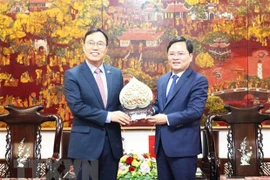
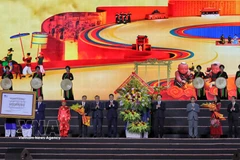
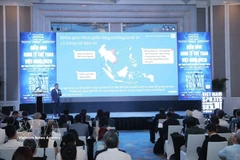
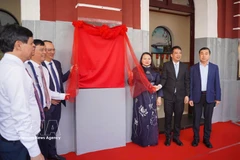
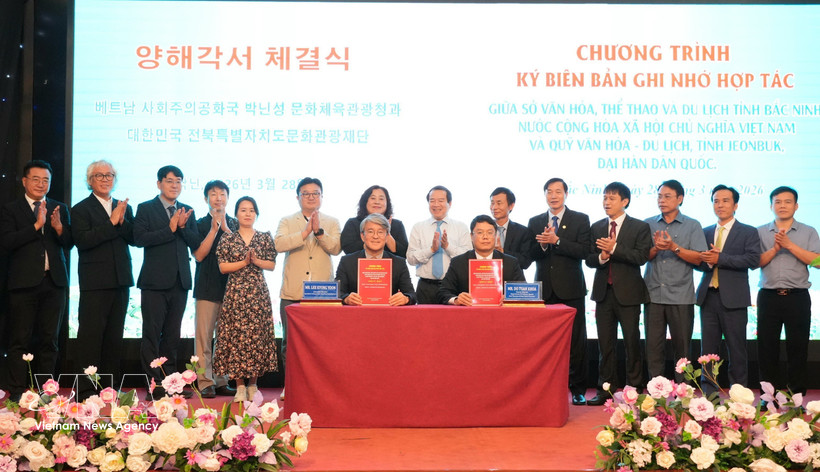
At the signing ceremony (Photo: VNA)

Bac Ninh (VNA) – The Department of Culture, Sports and Tourism of the northern province of Bac Ninh and the Culture and Tourism Foundation of Jeonbuk– a special self-governing province of the Republic of Korea (RoK), have signed a memorandum of understanding (MoU) to enhance cultural exchange and tourism development between the two localities.

Speaking at the event, Deputy Director of the Department of Culture, Sports and Tourism of Bac Ninh Do Tuan Khoa highlighted that in the context of the rapidly growing Vietnam – RoK comprehensive strategic partnership, localities enjoy favourable conditions to expand cooperation.

Bac Ninh has emerged as a key destination for Korean businesses and investors, while also possessing great potential for collaboration in culture and tourism, he added.

According to Khoa, both Bac Ninh and Jeonbuk boast rich and distinctive cultural heritage. Jeonbuk is known for Pansori, a traditional Korean vocal art, and Hanji paper, which is being nominated for UNESCO recognition. Meanwhile, Bac Ninh is home to Quan Ho folk singing and the Dong Ho folk painting tradition. These shared strengths provide a solid foundation for the two sides to jointly develop cultural tourism products and promote artistic exchanges.

Lee Kyung Yoon, Director of the Jeonbuk state Culture and Tourism Foundation, described the agreement as a starting point and important milestone opening a new phase of joint development between Jeonbuk and Bac Ninh through culture and tourism. He noted that Jeonbuk has actively promoted exchanges and achieved positive results in cooperation with Vietnam across various fields.

Through efforts to support Jeonbuk’s tourism enterprises in accessing the Vietnamese market, the Korean locality’s tourism products have gradually gained a foothold in Vietnam, he said.

In addition, Jeonbuk has expanded cooperation with Vietnam in medical tourism, with healthcare institutions building networks and maintaining sustainable exchanges, he said, adding that based on these experiences, Jeonbuk views Vietnam not only as a promotional market but also as a key partner for substantive cooperation aimed at delivering concrete outcomes.

Looking ahead, the two sides agreed to step up diverse cooperation programmes, extending beyond culture and the arts to tourism, education and creative industries. Priority will be given to developing tourism products that connect the cultural heritage of the two localities, implementing joint promotional campaigns to attract visitors, and organising exchange programmes for youth and artists.

Under the MoU, the two sides will intensify delegation exchanges, organise cultural and artistic exchange activities, and promote signature festivals, and introduce heritage values.

The agreement also emphasises enhanced information sharing, exchange of experience, and cooperation in human resource development, while encouraging tourism enterprises to strengthen connectivity, co-develop products and promote markets.

The MoU takes effect from the date of signing, with an initial duration of three years and automatic renewal for another three years unless either side decides to terminate it.

The cooperation is expected to contribute to enriching cultural exchanges, boosting tourism flows, and strengthening the friendship between the people of Bac Ninh and Jeonbuk, while supporting strengthening the Vietnam–RoK relations./.
VNA

See more

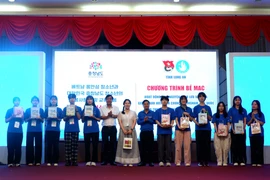
Viet Youth Readiness Hub debuts at the event (Photo: VNA)

Vietnamese Canadian youth hub launched to fight mother tongue erosion

The Viet Youth Readiness Hub is seen as a dedicated platform to connect, support, and empower Vietnamese-Canadian youth. It aims to emerge as a central force to host social events, advance heritage education, foster exchange and integration among young Vietnamese in Canada.

At the event “Vietnamese Language in the heart of Kyushu, Japan” (Photo: VNA)

Vietnamese in Japan revive mother tongue among young generations

While the number of Vietnamese-origin children in Japan is surging, opportunities to actually speak Vietnamese in daily life are vanishing fast. Many children can understand the language but default to Japanese in response, gradually relegating their mother tongue to a secondary role, sometimes even treating it as a “second foreign language” inside their own houses.

A tribute to Hung Kings in Ho Chi Minh City (Photo: VNA)

Hung Kings’ Commemoration Day 2026 to spread sacred values, foster national unity

Following the merger of Phu Tho, Vinh Phuc, and Hoa Binh provinces into the new Phu Tho province last year, the Hung Kings Temple Festival has taken on heightened significance. It now serves not only as a tribute to the ancestral homeland but also a unified cultural platform that extends sacred ancestral values to Vietnamese communities at home and abroad.

A traditional art performance at Bach Ma temple in Hanoi (Photo: VNA)

Traditional arts hold untapped economic power

Traditional arts embody deep aesthetic values, worldviews, and national identity, shaping the country’s distinctive “aesthetic identity” and foundational cultural tastes

A performance at the opening ceremony of the Hung Kings Temple Festival and the 2026 Ancestral Land Culture and Tourism Week on late April 17 (Photo: VNA)

Hung Kings Temple Festival, associated tourism week kick off

The annual festival serves as a major national cultural event, offering an opportunity for people across Vietnam and overseas Vietnamese communities to pay tribute to their ancestors, express gratitude, and strengthen the great national solidarity.

A ritual at Hue Nam Temple Festival (Photo: VNA)

Hue Nam Temple Festival: From imperial relic to distinctive cultural celebration in Hue

Historically known as Ngoc Tran Son Tu, the temple was renamed Hue Nam during the reign of King Dong Khanh in the late 19th century, symbolising royal gratitude to the Mother Goddess. It is also the only temple in Hue that harmoniously combines royal ceremonial elements with folk religious practices, creating a distinctive blend of court ritual and popular belief.

Participants in the 20th Cong hien (Devotion) Awards presentation ceremony in Hanoi on April 15 (Photo: VNA)

Devotion Awards mark two decades of honouring excellence in music, sports

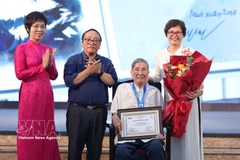
Nguyen Thien Thuat, Editor-in-Chief of the The Thao & Van Hoa newspaper and Head of the organising board of the awards, said, noting that their achievements reflect the spirit of the Politburo’s Resolution No. 80, which emphasises preserving national cultural values while selectively absorbing the essence of world culture.

Artisans and students take part in cultural activities and exchanges in the Xoan singing performance space at Hung Lo ancient communal house in Phu Tho province (Photo: VNA)

Ancestral legends revived through contemporary performance

Beyond cultural value, well-organised festival programmes linked with tourism and media can contribute to the development of cultural industries and enhance Vietnam’s cultural soft power, positioning heritage-based events as distinctive national cultural brands in the international arena.