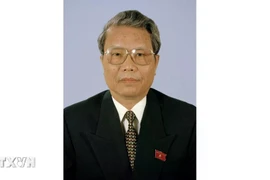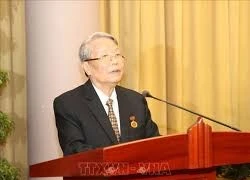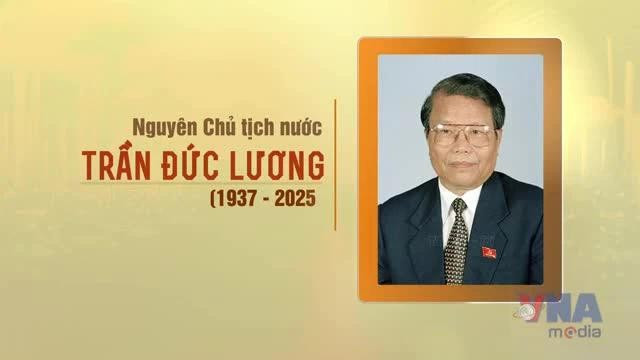
Hanoi (VNA) - Tran Duc Luong, former member of the Politburo and former President of the Socialist Republic of Vietnam, passed away on May 20 at the age of 88.
The following is the brief biography of Tran Duc Luong.
Tran Duc Luong was born on May 5, 1937, in Pho Khanh commune, Duc Pho district (now Duc Pho township), Quang Ngai province. His permanent residence is 298 Van Phuc street, Lieu Giai ward, Ba Dinh district, Hanoi. He joined the revolution in February 1955 and became a member of the Communist Party of Vietnam on December 19, 1959.
SUMMARY OF CAREER
- From February 1955 to September 1955: He gathered in the North, studied elementary geological engineering at the Ministry of Industry and Trade.
- From October 1955 to August 1959: He worked as a technical worker in geological exploration teams and groups; studied intermediate geology for 8 months.
- From September 1959 to March 1964: He was leader of Geological Team 4 of Geological Group 20, Secretary of the Youth Union of Geological Team 4, member of the Executive Committee of the Labour Youth Union of the Department of Geology, member of the Party Cell of the department.
- From April 1964 to August 1966: He was deputy technical head of Geological Group 20, Secretary of the Party Cell of the Department of Geology, member of the inter-agency Party Committee.
- From September 1966 to January 1970: He was a student, monitor of the geological exploration class (K11) of the Hanoi University of Mining and Geology; member of the school’s Party Committee, Secretary of the school’s Youth Union (1969).
- From February 1970 to August 1975: He worked as Deputy Director of the Department of Geological Mapping; member of the department’s Party Committee; member of the Standing Board of the department’s Party Committee.
- From September 1975 to September 1977: He studied at Nguyen Ai Quoc School; worked as Secretary of the class’s Party cell.
- From August 1977 to July 1979: He worked as deputy head and then acting head of the Federation of Geological Mapping under the General Department of Geology; Secretary of the federation’s Party Committee, member of the Executive Committee of the General Department of Geology's Trade Union; member of the Executive Committee of the Vietnam General Confederation of Labour.
- From August 1979 to January 1987: He was Director General of the General Department of Geology, Secretary of the Party Civil Affairs Committee of the General Department; studied a 4-month economic management course at the Academy of National Economics of the Soviet Union (1981). He was member of the 7th National Assembly, Vice Chairman, and then Chairman of the National Assembly's Science and Technology Committee; Vice Chairman of the Central Committee of the Vietnam - Soviet Union Friendship Association.
At the 5th National Party Congress (March 1982), he was elected as an alternate member of the Party Central Committee. At the 6th National Party Congress (December 1986), he was elected as a member of the Party Central Committee.
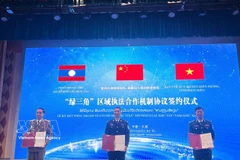
- From February 1987 to August 1992: He was Vice Chairman of the Council of Ministers; member of the 8th National Assembly; permanent representative of the Socialist Republic of Vietnam at the Council for Mutual Economic Assistance (SEV). At the 7th National Party Congress (June 1991), he was re-elected as a member of the Party Central Committee.
- From September 1992 to August 1997: He was Deputy Prime Minister of the Socialist Republic of Vietnam. At the 8th National Party Congress, he was elected to the Party Central Committee, and was elected by the Party Central Committee to the Politburo (June 1996).
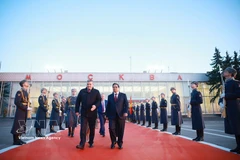
- From September 1997 to June 2006: He was President of the Socialist Republic of Vietnam, Chairman of the National Defence and Security Council (September 1997); member of the Politburo’s Standing Committee (January 1998). At the 9th National Party Congress, he was again elected to the Party Central Committee, and was elected by the Party Central Committee to the Politburo (April 2001).
He was a member of the Party Central Committee of the 5th, 6th, 7th, 8th, and 9th tenures; a Politburo member of the 8th and 9th terms; member of the Standing Committee of the 8th Politburo; Vice Chairman of the Council of Ministers from February 1987 to August 1992; Deputy Prime Minister from September 1992 to August 1997; President of the Socialist Republic of Vietnam, Chairman of the National Defence and Security Council of the 10th and 11th tenures from September 1997 to June 2006; member of the National Assembly of the 7th, 8th, 10th and 11th tenures.
He was granted retirement by the Party and the State on January 1, 2008, in accordance with regulations.
For his great and outstanding contributions to the revolutionary cause of the Party and the nation, he was awarded the Gold Star Order, the 65-year Party membership badge and many other noble orders and medals, awards and titles of Vietnam and the world./.
Former State President Tran Duc Luong passes away
Despite the dedicated treatment provided by the Party, the State, a team of professors and medical doctors, and the devoted care of his family, his advanced age and declining health ultimately led to his passing.