Dien Bien Phu Campaign - globe-shaking victory

Exactly 70 years ago, on March 13, 1954, the Vietnamese revolutionary army launched the first attack against the French colonialists’ heavily fortified base of Dien Bien Phu, starting a 56-day historic campaign whose victory directly led to the signing of the Geneva Accords on ending the war and restoring peace in Indochina.

Dien Bien Phu Campaign - globe-shaking victory ảnh 1
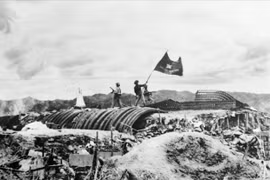
Vietnamese soldiers fly the flag of victory on the Him Lam fortification that they occupied in the opening battle of the Dien Bien Phu Campaign in the afternoon of March 13, 1954. (File photo: VNA)

Hanoi (VNA) – Exactly 70 years ago, on March 13, 1954, the Vietnamese revolutionary army launched the first attack against the French colonialists’ heavily fortified base of Dien Bien Phu, starting a 56-day historic campaign whose victory directly led to the signing of the Geneva Accords on ending the war and restoring peace in Indochina.

In the autumn - winter of 1953, French colonialists and US interventionists built the Navarre Plan that focused on turning Dien Bien Phu into the strongest military base in Indochina so as to seize control over the entire Northwest of Vietnam and the Upper Laos and destroy the majority of Vietnam’s regular troops, paving the way for controlling the Vietnamese territory and pacifying South Indochina.

French generals at that time heaped praise on this heavily fortified base, which was dubbed a “hedgehog” with entrenched concrete fortifications built across the four directions. In Muong Thanh Valley, France arranged 16,200 troops in 21 battalions divided into northern, central, and southern zones that comprised 49 entrenched fortifications supporting one another. At the airfields of Muong Thanh and Hong Cum, nearly 100 flight departures and arrivals occurred each day, capable of transporting about 200 - 300 tonnes of cargo and parachuting 100 - 150 soldiers.

Considering Dien Bien Phu as a trap for crushing the regular troops of Viet Minh (League for the Independence of Vietnam), general Rene Cogny boasted that the French colonialists had fire strong enough to wipe out an enemy four to six times larger than them.

Prior to the battle, US Vice President Richard Nixon, who later become President of the US, came to inspect the building of this military base to ensure that the US investment in Indochina was used effectively, and he expressed his satisfaction.

Realising the plot and ruses of French colonialists, in early December 1953, the Politburo of the Worker's Party of Vietnam (now the Communist Party of Vietnam) decided to launch the Dien Bien Phu Campaign and adopted the combatant strategy of “fast attack, fast victory”. However, after considering the balance of power between the two sides, General Vo Nguyen Giap made the most difficult decision of his career: Halting the attack and shifting the strategy from “fast attack, fast victory” to “steady attack, steady advance”.

The Party committees of military units convened meetings to provide detailed information about the new fighting strategy and encourage the entire troops to weather challenges to fulfill the new tasks.

With all-out wisdom, efforts, and determination of reserving all for the battlefield and for the victory, in the following nearly two months, the Vietnamese army continued applying the diversionary tactics while widening and lengthening the paths through the mountains and forests of Dien Bien Phu. Soldiers built stronger fortifications, dug deeper trenches, and moved closer to the French base. More food, weapons, and other supplies from the rear were delivered to the front to prepare for a long battle.

During the Dien Bien Phu Campaign, tens of thousands of people engaged in transporting supplies to the front or building the road for moving the artillery serving the battle.

People of Thanh Hoa province alone sent 9,000 tonnes of rice to the frontline. Meanwhile, people of Lai Chau province contributed 2,666 tonnes of rice, 226 tonnes of meat, 210 tonnes of vegetables, 16,972 personnel, 517,210 workdays, 348 pack horses, 58 boats, along with 25,070 timber trees for making roads. From 1951 to 1954, people of Inter-region 5 donated more than 1.32 million tonnes of unhusked rice and a large sum of money.

In his letter sent to soldiers on March 11, 1954, then President Ho Chi Minh said the duty was very difficult but also very glorious. He expressed his firm belief that the soldiers would bring into play the previous victory to overcome every difficulty and hardship to fulfill the coming glorious duty.

Exactly at 5pm on March 13, 1954, the Vietnamese troops opened fire on the Him Lam fortification, starting the Dien Bien Phu Campaign. They annihilated this fortification and later the Doc Lap fortification and forced the Ban Keo fortification to surrender, thus destroying the northern gateway of the Dien Bien Phu base. More than 2,000 French soldiers were killed or taken prisoners, 25 aircraft destroyed, a regiment eradicated, and the Muong Thanh airfield threatened. In April 1954, the revolutionary army concurrently attacked fortifications, tightened the siege, and seized the control of Muong Thanh airfield, forcing the enemy into the passive status and extreme anxiety.

From May 1 to 7, 1954, the Vietnamese troops seized control over the fortifications in the east and waged a general offensive to decimate the entire military base of Dien Bien Phu.

At 5:30pm on May 7, 1954, the “Determined to fight, determined to win” flag of the Vietnamese army was raised on the top of the command tunnel of French general De Castries. By the midnight on the same day, all the French troops were captured.

During the 56 days of undaunted, brave, and creative fighting, the Vietnamese army and people created the Dien Bien Phu Victory that “resounded across the five continents and shook the globe”. The entire so-called “invincible” military base of Dien Bien Phu was completely eradicated by the Vietnamese army and people.

President Ho Chi Minh affirmed that the Dien Bien Phu Victory was a brilliant golden milestone in history that directly led to the signing of the Geneva Accords on ending the war and restoring peace in Indochina. It also created the foundation and conditions for the Vietnamese people to secure victory in the resistance war against the US, liberate the South, and reunify the country in 1975.

Seventy years have passed, but the Dien Bien Phu Victory remains a source of pride of the Vietnamese people due to its great significance.

Prime Minister Pham Minh Chinh has affirmed that the Dien Bien Phu Victory held substantially historic significance. It was a triumph of patriotism, the undaunted spirit, and the strength of the great national solidarity of Vietnam under the smart and clear-sighted leadership of the Party. It was also a demonstration of the maturity of the Vietnam People’s Army./.

VNA

See more

Minister of Public Security Luong Tam Quang speaks at the session (Photo: VNA)

Lawmakers push sharper rules for infrastructure critical to national security

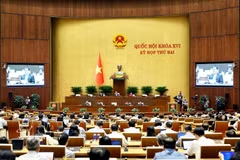
The draft law on protection of infrastructure related to national security should spell out core conditions, including the level of impact on national security, the risk of disrupting essential operations and the need for special protection. He said the Government should set detailed technical criteria, said a deputy from Lam Dong province.

☀️ Morning digest on November 5

☀️ Morning digest on November 5

Party General Secretary and President To Lam's reception for Lao NA President Sonexay Siphandone, Vietnam attending the 11th Lancang–Mekong Cooperation Foreign Ministers’ Meeting, and the Vietnam-EU Economic and Trade Cooperation Forum 2026 are among news highlights on November 4 evening.

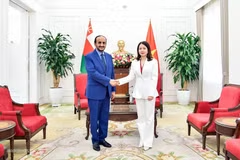
Vietnamese Deputy Minister of Foreign Affairs Nguyen Minh Hang (right) and Undersecretary for Political Affairs at the Foreign Ministry of Oman Khalifa bin Ali bin Issa Al-Harthy in Hanoi on November 4 (Photo: baoquocte.vn)

Vietnam, Oman convene fifth political consultation

The officials agreed to use the 35th anniversary of diplomatic ties in 2027 as an important milestone to further deepen bilateral relations, enhance economic resilience and diversify partners amid global uncertainties.

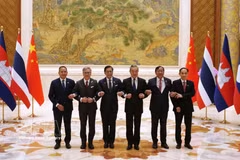
Minister of Foreign Affairs Le Hoai Trung (first, right) and other heads of the delegations at the 11th Lancang–Mekong Cooperation Foreign Ministers’ Meeting in Beijing on November 4, 2026. (Photo: VNA)

Vietnam proposes stronger Mekong–Lancang connectivity to respond to challenges

Minister of Foreign Affairs Le Hoai Trung suggested a resilient and innovative Mekong–Lancang region be built, regional connectivity strengthened, coordination between the MLC and other regional and Mekong cooperation mechanisms boosted, cooperation in addressing non-traditional security challenges fostered, and people placed at the centre of the MLC.

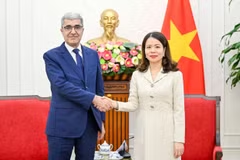
Vietnamese Deputy Minister of Foreign Affairs Nguyen Minh Hang (right) and her Tajik counterpart Idibek Kalandar at the meeting in Hanoi on November 4, 2026 (Photo: Vietnamese Ministry of Foreign Affairs)

Vietnam, Tajikistan to boost high-level exchanges, bilateral cooperation

Officials agreed that their foreign ministries should continue working together to promote high-level and other-level mutual visits and meetings; strengthen their role as focal points in supporting the countries' ministries, agencies and localities to step up economic, trade and investment partnerships; and make better use of the potential and complementary strengths of the two economies.

Politburo member, Secretary of the Party Central Committee and Chairman of its Commission for Internal Affairs Le Minh Tri (left) and Vice Chairperson of the Anti-Corruption and Civil Rights Commission (ACRC) of the Republic of Korea at their meeting in Hanoi on November 4, 2026 (Photo: VNA)

Vietnam, RoK strengthen anti-corruption cooperation

Speaking highly of the RoK's achievements in combating corruption, Chairman of the Commission for Internal Affairs Le Minh Tri stressed that as Vietnam pursues its target of double-digit economic growth in 2026 and subsequent years, anti-corruption efforts must not only focus on detecting and handling violations but also contribute to development.

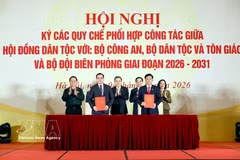
NA President Tran Thanh Man and delegates witness the signing of coordination regulations between the NA's Council for Ethnic Affairs and the Ministry of Ethnic and Religious Affairs. (Photo: VNA)

Top legislator urges stronger inter-agency coordination in ethnic policy development

National Assembly (NA) President Tran Thanh Man said the coordination programme aims to link legislative work, appraisal and supervision with State management, improve the legal and policy framework, and address obstacles to policy implementation in ethnic minority, mountainous and border areas. It also seeks to strengthen information sharing and inter-agency coordination, improve living conditions for ethnic minority communities and reinforce public trust in the Party and State.

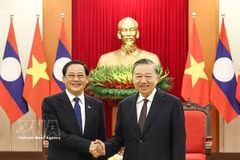
General Secretary of the Communist Party of Vietnam Central Committee and President To Lam (right) receives visiting President of the Lao National Assembly Sonexay Siphandone in Hanoi on November 4, 2026. (Photo: VNA)

Top Vietnamese leader hosts Lao NA leader

The two leaders expressed satisfaction with the strong development of the great friendship, special solidarity, comprehensive cooperation and strategic cohesion, which have grown increasingly substantive across Party, State, local and people-to-people channels.

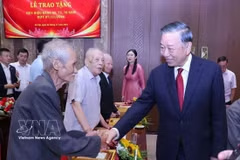
General Secretary of the Communist Party of Vietnam Central Committee and President To Lam greets veteran Party members at the ceremony held by the Hanoi Party Committee on November 4, 2026. (Photo: VNA)

Top leader attends Hanoi ceremony honouring veteran Party members

Top leader To Lam said the Party Central Committee expects much from the capital and has granted it breakthrough mechanisms, meaning greater responsibility and higher determination. Hanoi must lead not only in economic growth but also act as a standard-bearer in Party building and rectification, a model in renewing thinking and administrative reform, a leader in preserving and spreading Thang Long-Hanoi cultural values, and a driver of better living standards.

Politburo Member, Standing Member of the Party Central Committee’s Secretariat and Secretary of the Party Committee of Central Party Agencies Tran Cam Tu speaks at the conference (Photo: VNA)

Key Party leader urges clearer job roles, KPI-based performance review

Politburo Member, Standing Member of the Party Central Committee’s Secretariat and Secretary of the Party Committee of Central Party Agencies Tran Cam Tu asked each Standing Board member and Secretary of subordinate Party committees of the Party Committee of Central Party Agencies to keep up responsibility and uphold exemplary role, lead resolutely, fix shortcomings and limitations, and strive to complete 2026 tasks well.