Lawmakers push sharper rules for infrastructure critical to national security

The draft law on protection of infrastructure related to national security should spell out core conditions, including the level of impact on national security, the risk of disrupting essential operations and the need for special protection. He said the Government should set detailed technical criteria, said a deputy from Lam Dong province.

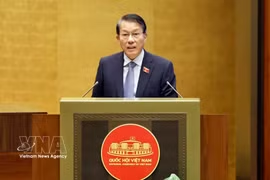
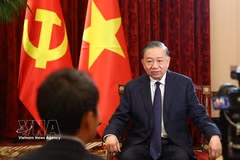
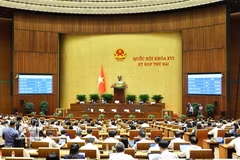
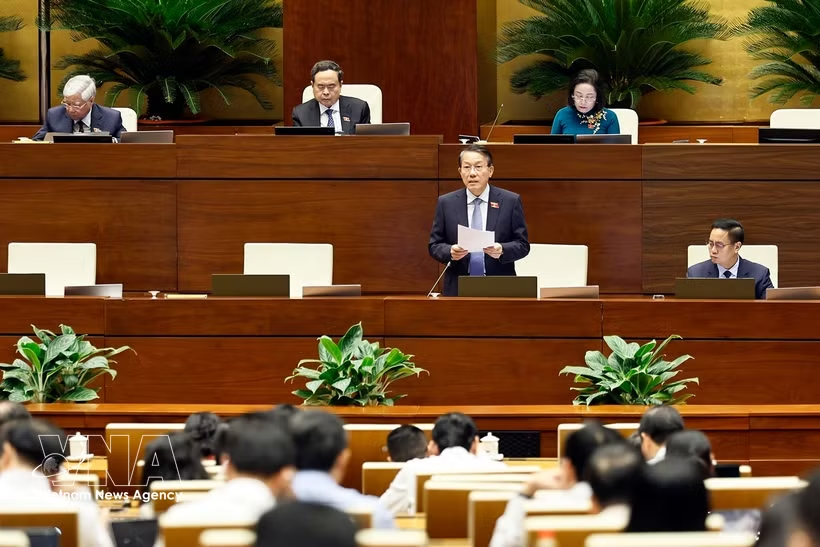
Minister of Public Security Luong Tam Quang speaks at the session (Photo: VNA)

Hanoi (VNA) – The 16th National Assembly on November 5 pressed for tighter criteria to identify and classify facilities deemed critical to national security, focusing on security impact and the fallout from disruption.

They also called for clearer delegation of authority, less red tape and stronger links to management, inspection and oversight.

Criteria, classification under scrutiny

Deputy Duong Khac Mai from Lam Dong province said the draft law on protection of infrastructure related to national security should spell out core conditions, including the level of impact on national security, the risk of disrupting essential operations and the need for special protection. He said the Government should set detailed technical criteria.

Deputy Tran Manh Huy from Da Nang city argued that importance should be judged by disruption consequences, not size or location alone. That means identifying affected services if a facility goes down, backup options and restoration time. For digital-dependent facilities, protection plans should name control systems, transmission links, essential operating data and the unit accountable when incidents hit.

Huy warned against stretching the law to cover all identity, tax and social insurance data or every digital platform. Those systems should remain governed by data, cybersecurity and sector-specific rules.

On investment-phase protection, deputy Hoang Quoc Khanh from Lai Chau province urged deeper decentralisation of appraisal for Class III facilities managed by a city or province.

Khanh said the Ministry of Public Security should issue a technical framework on security conditions, giving a common basis for listing facilities and applying rules nationwide to reconcile early, far-reaching security safeguards with administrative reform.

Draft law needs coherence

Minister of Public Security Luong Tam Quang said the drafting team is preparing a Government decree to detail the law. It will specify which electricity, oil and gas, telecom, data, finance, transport, digital infrastructure and other facilities qualify for the Class I, II and III national-security list if they meet all criteria.

On calls to clarify the Prime Minister’s power to apply protection measures not yet codified in special or urgent cases, he said technology is widening and complicating attack methods, including unprecedented ones. The draft therefore adds that mechanism to allow timely protection measures for facilities critical to national and regime security, in line with the Party Central Committee’s Resolution 22-NQ/TW on the National Security Strategy./.

VNA
See more

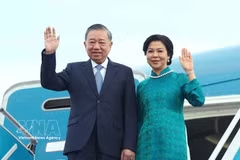
General Secretary of the Communist Party of Vietnam Central Committee and President To Lam, his spouse Ngo Phuong Ly and a high-ranking Vietnamese delegation leave Hanoi on November 8 for a four-day official visit to Japan at the invitation of the Japanese State. (Photo: VNA)

Top leader and spouse depart for official visit to Japan

General Secretary of the Communist Party of Vietnam Central Committee and President To Lam, his spouse Ngo Phuong Ly and a high-ranking Vietnamese delegation left Hanoi on November 8 for a four-day official visit to Japan at the invitation of the Japanese State.

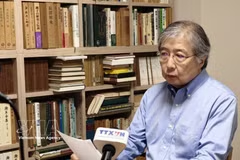
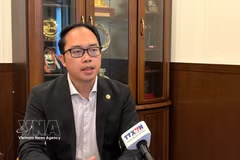
Toshiro Nishizawa, a Senior Fellow at Graduate School of Public Policy under the University of Tokyo in an interview with the Vietnam News Agency (VNA)'s correspondent in Japan (Photo: VNA)

Top leader’s visit to deepen Vietnam-Japan strategic cooperation: expert

The upcoming visit to Japan by General Secretary of the Communist Party of Vietnam Central Committee and President To Lam is expected to give fresh impetus to the Vietnam-Japan Comprehensive Strategic Partnership, reflecting the strategic priorities of both countries, according to a Japanese expert.

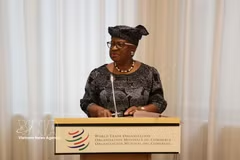
WTO Director-General Ngozi Okonjo-Iweala speaks at the event (Photo: VNA)

WTO hails Vietnam’s 20-year journey since accession

Joining the WTO was a strategic choice for Vietnam, closely associated with its Doi Moi (Renewal) process, opening-up policy and international economic integration. Over the past two decades, international economic integration has become a driving force for institutional reforms, trade expansion, foreign investment attraction and enhancement of the country's international standing.

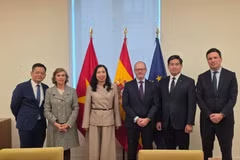
Vietnamese Deputy Minister of Foreign Affairs Le Thi Thu Hang (third, left) and other delegates at the political consultation (Photo: The Ministry of Foreign Affairs)

Vietnam, Spain seek to deepen Strategic Partnership

Vietnam asked Spain to continue voicing its support for and urging the European Commission (EC) to swiftly lift the IUU “yellow card” imposed on Vietnamese seafood, while actively encouraging EU member states to ratify the EU-Vietnam Investment Protection Agreement (EVIPA) at an early date.

Standing Deputy Minister of Foreign Affairs Nguyen Minh Vu (Photo: Ministry of Foreign Affairs)

Top leader's official visit to Japan carries three major strategic implications: Deputy FM

The visit, the first to Japan by the leader in his new capacity and the first visit to Japan by a General Secretary of the Communist Party of Vietnam in 11 years, will first set the overall strategic direction for bilateral relations in the new period, enabling leaders of the two countries to identify long-term cooperation orientations and priority areas that meet the development needs of both sides.

A performance at the 2026 Cultural and Artistic Exchange Programme for the Spring Border Festival between Lao Cai (Vietnam) and Honghe (China) (Illustrative image. Source: VNA)

Party directive calls for strengthening people-to-people diplomacy

People-to-people diplomacy is a key, regular task of the entire political system and people. People’s organisations, citizens, businesses, entrepreneurs, intellectuals, artists and overseas Vietnamese are at its centre and are the principal actors and direct participants in implementation, according to a new directive of the Party Central Committee's Secretariat.

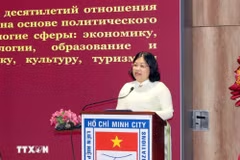
Nguyen Truong Nhat Phuong, Vice Chairwoman of the Ho Chi Minh City People's Council and President of the city's Vietnam-Russia Friendship Association, speaks at the gathering. (Photo: VNA)

Ho Chi Minh City seeks to strengthen cooperation with Russian localities

The Russian October Revolution laid the foundation for the longstanding friendship between Vietnam and Russia. Despite ups and downs of history, the traditional Vietnam-Russia friendship has been strengthened and nurtured by generations, with bilateral ties elevated to a Comprehensive Strategic Partnership.

An overview of the 14th Vietnam–US Defence Policy Dialogue. (Photo: VNA)

14th Vietnam–US Defence Policy Dialogue held in Washington DC

Deputy Minister of National Defence Nguyen Truong Thang called for greater sharing of information, documents and memorabilia concerning Vietnamese servicemen killed or missing in action, as well as support in strengthening DNA identification capacity to accelerate Vietnam's 500-day campaign to intensify the search for, collection and identification of the remains of fallen soldiers.