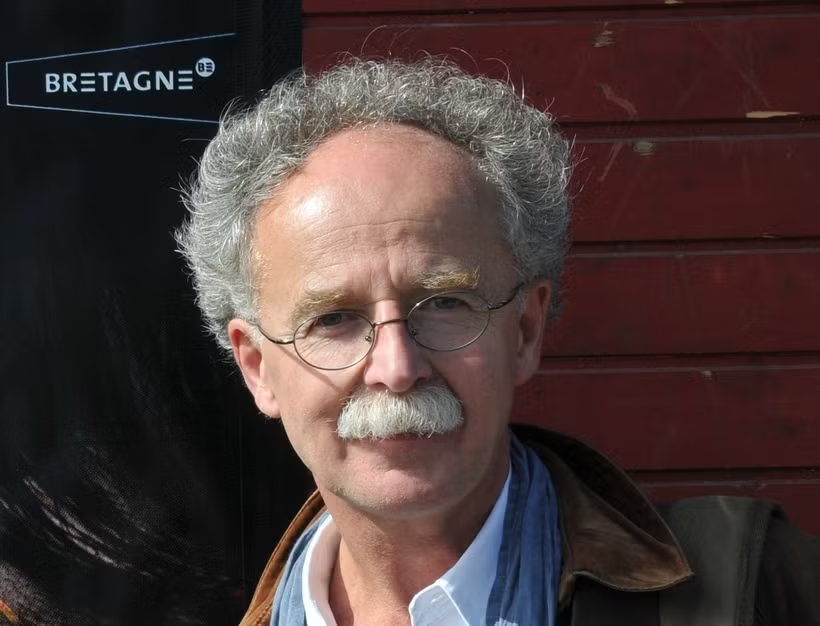
Paris (VNA) - Gildas Tréguier, Secretary-General of the France-Vietnam Health Federation (FSFV), has spent nearly 40 years engaged in healthcare cooperation with Vietnam, witnessing the country’s shift from early years of Doi Moi (Renewal) to its current phase of rapid socio-economic expansion.
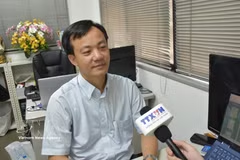
Speaking to the Vietnam News Agency's correspondents in Paris ahead of Vietnam’s 81st National Day (September 2), Tréguier said he entered the health partnership between Vietnam and France in 1988. That tenure spans the launch of Doi moi in 1986, the lifting of the US embargo in 1994, and the acceleration of growth from the 2000s onward.
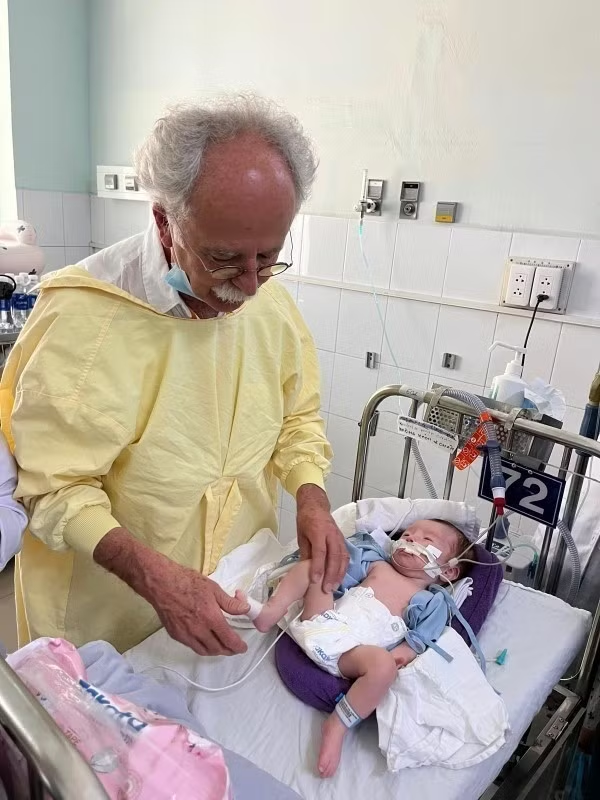
Tréguier, born in 1955 in Quimperlé, Brittany, is a specialist in pediatrics and neonatology. He formerly worked at the South Brittany Hospital Group (GHBS) and has held multiple roles in child health, perinatal care, and early intervention.
He currently serves as President of the Association for Action for Child Development and Protection (APPEL), medical coordinator of GHBS’s Vietnam cooperation programme, and sits on the national executive board of the France-Vietnam Friendship Association. He also founded Brittany’s Observatory of the First 1,000 Days of Life (OMPJ).
His involvement with Vietnam began in 1988 and became central to his career. Over four decades, he has engaged in successive phases of the “Born and Raised in Vietnam” programme, run by APPEL, GHBS, and partners, including Lorient city and Brittany region. He has also worked with the FSFV, established in 2015, for more than a decade.
That engagement held through the pandemic. As the COVID-19 pandemic spread in Vietnam, the FSFV actively connected partners and sourced vaccines, ventilators, and medical supplies, supporting the country’s response. As its Secretary-General, Tréguier directly facilitated exchanges between French and Vietnamese health professionals during the crisis.
His perspective on Vietnam is shaped by medical background, with maternal and child health as his primary focus. But he also describes himself as someone who “loves” Vietnam, a country he says Europeans can learn from, as much as share with.
Vietnam’s development record, he said, has drawn recognition from international bodies and attention from western policymakers.
Looking ahead, Tréguier said 2026 could mark a turning point, as Vietnam pushes through structural reforms following the 14th National Congress of the Communist Party of Vietnam.
With a population nearing 102 million and average GDP growth above 6% from 2012 to 2025, Vietnam ranks among the world’s more consistently broad-based developers. Political stability has made it a partner of choice for major economies, he added.
Tréguier highlighted reforms aimed at streamlining the state apparatus, fostering public-private partnerships, and creating space for private-sector growth to raise the efficiency of the open economy.
The economic shift has also reshaped society. He cited healthcare gains, including infant mortality approaching developed-world levels and life expectancy above 70, alongside demographic pressures from aging, falling fertility, and declining birth numbers.
Years of collaboration have also sharpened his view of Vietnamese professionals. Rising expertise has driven demand for more specialised cooperation, raising the bar for French partners to keep pace, he said.
After nearly four decades, the relationship has moved beyond professional cooperation into enduring human ties across generations.
He likened those who shape history to “small bricks”, mostly unseen, often unacknowledged, yet collectively building something great.
For Tréguier, he is not just a friend of Vietnam, but someone who “loves” it./.