Mexican newspaper spotlights Vietnam’s transformation after four decades

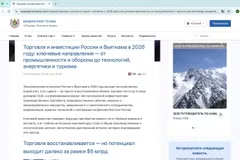
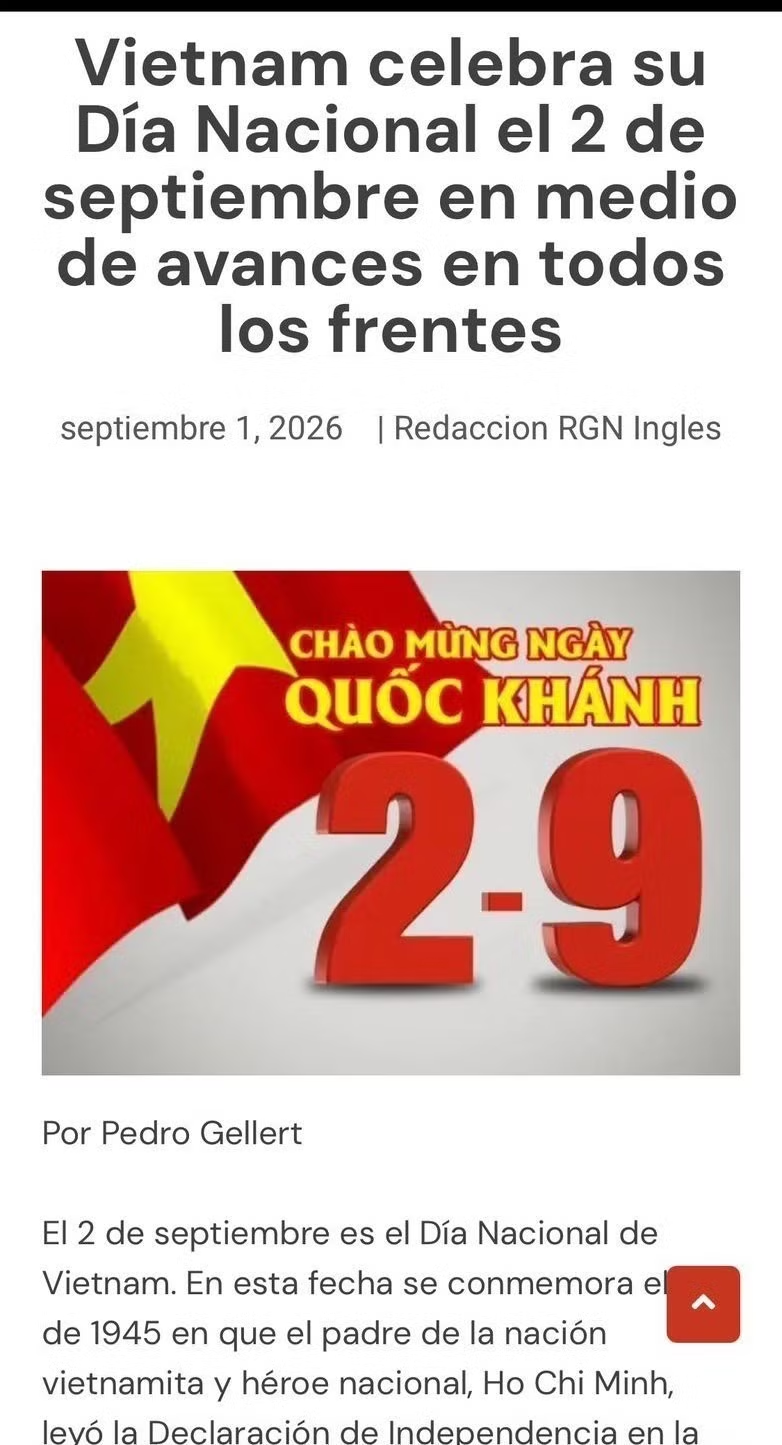
Pedro Gellert wrote in a September 1 article for Regeneración, the political news outlet of Mexico’s ruling National Regeneration Movement, that Vietnam’s socialist-oriented development drive stands out for its progress. The piece, timed to Vietnam’s National Day (September 2), highlights 40 years of Doi moi (Renewal) process.

The article by Pedro Gellert (Photo: Screenshot)

Mexico City (VNA) – While Vietnam’s victory in the struggle for national independence and reunification remains remembered by people around the world as a historic milestone, the country’s modern record now commands equal attention.

Pedro Gellert wrote in a September 1 article for Regeneración, the political news outlet of Mexico’s ruling National Regeneration Movement, that Vietnam’s socialist-oriented development drive stands out for its progress. The piece, timed to Vietnam’s National Day (September 2), highlights 40 years of Doi Moi (Renewal) process.

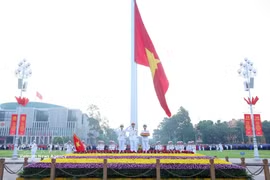
The article opened with September 2, 1945 when President Ho Chi Minh proclaimed the Declaration of Independence at Ba Dinh Square in Hanoi, establishing the Democratic Republic of Vietnam, now the Socialist Republic of Vietnam.

According to the author, this was a historic milestone, ushering in a new phase in the struggle for national independence and sovereignty. Later victories in the resistance wars against French colonialists and US imperialism become a source of inspiration for anti-imperialist movements worldwide.

Shifting to the present, he noted that 40 years of Doi Moi, from 1986 to 2026, have produced historic socio-economic gains and set the stage for a new growth phase.

Economically, Vietnam has sustained rapid growth and cemented upper-middle-income status. GDP expanded at an average 6.2% annually from 2016 through 2025, accelerating to 7.09% in 2024 and 8.02% in 2025. The economy now exceeds 514 billion USD, with per capita income above 5,000 USD. These gains Gellert links to improved living standards and social welfare.

Education, health care and essential services have also advanced. Adult literacy is near 99%, health insurance covered more than 94% of the population in 2024, and over 96% of households have clean water, sanitation services and electricity.

Vietnam is now among the world’s most open and highly integrated economies. It has 17 free trade agreements in force with 60 partners. That integration has made it a rising Asian manufacturing hub for electronics, technology and strategic goods. Heavy investment in expressways, airports, seaports and the national power grid has upgraded infrastructure, supporting industrialisation and growth.

Gellert highlighted Vietnam’s 2025 administrative reform as a key step to streamline the state apparatus, use resources more efficiently and put people at the centre of development policies. The overhaul cut administration tiers from four to three, including central, provincial and communal levels, and reduced provincial-level administrative units to 34 from 63.

On national defence-security, the article points to Vietnam’s “Four No’s” policy of no military alliances, no siding with one country against another, no foreign bases or use of Vietnamese territory to oppose other countries, and no use or threat of force in international relations. According to the author, the policy helps safeguard Vietnam’s independence, sovereignty, unity and territorial integrity while maintaining an environment of peace and stability for development.

Looking forward, the 14th National Congress of the Communist Party of Vietnam has set 2026–2030 development goals with a vision to 2045. In foreign policy, Vietnam will stick to independence, self-reliance, peace, friendship, cooperation and development, while diversifying and multilateralising external ties and positioning itself as a reliable partner and responsible member of the international community.

Vietnam’s development path is no longer just a national case study but a reference for other countries seeking to build humane, united and prosperous societies, he said.

The foundations laid over four decades of Doi Moi are opening room for Vietnam to push for further breakthroughs, broader development and a higher quality of life, he concluded./.
VNA

See more

The forum on ASEAN's role in the Indo-Pacific region and prospects for cooperation with Argentina takes place on September 10 (Photo: VNA)

ASEAN highlights its central role in Indo-Pacific

The Ambassador of Indonesia, the country holding the rotating chairmanship of ASEAN in Argentina, stressed that maintaining peace and stability, along with an open, transparent regional environment based on mutual respect, are fundamental conditions for a peaceful, inclusive, and prosperous Indo-Pacific.

A street in Bangkok, Thailand. (Illustrative photo: Xinhua/VNA)

Thailand’s business activity shows signs of gradual recovery

As of August 31, Thailand had more than 1 million active legal entities with total registered capital of 24.13 trillion THB. The service sector accounted for the largest share, with 552,830 entities, or 54.48%, followed by wholesale and retail with 332,791 entities (32.79%) and manufacturing with 129,215 (12.73%).

Prime Minister Hun Manet (front row, centre) and Labour and Vocational Training Minister Heng Sour (front row, right) visit a garment factory in Preah Sihanouk province. MLVT (Photo: khmertimeskh.com)

Cambodia records 7,458 more enterprises in three years

A Cambodian official said that the growth should not be assessed solely by the number of newly established enterprises and facilities, but also by their contributions to investment, production, job creation and household incomes.

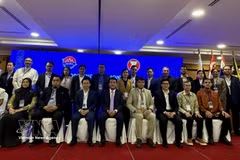
The ASEAN Senior Officials’ Meeting (SOM) convenes in Manila, the Philippines, on September 9. The Vietnamese delegation is led by Deputy Minister of Foreign Affairs Dang Hoang Giang (fifth, left), head of the ASEAN-Vietnam SOM.(Photo: asean.org)

Vietnam calls for stronger ASEAN unity, resilience

Deputy Minister of Foreign Affairs Dang Hoang Giang urged ASEAN to make full use of existing mechanisms to enhance dialogue, build trust and prevent risks and conflicts, particularly by strengthening the Treaty of Amity and Cooperation in Southeast Asia (TAC), the Southeast Asia Nuclear Weapon-Free Zone Treaty (SEANWFZ), and cooperation based on international law.

Timor-Leste President Jose Ramos-Horta (Photo: VNA)

Timor-Leste diversifies economy, seeks to attract investment

The President noted Timor-Leste is pursuing sustainable development, stronger regional connectivity and expanded international cooperation while seeking investment opportunities in energy, tourism and emerging economic sectors to reduce its dependence on oil and gas revenues.

Minister Counsellor Nguyen Hai Luu, Deputy Permanent Representative of Vietnam to the UN (Photo published by VNA)

Vietnam cooperates with UN to advance gender equality

Minister Counsellor Nguyen Hai Luu highlighted Vietnam’s positive achievements in promoting gender equality, noting that 13 of the 20 targets under the national strategy on gender equality had been met or exceeded by 2025.

General Secretary of the Communist Party of Vietnam Central Committee and President To Lam meets with Russian President Vladimir Putin in Moscow on September 9, 2026. (Photo: VNA)

Russian public, experts praise top Vietnamese leader’s visit

Positive reactions to General Secretary and President To Lam’s visit have reaffirmed Vietnam’s steady foreign policy amid global changes, while highlighting the enduring trust and friendship between Vietnam and Russia, which are working together to create new breakthroughs in bilateral cooperation.

Thailand eases rules for foreign enterprises

Thailand eases rules for foreign enterprises

The regulatory adjustment is part of Thailand's efforts to simplify regulations governing foreign business operations and clarify licensing requirements, while simultaneously fostering economic development and enhancing the country's international competitiveness.