Law on Digital Technology Industry, amended Law on Chemicals adopted

The 15th National Assembly passed the Law on Digital Technology Industry and the revised Law on Chemicals during its ongoing ninth session on June 14.

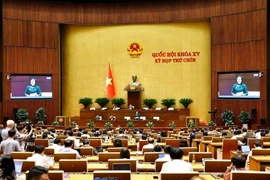
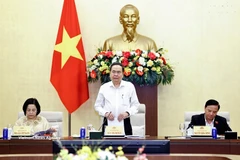
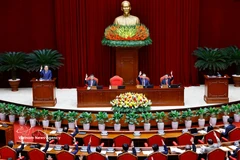
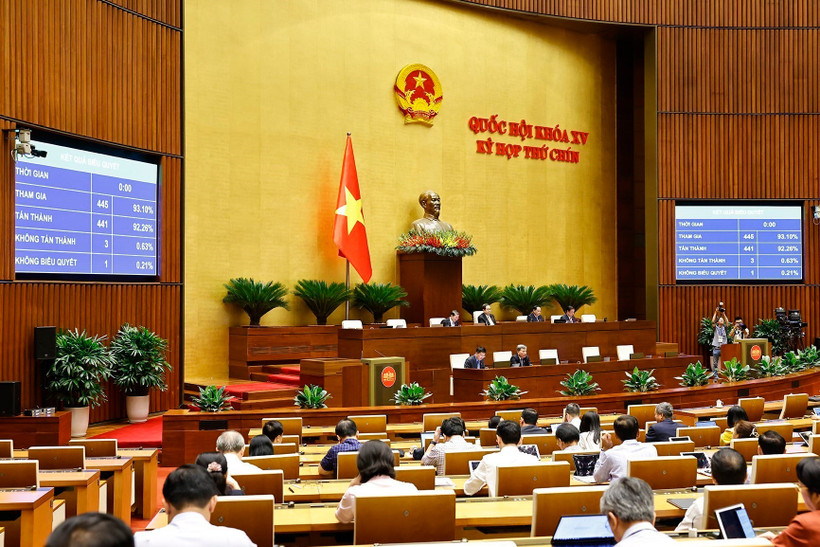
With 441 out of 445 lawmakers voting in favour, the Law on Digital Technology Industry is adopted (Photo: VNA)

Hanoi (VNA) – The 15th National Assembly passed the Law on Digital Technology Industry and the revised Law on Chemicals during its ongoing ninth session on June 14.

With 441 out of 445 lawmakers voting in favour, the Law on Digital Technology Industry was adopted, setting the legal framework for developing Vietnam’s digital industry, including semiconductors, artificial intelligence (AI), and digital assets.

Presenting the report on revisions to the draft law, Chairman of the NA’s Committee on Science, Technology and Environment Le Quang Huy said the legislation outlines policies to attract investment in research, development, and technology transfer; build national and regional digital industrial infrastructure; and gradually master digital technologies.

A key highlight is the introduction of policies to attract and develop digital talent. The law defines “digital technology talent” as individuals with notable expertise and achievements in the sector across both public and private domains. Clear criteria for identifying such talent are also included to ensure transparency and enable appropriate recruitment and incentives.

The law encourages AI training and re-skilling within the national education system and promotes workforce development strategies across both public and private sectors. AI is also identified as a priority for research and application.

On digital assets, it recognises their legal status under civil law and stipulates rights to ownership, transactions, data security, and dispute resolution through existing frameworks, including anti-corruption and anti-money laundering laws.

The same day, the NA also passed the amended Law on Chemicals, with 442 out of 445 deputies voting in favour.

According to Huy, the revised law reflects feedback from legislators to promote sustainable development by encouraging the efficient use of natural resources and environmentally friendly chemicals.

It introduces provisions on priority development sectors aligned with each development stage, targeting high-value chemicals that contribute to socio-economic progress. It also ensures environmental safety, national security, and defence.

A new article sets out strategic tasks to boost the chemical industry, including support for key and innovative products.

The law also enhances management by requiring new chemical registration procedures, data integration into the national database, and stricter traceability and disclosure rules for controlled substances./.
VNA

See more

Party General Secretary To Lam (L) meets with Lao Prime Minister Sonexay Siphandone in Vientiane on December 1, 2025 (Photo: VNA)

Vietnam, Laos foster great friendship, strategic cohesion

Vietnam and Laos will continue to stand together, share strategic interests, support each other’s development and coordinate closely in addressing common challenges. The Vietnam–Laos relationship remains an invaluable legacy and an exceptional model of international cooperation and shared development in the new era.

Prime Minister Le Minh Hung meets with Prime Minister Xanana Gusmão of Timor-Leste on May 7, 2026 on the sidelines of the 48th ASEAN Summit in Cebu, the Philippines (Photo: VNA)

Timor-Leste PM’s official visit to strengthen traditional friendship

Prime Minister Kay Rala Xanana Gusmão’s official visit to Vietnam and participation in the 3rd ASEAN Future Forum from June 7 to 10, 2026, is considered a highly significant event, particularly for Timor-Leste’s integration process as a newly admitted ASEAN member and for the future development of the ASEAN Community.

Deputy Minister of Foreign Affairs Le Thi Thu Hang speaks at the panel discussion titled “Russia – APEC: Broad Cooperation Prospects on the Horizon until 2035”. (Photo: VNA)

Vietnam shares vision, preparations for APEC 2027

Deputy Foreign Minister Le Thi Thu Hang underlined the importance of stronger coordination between APEC and other regional and global mechanisms in order to improve efficiency and optimise resources in addressing common challenges.

General Secretary of the Central Committee of the Communist Party of Vietnam and President of Vietnam To Lam delivers a keynote address at the opening of the 23rd Shangri-La Dialogue in Singapore on May 29. (Photo: VNA)

Singaporean FM highlights shared strategic outlook with Vietnam

Singapore and Vietnam remain committed to supporting a rules-based international order, strengthening ASEAN integration, and enhancing the bloc’s resilience. The two countries upgraded their ties to a Comprehensive Strategic Partnership (CSP) last year, marking Singapore’s first CSP with an ASEAN member state.

Deputy Minister of Foreign Affairs Nguyen Manh Cuong (Photo: VNA)

ASEAN Future Forum 2026 to advance ASEAN community-building process

Vietnam hopes the forum will continue to demonstrate its role as an active and responsible member of the Association of Southeast Asian Nations (ASEAN), contributing to regional affairs and advancing the Party and State’s foreign policy and international integration strategy.

General Secretary of the Communist Party of Vietnam Central Committee and State President To Lam speaks at the 23rd Shangri-La Dialogue on May 29, 2026. (Photo: VNA)

Vietnam contributes to shaping regional agenda at 23rd Shangri-La Dialogue: Indian expert

Speaking to Vietnam News Agency correspondents in New Delhi, Pradhan noted that, drawing on his extensive experience in national security and international relations, as well as his deep knowledge of international law, the top Vietnamese leader identified three closely interrelated crises facing the world today: a crisis of the international order, a crisis of the development model, and a crisis of strategic trust.