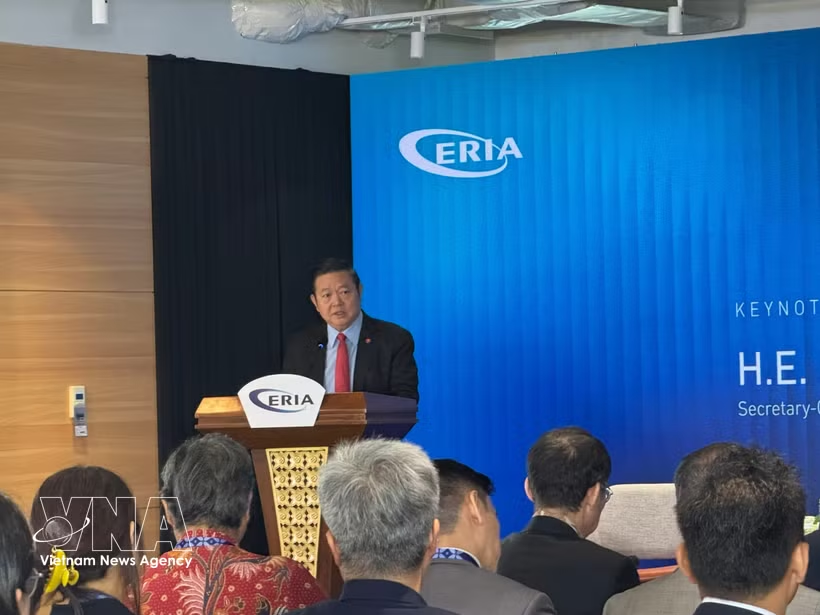
Jakarta (VNA) – The ERIA School of Government under the Economic Research Institute for ASEAN and East Asia (ERIA), in collaboration with the Japan Institute of International Affairs (JIIA), on July 9 launched a lecture series on the ASEAN Outlook on the Indo-Pacific (AOIP) and a symposium on deepening synergies between Japan's Free and Open Indo-Pacific (FOIP) strategy and the AOIP, marking the 10th anniversary of the FOIP.
Speaking at the opening ceremony in Jakarta, Indonesia, ERIA President Tetsuya Watanabe said the event aims to provide a platform for policy dialogue on strategic regional issues, thereby contributing to strengthening ASEAN's role in shaping regional and global agendas.
In his keynote remarks, ASEAN Secretary-General Kao Kim Hourn said the Indo-Pacific region is facing geopolitical competition, economic fragmentation, technological disruptions, and mounting strain on the rules-based international order.
Against this backdrop, he noted, the AOIP continues to demonstrate its relevance by promoting dialogue, cooperation and inclusiveness rather than confrontation and competition among major powers.
Kao stressed that while the AOIP and Japan's FOIP reflect distinct strategic and policy approaches, they converge on fundamental principles, including the promotion of an open, transparent, inclusive, resilient and rules-based regional architecture.
These principles, he said, were reaffirmed by ASEAN and Japan at the 28th ASEAN–Japan Summit in 2025 and continue to be advanced under the framework of the ASEAN–Japan Comprehensive Strategic Partnership.
According to the ASEAN Secretary-General, as of June 2026, ASEAN and Japan had implemented about 81% of the action lines in the implementation plan between ASEAN and Japan, laying an important foundation for closer coordination between the AOIP and the FOIP in the coming period.
Regarding economic cooperation, Kao said that amid rising protectionism, ASEAN and Japan should continue promoting free trade, including by exploring the possibility of upgrading the ASEAN–Japan Comprehensive Economic Partnership (AJCEP) Agreement to facilitate trade and investment.
ASEAN and Japan can also deepen cooperation in emerging areas — cybersecurity, trusted digital ecosystems, and the responsible, human-centred governance of artificial intelligence, he added.
On maritime cooperation, he stressed that freedom of navigation, exercised in accordance with the 1982 United Nations Convention on the Law of the Sea (UNCLOS), remains fundamental to regional stability, global trade, and economic security.
The ASEAN Secretary-General also called on dialogue partners, including Japan, to continue supporting the implementation of the AOIP through concrete programmes and projects, while proposing new initiatives to further advance the AOIP, uphold international law and norms, and reinforce ASEAN centrality.
Participants at the symposium discussed measures to strengthen coordination between the FOIP and the AOIP amid evolving regional geopolitical dynamics, as well as prospects for expanding cooperation in such areas as connectivity, maritime security, supply chain resilience, digital transformation, and enhancing ASEAN centrality in the regional architecture./.