Belgium calls for stronger EU - ASEAN strategic cooperation

Belgian Deputy Prime Minister and Minister of Foreign Affairs, European Affairs and Development Cooperation Maxime Prevot said the two regions, representing more than one billion people, are well placed to offer stability, security and predictability in an increasingly uncertain global environment.

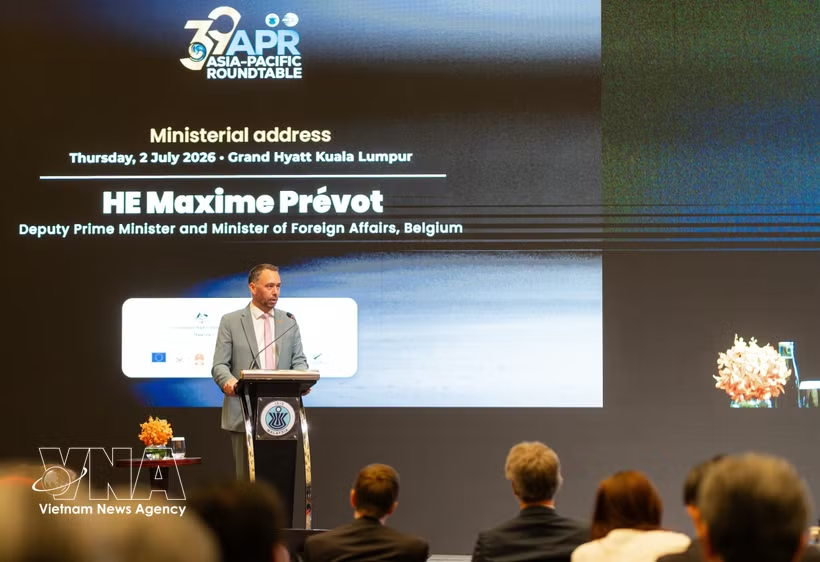
Belgian Deputy Prime Minister Maxime Prévot delivers his address at the 2026 Asia-Pacific Roundtable (APR). (Photo: VNA)

Kuala Lumpur (VNA) – Belgium has called for stronger strategic alliances between the European Union (EU) and the Association of Southeast Asian Nations (ASEAN), saying closer collaboration based on shared principles and international law has become increasingly important amid growing geopolitical uncertainty.

Speaking at the recent ministerial address session of the 39th Asia-Pacific Roundtable (APR) in Kuala Lumpur, Belgian Deputy Prime Minister and Minister of Foreign Affairs, European Affairs and Development Cooperation Maxime Prevot said the two regions, representing more than one billion people, are well placed to offer stability, security and predictability in an increasingly uncertain global environment.

He noted that Europe has become overly dependent on the US for military, China for trade and Russia for energy, arguing that the current geopolitical landscape underscores the need to strengthen strategic alliances, not by seeking to oppose anyone, but for the sake of principles and for the common good rather than national isolationism.

Prevot described the EU – ASEAN partnership as a model of dialogue, diplomacy and long-term cooperation, urging both sides to take advantage of shifting global dynamics to deepen collaboration.

"If interdependence defines our reality, then multilateralism must define our response. Multilateralism is an essential part of Belgium’s and Europe’s DNA," he said.

However, the official noted, as the multilateralism system is under strain, it must adapt to remain credible and effective in such a changing world.
potal-bi-keu-goi-tang-cuong-hop-tac-chien-luoc-eu-asean-8873720.jpg
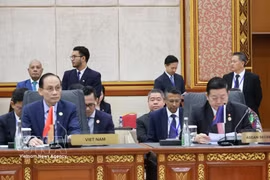
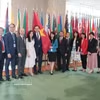
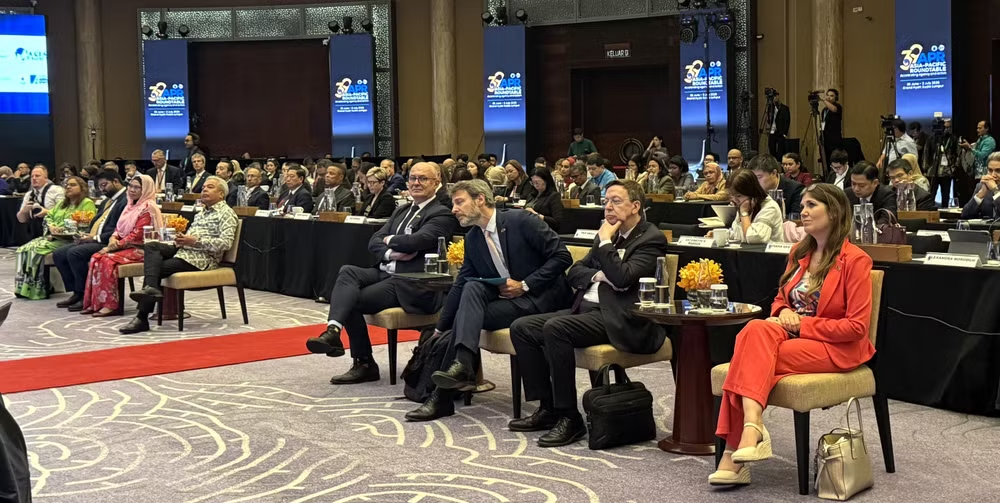
Delegates attend the 2026 APR. (Photo: VNA)

On security, Prevot said today's challenges extend beyond national borders and require collective responses, noting that security now encompasses not only military issues but also economic stability and environmental sustainability. He reaffirmed Belgium's commitment to the rules-based international order and support for international legal frameworks, including the International Criminal Court (ICC), the United Nations Charter and the 1982 United Nations Convention on the Law of the Sea (UNCLOS).

Ahead of the 50th anniversary of the Treaty of Amity and Cooperation in Southeast Asia (TAC) on July 24, he also announced Belgium's decision to ratify the ASEAN treaty, saying the move underscores the country's commitment to peaceful interstate relations and stronger engagement with Southeast Asia./.
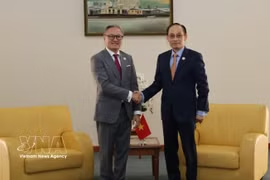
VNA

See more

Illustrative photo: VNA

Malaysia steps up preparedness for "Super El Niño"

An official said the Malaysian government is shifting towards a proactive approach to disaster prevention, rather than simply responding to disasters, adding that all necessary resources and personnel have been prepared for rapid mobilisation should the situation worsen.

World Bank backs Indonesia’s rural green economy initiative

World Bank backs Indonesia’s rural green economy initiative

The Sehati initiative is designed to support Indonesia’s priorities of promoting grassroots economic growth amid limited fiscal resources. It focuses on three key objectives: strengthening food security, advancing the green economy and empowering rural communities.

The Maybank Investment Banking Group (Maybank IBG) raises Malaysia’s 2026 gross domestic product (GDP) growth forecast to 4.9% from 4.4% previously (Photo: Xinhua/VNA)

Maybank IBG lifts Malaysia's 2026 GDP forecast to 4.9%

Maybank IBG said outlook for the second half of 2026 remains healthy, especially amid the sustained momentum in investment approvals, particularly in technology, renewable energy, industrial real estate and infrastructure segments.

Malaysia plans transit centre for foreign workers

Malaysia plans transit centre for foreign workers

Malaysia is planning to establish a transit centre capable of accommodating 1,000–2,000 foreign workers as part of efforts to strengthen migrant labour management, enhance security, and ease airport congestion.

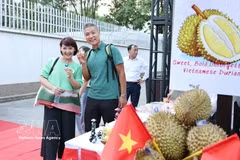
Vietnamese durian is promoted at an event in Beijing. (Photo: VNA)

Vietnamese fruit expands foothold in Chinese market

Thanks to its strategic location bordering Vietnam and other ASEAN countries, Guangxi remains a major gateway for tropical fruit entering China. Chinese media have also identified Vietnamese lychees as one of the country's favourite seasonal fruits.

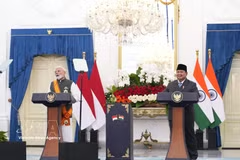
Indonesian President Prabowo Subianto (right) and Indian Prime Minister Narendra Modi at the Merdeka Palace in Jakarta on July 7, 2026. (Photo: VNA)

Indonesia, India expand cooperation across key strategic sectors

The two leaders agreed to intensify state visits and high-level talks, foster closer coordination through bilateral consultation mechanisms, and strengthen institutional cooperation involving think tanks and the newly formed interparliamentary friendship group.

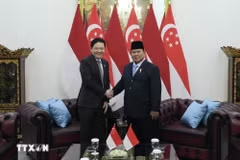
Indonesian President Prabowo Subianto (R) welcomes Singaporean Prime Minister Lawrence Wong in Jakarta on July 6. (Photo: VNA)

Indonesia, Singapore deepen comprehensive cooperation

Indonesia and Singapore signed 26 cooperation agreements, including 18 government-to-government agreements and eight business ones. The deals focus on emerging drivers of bilateral cooperation, including trade, investment, energy, the digital economy, cybersecurity, food supply chain development, environmental cooperation and carbon trading.

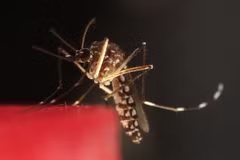
An Aedes aegypti mosquito. (Photo: Xinhua/VNA)

Malaysia's dengue-related deaths rise nearly 70% in first half of 2026

Health authorities attributed the increase partly to a shift in the dominant dengue virus strain from DENV-2 to DENV-3. Rapid urbanisation, favourable weather conditions, mosquito breeding sites and increased population mobility have also contributed to the spread of the disease.

Malaysia targets 50% cut in food imports by 2050

Malaysia targets 50% cut in food imports by 2050

Malaysia has set a target of reducing its reliance on imported food by 50% by 2050 as part of efforts to strengthen national food security. The goal comes as the country's annual food import bill has reached around 80 billion MYR (20 billion USD).