Malaysia steps up preparedness for "Super El Niño"

An official said the Malaysian government is shifting towards a proactive approach to disaster prevention, rather than simply responding to disasters, adding that all necessary resources and personnel have been prepared for rapid mobilisation should the situation worsen.

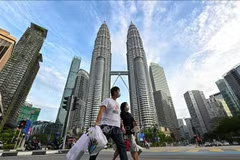
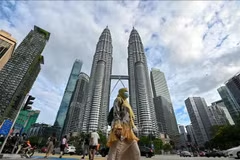
Illustrative photo: VNA

Kuala Lumpur (VNA) – Malaysian disaster management agencies are on high alert ahead of the possible onset of a "Super El Niño" later this year while also strengthening their response to extreme heat and haze during the southwest monsoon season.

Director-General of the National Disaster Management Agency (NADMA) Meor Ismail Meor Akim said government agencies responsible for disaster management convened a meeting on July 7 to review their preparedness and strengthen coordinated response efforts.

He said the Malaysian government is shifting towards a proactive approach to disaster prevention, rather than simply responding to disasters, adding that all necessary resources and personnel have been prepared for rapid mobilisation should the situation worsen.

NADMA has urged the public to remain vigilant against the risks of heatwaves, open burning and haze in the coming months, while calling on the media to help disseminate preventive measures.

Deputy Director-General of the Malaysian Meteorological Department Ambun Dindang said the department is closely monitoring the potential formation of a "Super El Niño" based on data from the US National Oceanic and Atmospheric Administration (NOAA) and the Climate Prediction Centre (CPC), particularly changes in sea surface temperatures in the central Pacific Ocean.

According to current forecasting models, the phenomenon is expected to begin developing around November and affect Malaysia early next year. However, Ambun noted that forecasts remain subject to change as more data becomes available.

The Malaysian Meteorological Department warned that the southwest monsoon could bring drier and hotter weather while reducing rainfall in some areas, increasing the risks of hotspots, forest fires, peat fires and transboundary haze. The extent of the impact will depend on the forest fire situation in neighbouring countries and prevailing wind patterns./.


VNA

See more

World Bank backs Indonesia’s rural green economy initiative

World Bank backs Indonesia’s rural green economy initiative

The Sehati initiative is designed to support Indonesia’s priorities of promoting grassroots economic growth amid limited fiscal resources. It focuses on three key objectives: strengthening food security, advancing the green economy and empowering rural communities.

The Maybank Investment Banking Group (Maybank IBG) raises Malaysia’s 2026 gross domestic product (GDP) growth forecast to 4.9% from 4.4% previously (Photo: Xinhua/VNA)

Maybank IBG lifts Malaysia's 2026 GDP forecast to 4.9%

Maybank IBG said outlook for the second half of 2026 remains healthy, especially amid the sustained momentum in investment approvals, particularly in technology, renewable energy, industrial real estate and infrastructure segments.

Malaysia plans transit centre for foreign workers

Malaysia plans transit centre for foreign workers

Malaysia is planning to establish a transit centre capable of accommodating 1,000–2,000 foreign workers as part of efforts to strengthen migrant labour management, enhance security, and ease airport congestion.

Vietnamese durian is promoted at an event in Beijing. (Photo: VNA)

Vietnamese fruit expands foothold in Chinese market

Thanks to its strategic location bordering Vietnam and other ASEAN countries, Guangxi remains a major gateway for tropical fruit entering China. Chinese media have also identified Vietnamese lychees as one of the country's favourite seasonal fruits.

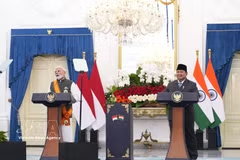
Indonesian President Prabowo Subianto (right) and Indian Prime Minister Narendra Modi at the Merdeka Palace in Jakarta on July 7, 2026. (Photo: VNA)

Indonesia, India expand cooperation across key strategic sectors

The two leaders agreed to intensify state visits and high-level talks, foster closer coordination through bilateral consultation mechanisms, and strengthen institutional cooperation involving think tanks and the newly formed interparliamentary friendship group.

Indonesian President Prabowo Subianto (R) welcomes Singaporean Prime Minister Lawrence Wong in Jakarta on July 6. (Photo: VNA)

Indonesia, Singapore deepen comprehensive cooperation

Indonesia and Singapore signed 26 cooperation agreements, including 18 government-to-government agreements and eight business ones. The deals focus on emerging drivers of bilateral cooperation, including trade, investment, energy, the digital economy, cybersecurity, food supply chain development, environmental cooperation and carbon trading.

An Aedes aegypti mosquito. (Photo: Xinhua/VNA)

Malaysia's dengue-related deaths rise nearly 70% in first half of 2026

Health authorities attributed the increase partly to a shift in the dominant dengue virus strain from DENV-2 to DENV-3. Rapid urbanisation, favourable weather conditions, mosquito breeding sites and increased population mobility have also contributed to the spread of the disease.

Malaysia targets 50% cut in food imports by 2050

Malaysia targets 50% cut in food imports by 2050

Malaysia has set a target of reducing its reliance on imported food by 50% by 2050 as part of efforts to strengthen national food security. The goal comes as the country's annual food import bill has reached around 80 billion MYR (20 billion USD).

Statistics show that Malaysia records GDP growth of 5.4% in the first quarter, while research organisations forecast growth of 4.6–4.9% in the second quarter. ( Illustrative photo: XINHUA/VNA)

Malaysia's economy projected to grow faster in 2026

Despite the positive outlook, economists cautioned that downside risks remain in the second half of the year, requiring Malaysia to closely monitor geopolitical developments and uncertainties in global trade.