World Bank backs Indonesia’s rural green economy initiative

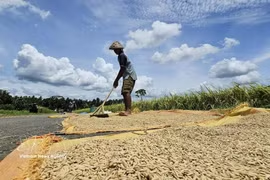
The Sehati initiative is designed to support Indonesia’s priorities of promoting grassroots economic growth amid limited fiscal resources. It focuses on three key objectives: strengthening food security, advancing the green economy and empowering rural communities.

Jakarta (VNA) – Indonesia’s Ministry of Villages and Development of Disadvantaged Regions, in collaboration with the World Bank (WB), on July 7 launched discussions and field assessments to prepare for the implementation of the national Integrated Green Economy and Food Self-Sufficiency (Sehati) Programme for the 2027–2031 period.

Rio Pongdapati, a representative of the ministry, said the programme, with an estimated budget of 600 million USD, will select beneficiary villages based on institutional capacity, financial management quality and implementation readiness.

The Sehati initiative is designed to support Indonesia’s priorities of promoting grassroots economic growth amid limited fiscal resources. It focuses on three key objectives: strengthening food security, advancing the green economy and empowering rural communities.

Following the planning phase scheduled for this year, the programme is expected to be launched in 2027, with a target of benefiting around 7,000 selected villages nationwide.

In Banyumas district of Central Java province, where initial preparations are under way, local authorities expect about 20 villages to participate in the programme. Each beneficiary village is expected to receive annual incentives worth 500 million IDR (27,800 USD), accompanied by training programmes and support for the development of essential infrastructure./.
VNA

See more

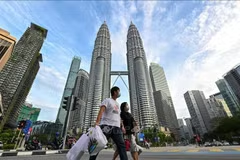
The Maybank Investment Banking Group (Maybank IBG) raises Malaysia’s 2026 gross domestic product (GDP) growth forecast to 4.9% from 4.4% previously (Photo: Xinhua/VNA)

Maybank IBG lifts Malaysia's 2026 GDP forecast to 4.9%

Maybank IBG said outlook for the second half of 2026 remains healthy, especially amid the sustained momentum in investment approvals, particularly in technology, renewable energy, industrial real estate and infrastructure segments.

Malaysia plans transit centre for foreign workers

Malaysia plans transit centre for foreign workers

Malaysia is planning to establish a transit centre capable of accommodating 1,000–2,000 foreign workers as part of efforts to strengthen migrant labour management, enhance security, and ease airport congestion.

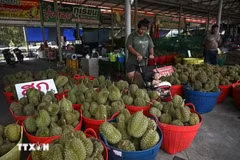
Vietnamese durian is promoted at an event in Beijing. (Photo: VNA)

Vietnamese fruit expands foothold in Chinese market

Thanks to its strategic location bordering Vietnam and other ASEAN countries, Guangxi remains a major gateway for tropical fruit entering China. Chinese media have also identified Vietnamese lychees as one of the country's favourite seasonal fruits.

An Aedes aegypti mosquito. (Photo: Xinhua/VNA)

Malaysia's dengue-related deaths rise nearly 70% in first half of 2026

Health authorities attributed the increase partly to a shift in the dominant dengue virus strain from DENV-2 to DENV-3. Rapid urbanisation, favourable weather conditions, mosquito breeding sites and increased population mobility have also contributed to the spread of the disease.

Malaysia targets 50% cut in food imports by 2050

Malaysia targets 50% cut in food imports by 2050

Malaysia has set a target of reducing its reliance on imported food by 50% by 2050 as part of efforts to strengthen national food security. The goal comes as the country's annual food import bill has reached around 80 billion MYR (20 billion USD).

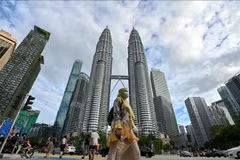
Statistics show that Malaysia records GDP growth of 5.4% in the first quarter, while research organisations forecast growth of 4.6–4.9% in the second quarter. ( Illustrative photo: XINHUA/VNA)

Malaysia's economy projected to grow faster in 2026

Despite the positive outlook, economists cautioned that downside risks remain in the second half of the year, requiring Malaysia to closely monitor geopolitical developments and uncertainties in global trade.

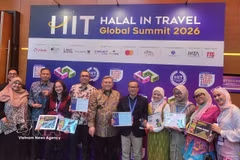
Many travel companies have been granted halal certifications. (Photo: VNA)

Indonesia eyes larger share of global Muslim tourism market by 2030

Indonesia boasts strong advantages in developing the sector as the country is home to 11.3% of the world's Muslim population, 17% of Asia's, and 86% of ASEAN's. Nineteen provinces have Muslim populations exceeding 90%, providing a solid foundation for tailored tourism products.

Electric vehicles produced by Chinese automaker BYD. (Photo: Xinhua/VNA)

Thailand attracts over 4.1 billion USD in EV investment

In 2025, electrified vehicles accounted for more than 44% of new vehicle registrations in Thailand, up sharply from 3% five years earlier. Hybrid vehicles represented 21.8% of new registrations, followed by BEVs at 19.6% and PHEVs at 2.9%.