Legal transparency key to making VIFC more attractive: experts

Dominic Scriven, Chairman and Founder of Dragon Capital, said legal clarity, consistency and predictability are essential to strengthening investor confidence, enabling long-term business planning and encouraging firm capital commitments to Vietnam.

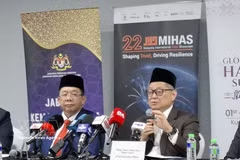
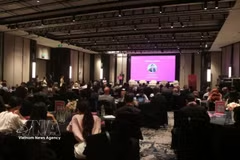
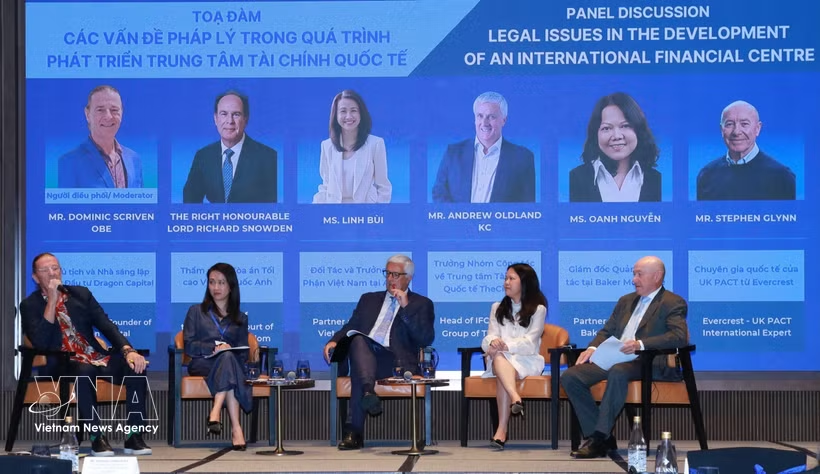
Speakers at the seminar (Photo: VNA)

Ho Chi Minh City (VNA) – To attract and retain international capital, the Vietnam International Financial Centre (VIFC) needs not only competitive financial mechanisms but also a clear, consistent and predictable legal framework, as legal certainty and effective dispute resolution can directly influence investment costs, risks and decisions, experts said at a conference held in Ho Chi Minh City on August 25.

The event was part of the Loseby Lecture 2026, jointly organised by the British Chamber of Commerce Vietnam (BritCham Vietnam) and Dragon Capital.

Legal transparency critical to international capital attraction

Speakers examined the role of the rule of law, judicial institutions and dispute resolution mechanisms in promoting cross-border investment and trade and supporting the VIFC’s development.

As Vietnam moves to build an internationally competitive VIFC, experts said efforts should go beyond preferential policies and expanded financial services to creating a legal environment that is clear, consistent and predictable.

Dominic Scriven, Chairman and Founder of Dragon Capital, said legal clarity, consistency and predictability are essential to strengthening investor confidence, enabling long-term business planning and encouraging firm capital commitments to Vietnam.

Denzel Eades, Chairman of BritCham Vietnam, stressed that a robust and transparent legal framework, together with independent judicial institutions, is fundamental to international investor confidence.

He said the British business community remains committed to sharing its experience in commercial law, dispute resolution and regulatory development as Vietnam pursues its ambition of building a world-class VIFC.

Common law can reduce risk premiums

Speaking online, Lord Richard Snowden, a justice of the UK Supreme Court, highlighted the potential role of Common Law in developing Vietnam’s IFC.

He noted Vietnam’s significant progress, particularly the adoption of legislation on a specialised IFC court in December 2025. Allowing English as a working language, permitting foreign law and providing for the appointment of qualified foreign judges are important elements of a judicial institution serving international transactions.
vnanet-potal-toa-dam-cac-van-de-phap-ly-trong-qua-trinh-phat-trien-trung-tam-tai-chinh-quoc-te-8981504.jpg
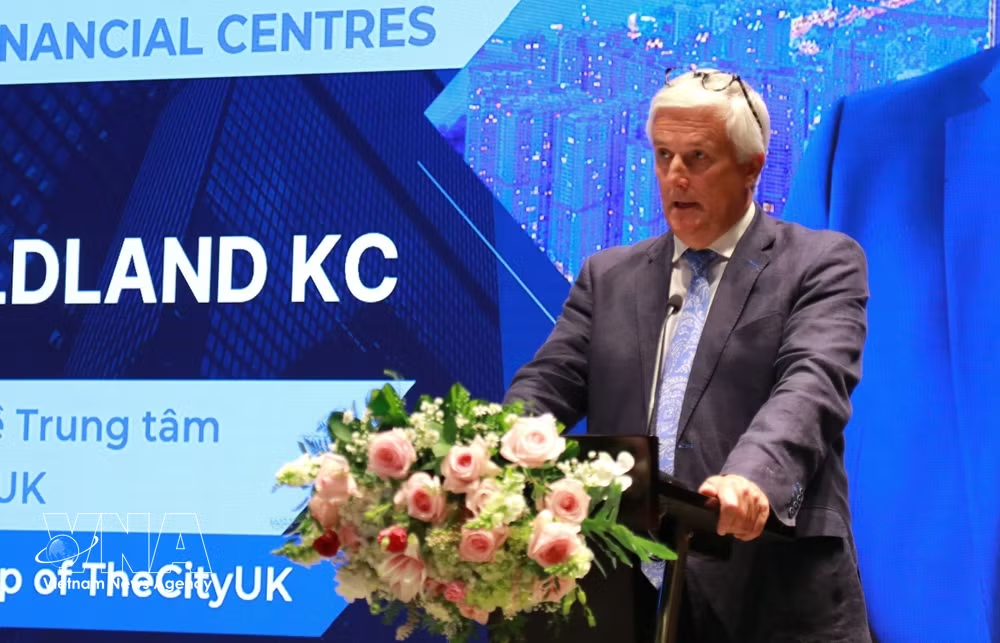
Andrew Oldland, head of TheCityUK’s IFC Working Group, speaks at the event. (Photo: VNA)

According to Snowden, applying Common Law principles and upholding the rule of law could bring tangible economic benefits as transactions can only flourish when parties have confidence and certainty about how disputes will be handled.

Where uncertainty exists, such as unfamiliar contractual terms, a foreign legal system or doubts about judicial independence, investors may be reluctant to enter into transactions. Even when they proceed, such uncertainty may be reflected in an additional “risk premium”, increasing transaction and financing costs and potentially reducing the number of deals.

However, Snowden noted that Vietnam’s IFC legal framework still requires further development, particularly in the enforcement of judgments. One notable gap is the lack of comprehensive provisions on collective enforcement mechanisms, including insolvency procedures.

Drawing on the experience of the Astana International Financial Centre (AIFC), Dubai International Financial Centre (DIFC) and Hong Kong, Andrew Oldland, head of TheCityUK’s IFC Working Group, said these centres share a common feature: specialised legal systems and courts distinct from those of their host countries. Such courts operate according to Common Law principles and maintain judicial independence from the wider national judicial system.

Another common feature is a pool of independent, experienced commercial judges capable of issuing well-reasoned judgments based on Common Law principles. They come from jurisdictions including Australia, New Zealand and Singapore, and many are recruited from former senior members of the judiciary or experienced lawyers in the UK.

Oldland said an IFC could be developed progressively by expanding permitted activities and broadening participation by different market players. However, a fully operational and independent court should be established from the outset. This is essential to building business confidence and providing a foundation for international trade and investment at Vietnam’s IFC./.
VNA

See more

Representatives of C.P. Vietnam, the Ministry of Agriculture and Environment, the Embassy of the Republic of Korea (RoK) in Vietnam and the Animal Husbandry Association of Vietnam attend a ceremony marking the export of the country’s first shipment of processed chicken to the RoK. (Photo: VNA)

Vietnam exports first shipment of processed chicken to RoK

Vietnam and the RoK announced the opening of the Korean market to processed chicken from Vietnam on April 22 this year. C.P. Vietnam became the first company to meet the requirements to ship Vietnam’s first consignment of processed chicken to the market.

A view of Vinh Loc 2 Industrial Park in My Yen commune, Tay Ninh province (Photo: VNA)

FDI surge fuels new real estate demand

According to Savills experts, FDI continues to flow into manufacturing, logistics, technology and digital infrastructure, changing property requirements for investors.

Lien Chieu Port is under construction in central Da Nang city. (Photo: VNA)

Energy infrastructure underpins marine economy development

The integrated investment in energy infrastructure will provide a vital infrastructure foundation for effectively harnessing the marine potential, helping realise the goal of making Vietnam a strong maritime nation and achieving sustainable and prosperous development from the sea./.

The Australia-Vietnam Policy Institute Forum in Ho Chi Minh City on August 25, 2026 discusses how Australian expertise, partnerships and capital can support Vietnam's growth, and how to build stronger connections between the two countries' business communities. (Photo: VNA)

Vietnam, Australia seek new space for economic cooperation

The Australia–Vietnam Policy Institute Forum was held in Ho Chi Minh City on August 25, bringing together policymakers, businesses, and organisations for discussing how the business communities of Australia and Vietnam can build stronger connections.

Officers from Thanh Hai Border Guard Station (Phu Thuy ward, Lam Dong province) patrol and monitor fishing vessels entering and leaving the port. (Photo: VNA)

Lam Dong province deploys 10 key measures to combat IUU fishing

The measures target key gaps, including ineligible fishing vessels, port controls, electronic fishing-trip data, seafood traceability and vessel monitoring system (VMS) violations. Authorities will also act against vessels detained by foreign authorities, submit weekly progress reports and draw up specific action plans.

Illustrative photo (Photo: VNA)

Vietnam promotes cooperation to remove barriers to rice trade with Philippines

Vietnam proposed studying a higher-level cooperation framework on rice trade to provide a more stable and long-term foundation for Vietnam-Philippine rice trade while balancing the interests of farmers, businesses and consumers, and providing sustainable livelihoods for rice growers and stable living conditions for Philippine consumers.

An overview of the 11th APEC Food Security Ministerial Meeting in Hangzhou on August 25. (Photo: VNA)

Vietnam proposes four strategic cooperation directions at APEC Food Security Ministerial Meeting

Vietnam’s proposals at the 11th APEC Food Security Ministerial Meeting, which took place in Hangzhou, China received broad support and consensus from participating economies. Several members expressed their desire to work with Vietnam to further build consensus, with a view to ensuring that the APEC Food Security Ministerial Meeting in Vietnam in 2027 will produce a shared vision and a substantive action programme.

Vietnam Post accelerates the adoption of modern technology, elevates logistics capabilities, and boosts the digital economy. (Photo: VNA)

Breakthrough opportunities for businesses in digital economy

Only when businesses view digital transformation as a fundamental change in their business models, while the State provides an enabling framework, data infrastructure and sufficiently broad markets for innovation, can the digital economy become a substantive growth driver.

A lecturer guides students on how to diagnose diseases in aquatic animals. (Photo: VNA)

Vietnam leans on digital workforce to unlock productivity boom

Vietnam needs a cohesive national strategy linking the State, enterprises, and training establishments. The strategy must prioritise standardising training to international norms and investing in technological infrastructure to boost national productivity.