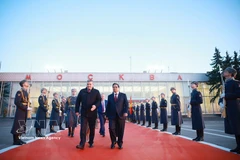
Hanoi (VNA) - The official visit to Vietnam by Lithuanian President Gitanas Nauseda and his spouse from June 11 to 12 is expected to help strengthen political trust and promote strategic connectivity between the two countries, particularly within the framework of ASEAN-EU cooperation.
This is a highly significant diplomatic event, demonstrating the two countries’ mutual regard for their traditional friendship and multifaceted cooperation, while also opening a new chapter in bilateral relations.
Vietnam, Lithuania enjoy fine traditional friendship
Vietnam and Lithuania officially established their diplomatic relations on March 18, 1992. Over the past more than three decades, the traditional friendship and multifaceted cooperation between the two countries have consistently been strengthened.
According to Vietnamese Ambassador to Poland and Lithuania Ha Hoang Hai, the outstanding characteristics of this relationship are political trust, goodwill for cooperation and high complementarity between the two economies despite differences in scale and geography.
Vietnam always considers Lithuania a sincere friend and partner in the Central Eastern European region, while Lithuania appreciates Vietnam's increasing role in Southeast Asia and in the Association of Southeast Asian Nations (ASEAN). The two countries share many similarities in their visions of sustainable development, international integration, digital transformation and adaptation to global challenges such as climate change, energy security or supply chains.
The two countries have also maintained coordination at multilateral forums such as the United Nations, the Asia-Europe Meeting (ASEM) and ASEAN-EU cooperation. Lithuania always supports important agreements between Vietnam and the EU such as the EU - Vietnam Free Trade Agreement (EVFTA) and the EU - Vietnam Investment Protection Agreement (EVIPA), creating an important legal and commercial foundation for expanding economic and investment cooperation between the two sides.
Promising economic-trade collaboration
The two countries have effectively taken advantage of cooperation under the EVFTA, and Lithuania was also one of the early EU member states to ratify the EVIPA.
Bilateral trade reached 192.7 million USD in 2023, 206.97 million USD in 2024, and 94.7 million USD in the first quarter of 2025.
In terms of investment, Lithuania currently has three active direct investment projects in Vietnam, with a total capital of approximately 260,000 USD, focusing on the fields of communications, science and technology, and health care.
During the COVID-19 pandemic, Lithuania was also among the first EU countries to donate vaccines to Vietnam, providing 168,700 doses of the AstraZeneca vaccine, contributing to Vietnam’s early containment of the pandemic.
Ambassador Hai assessed that Vietnam and Lithuania have many promising areas for cooperation, especially as both economies are highly complementary and are moving towards sustainable development models, green transition, and digital transformation. He noted that Vietnam, with a population of over 100 million and rapid growth, serves as a gateway to ASEAN, while Lithuania has advantages in logistics, food processing technology, pharmaceuticals, and clean energy. Therefore, taking advantage of the EVFTA and hastening the ratification process of the EVIPA will create more opportunities for businesses from both countries to access each other’s markets and connect the EU-ASEAN supply chains, particularly in the context of the global restructuring of value chains.
According to the ambassador, the two nations can boost partnerships in the fields of economy - trade - investment, digital transformation, innovation, financial technology, education – training, science and technology, high-tech agriculture, healthcare - pharmaceuticals, environmental protection, tourism - culture and high-quality labour. These areas not only bring economic efficiency but also contribute to enriching the foundation of people-to-people exchanges, and enhancing mutual understanding and connection between the two nations.
Hai said that the focuses of the visit will be talks and meetings between President Nauseda and leaders of the Vietnamese Party, State, Government and National Assembly. This is an opportunity for the two sides to assess the overall bilateral relationship, exchange strategic visions on regional and international issues of mutual concern, and propose new cooperation orientations in line with the development conditions of the two countries in the coming period.
The visit is expected to witness the signing of a number of cooperation documents in potential areas such as trade - investment, education - training, high-tech agriculture, health care, clean energy and digital transformation. In addition, investment promotion activities, a business forum and community connections between the two sides will also be organised to create practical conditions for more substantial and sustainable economic - trade cooperation.
He expressed his belief that the two countries have all the conditions to develop a more substantive, effective and comprehensive partnership, on the basis of complementary interests, mutual respect and the goal of sustainable development./.
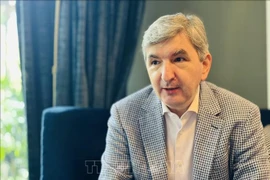
Lithuanian President’s visit to Vietnam holds historical significance: diplomat
As a member of the European Union (EU), Lithuania hopes that the two countries can fully utilise mechanisms such as the EU-Vietnam Free Trade Agreement (EVFTA) and the EU-Vietnam Investment Protection Agreement (EVIPA), and expects the President’s visit to be a strong boost to bilateral trade, Gaidys said.