Hanoi (VNA) – Although the Vietnamese economy is maintaining a positive trend, experts held that now is the time to accelerate and make breakthroughs to achieve the targets set for 2026.
Possitive growth trend so far
The economy’s positive trend has once again been reflected in a range of macroeconomic indicators for August and the first eight months of 2026.
State budget revenue in the eight-month period was estimated at 2.03 quadrillion VND (nearly 78 billion USD), equivalent to 80.2% of the annual target and up 16.2%. Public investment disbursement reached 509.6 trillion VND, or 49.8% of the plan, up 100.4 trillion VND in absolute terms and 3.5 percentage points in rate compared with the same period last year.
Another notable figure was registered foreign investment, which stood at about 40.63 billion USD in the eight-month period, up 55.4%. Disbursed foreign investment reached an estimated 17.25 billion USD, the highest eight-month level in five years and up 12% year-on-year.
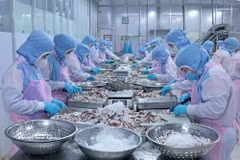
Meanwhile, total import – export turnover reached 770.14 billion USD, up 28.7% year-on-year.
The figures were reported by the Ministry of Finance at the Government’s regular meeting for August 2026.
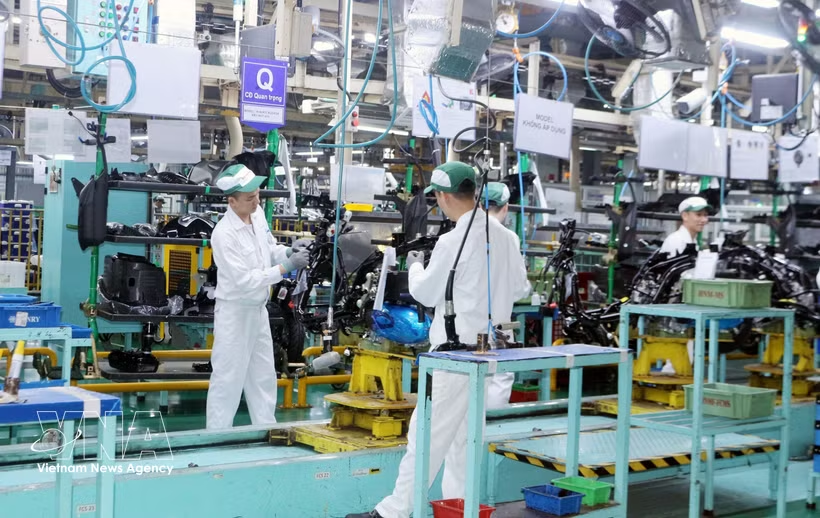
Deputy Minister of Finance Tran Quoc Phuong said agricultural, forestry and fishery production remained broadly stable, while the Index of Industrial Production (IIP) rose 14.4% in August and 11.9% in the first eight months compared to a year earlier.
In its release of Vietnam’s Manufacturing Purchasing Managers’ Index (PMI) for August 2026, which rose to 53.3 points from 52.9 points in July and remained above the 50-point threshold for the 14th consecutive month, S&P Global highlighted strong increases in both output and new orders, driven by new product development and improving customer demand.
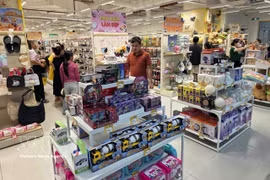
Total retail sales of goods and consumer service revenue went up 14.9% in August and 13.3% in the first eight months, equivalent to the full-year target of 13–15%.
The number of international visitors reached 1.99 million in August, up 18.4% year-on-year, bringing the total for the first eight months to 15.9 million, up 14.4%.
Meanwhile, 206,400 firms entered and re-entered the market in the first eight months, raising the number of active businesses to around 1.08 million as of the end of August, up 5.63% from the end of 2025.
More momentum needed for year-end race
The above indicators show that growth momentum continues to strengthen, but the final four months of the year will be a challenging sprint.
The Ministry of Finance has reported to the Government preliminary forecasts on the likelihood of achieving the full-year targets.
Of the 15 socio-economic development targets set for 2026, nine are forecast to be achieved or exceeded, while one, the rate of multidimensional household poverty reduction, is forecast to fall short.
The remaining five targets are subject to efforts to achieve them. All five are key economic targets, including GDP growth, per capita GDP, the share of the processing and manufacturing industry in GDP, the Consumer Price Index (CPI) expansion and labour productivity growth.
To promote growth, Prime Minister Le Minh Hung has asked ministries, sectors and localities to regularly review and update their growth scenarios on a monthly and quarterly basis, while proactively identifying bottlenecks affecting growth targets and focusing on removing them, particularly in sectors and localities that serve as growth drivers and still have significant room for expansion.
In 2026, the Government set a double-digit growth target, striving for GDP growth of at least 10%, along with CPI growth kept at 4.5%. However, with GDP growth standing at 8.18% in the first six months and average CPI pace reaching 4.45% in the first eight months, already close to the 4.5% ceiling, Vietnam will have to make substantial efforts in the remaining months of the year to achieve its targets.
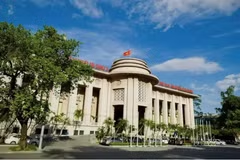
Speaking at the Government’s August meeting, Phuong said there is very little room for macroeconomic policy governance and that achieving the growth target is facing considerable pressure.
Meanwhile, to achieve full-year GDP growth of 10%, the Ministry of Finance estimated that GDP growth in the second half of the year will have to reach 11.7%. However, the current global and domestic context shows that considerable difficulties remain.
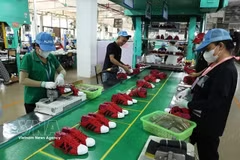
Although imports and exports have continued to grow strongly, trade deficit remains large, reaching 20.46 billion USD in the first eight months. Moreover, exports of several key products, including textiles and garments, footwear, wood products and toys, as well as some agricultural products such as cashew nuts and coffee, have either declined or recorded slow growth.
Public investment disbursement has also fallen short of expectations. Six ministries and sectors have disbursed less than 10% of their allocated funds or have yet to disburse any, while 14 major transport projects have disbursed less than 5%.
Traditional growth drivers are facing difficulties, which could affect overall economic expansion at a time when new growth drivers have yet to fully realise their potential.
Nevertheless, despite acknowledging the considerable pressure on the realisation of the double-digit growth target, the Ministry of Finance has continued to call on ministries, sectors and localities to resolutely and effectively implement the resolutions, conclusions and directions issued by the Party, National Assembly, Government and Prime Minister.
It has also called for steadfast efforts to achieve double-digit growth in 2026, maintain macroeconomic stability and keep inflation at around 4.5%.
In his remarks at the Government’s August meeting, PM Hung stressed that this is the time to “accelerate and make breakthroughs”, with the strongest possible determination to achieve the set targets.
To build momentum for the year-end race, one of the top priorities is to accelerate public investment disbursement, ensuring 100% of the allocated plan is disbursed without allowing funds to be concentrated in the final months of the year.
At the same time, the monetary policy should be governed flexibly, with credit directed towards production, exports and priority sectors and projects that serve as growth drivers. Efforts should also continue to remove difficulties facing production and business activities and long-delayed projects, while further improving the investment and business environment, institutions and policies./.