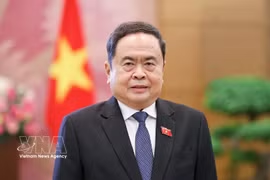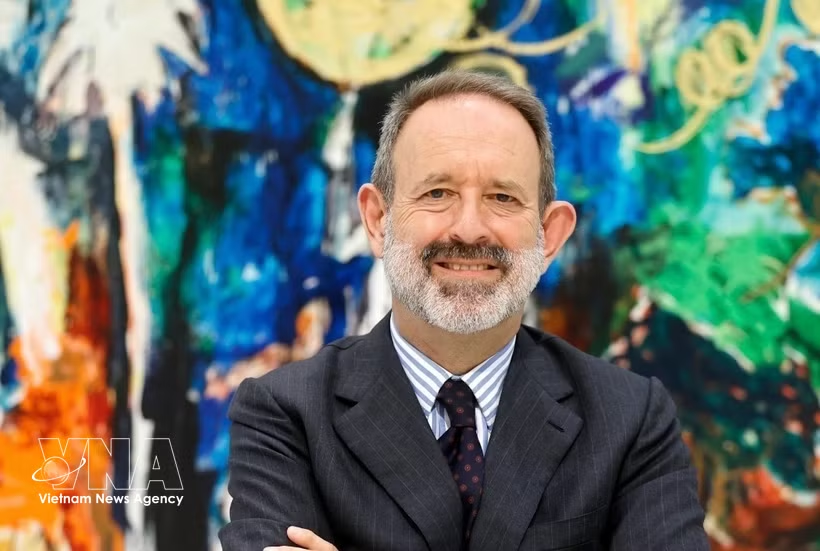
Hanoi (VNA) – Italian Ambassador to Vietnam Marco Della Seta has granted an interview to the Vietnam News Agency (VNA) ahead of the upcoming visit to Italy by National Assembly Chairman Tran Thanh Man, his spouse and a high-ranking delegation of Vietnam.
The following is the full text of the interview.
Reporter: Your Excellency, the visit to Italy by National Assembly Chairman Tran Thanh Man takes place as the Strategic Partnership between our two countries is flourishing across various sectors. How do you evaluate the significance of this visit in strengthening political trust and creating new momentum for cooperation between our two legislative bodies, as well as for the overall Vietnam-Italy relationship?
Ambassador Marco Della Seta: It is a great honour for Italy to welcome Chairman Tran Thanh Man and the high-level delegation of Vietnam to Rome and Milan. This visit is particularly significant as it takes place immediately following his re-election as Chairman of Vietnam's National Assembly and represents his first official visit abroad in this renewed capacity, thus conveying a strong political signal. Coming in the wake of the 14th National Congress of the Communist Party of Vietnam in January, and at a time of ongoing institutional developments and administrative reforms in Vietnam, the visit also provides a timely opportunity to present and illustrate the outcomes of this important phase of renewal. In this context, Chairman Man’s decision to visit Italy, which always follows these developments with great attention, is deeply appreciated and underscores the importance attributed to our country within Vietnam’s strategic outlook and the breadth and depth of our bilateral relationship.
Since the establishment of the Strategic Partnership 13 years ago, relations between Italy and Vietnam have steadily expanded and deepened, supported by the regular convening of bilateral mechanisms, particularly the annual Political Consultation and Joint Committee on Economic Cooperation meeting. This cooperation is further guided by successive action plans for the implementation of the Strategic Partnership, the latest of which, covering the 2025–2027 period, sets out ambitious objectives. While the first decade focused on building solid foundations, today our partnership has reached a stage of full maturity, reflecting the strength and quality of our bilateral engagement. Cooperation has evolved from an initial phase of broad-based collaboration into more structured and strategic engagement across key sectors, including science-technology, which has been identified as a key driver for Vietnam’s ambition to become an upper-middle-income country by 2030 and a high-income, developed country by 2045.
In this broader framework, this visit is particularly significant as it represents the first high-ranking mission led by the head of the legislative branch. Parliamentary diplomacy, though sometimes less visible, plays a fundamental role in strengthening bilateral relations. Parliaments lie at the core of the legislative and regulatory processes that shape cooperation across key areas such as trade, investment, energy, defence, and security. For two increasingly interconnected economies like Italy and Vietnam, dialogue between our legislative bodies is essential to ensure that our legal frameworks are aligned, forward-looking and supportive of our shared objectives. In this regard, Chairman Man’s visit offers a valuable opportunity to further enhance parliamentary cooperation and elevate it to an even higher level.
Looking ahead, I am confident that this visit will further strengthen mutual trust, consolidate the parliamentary dimension of our partnership, and inject fresh momentum into an already excellent bilateral relationship, with positive spillovers across all areas of cooperation.
Reporter: Italy is currently one of Vietnam’s leading trade partners within the EU, and Vietnam is a key trade partner for Italy within ASEAN. In your opinion, how will the implementation of the EVFTA and the efforts to promote the ratification of the EVIPA open up specific opportunities for the business communities of both countries, particularly in Italy’s areas of strength such as green technology, renewable energy, and industrial design?
Ambassador Marco Della Seta: Building on the strong momentum highlighted earlier, the upcoming visit of Chairman Man to Italy also offers a timely opportunity to further advance the economic dimension of our Strategic Partnership. This is because political trust and legislative dialogue translate into concrete opportunities for our business communities, supported by solid and predictable regulatory frameworks.
The foundations of our economic partnership are rooted in a long-standing relationship. Since the establishment of diplomatic ties in 1973, Italy has been among the earliest Western European partners of Vietnam, and this historical legacy has gradually evolved into a dynamic and forward-looking cooperation. Today, Vietnam is Italy’s leading trade partner within ASEAN, while Italy is Vietnam’s third-largest trade partner within the European Union, a position reinforced by frequent high-level exchanges and growing economic complementarities. Bilateral trade continues to demonstrate resilience and dynamism, reflecting not only quantitative growth – a 6% increase in trade turnover over the past year – but also an increasing qualitative dimension. Italy plays a key role in supporting Vietnam’s industrial modernisation, particularly in manufacturing, where Italian technologies and expertise contribute to enhancing productivity, quality, and added value.
In this context, the EU-Vietnam Free Trade Agreement (EVFTA), in force since 2020, has proven to be a cornerstone of our economic architecture. It has significantly facilitated market access and contributed to a steady expansion of bilateral trade, fostering greater integration between our economies. At the same time, the EU-Vietnam Investment Protection Agreement (EVIPA) represents the next crucial step. Italy ratified the Agreement in July 2023, becoming one of the first EU Member States to do so and reaffirming its strong confidence in Vietnam as a stable, reliable, and attractive destination for investment. Once fully ratified at by the European side, the EVIPA will provide enhanced legal certainty and protection, thereby encouraging a new wave of high-quality, long-term investments.
These frameworks are particularly important in unlocking opportunities in strategic sectors where Italy has well-recognised strengths, such as green technology, renewable energy, and industrial design. Italy is actively contributing to Vietnam’s green transition, including through its participation in the Just Energy Transition Partnership (JETP), by providing advanced technological solutions, expertise and financing. A prime example of this engagement is the Bac Ai pumped-storage hydropower project, to which the Italian financial institution Cassa Depositi e Prestiti (CDP) is contributing with 80 million EUR. At the same time, there is growing potential to expand cooperation in areas such as sustainable infrastructure, circular economy, and smart manufacturing. In the agri-business sector, cooperation is also evolving from traditional trade toward more innovative and technology-driven partnerships in food processing, traceability, and smart agriculture, with the aim of enhancing sustainability, food security, and added value for both countries.
Against this backdrop, the combined impact of the EVFTA and the future entry into force of the EVIPA is set to further strengthen trade and investment ties, while opening new avenues for cooperation in innovation, digital transformation, and sustainable development. Together, these instruments are laying the foundations for a deeper, more resilient, and forward-looking partnership between Italy and Vietnam, capable of delivering tangible benefits to our business communities and our citizens alike.
Reporter: Beyond political and economic cooperation, people-to-people exchanges and cultural cooperation have always been vital "bridges" connecting our two nations. Could you share some of the key projects or initiatives that the Embassy is currently implementing to enhance mutual understanding between our peoples, especially as both nations work toward sustainable development goals?
Ambassador Marco Della Seta: People-to-people exchanges and cultural cooperation are indeed among the most vital pillars of the relationship between Italy and Vietnam, as they create lasting connections that go beyond institutional and economic ties. Italy’s rich cultural heritage and contemporary creativity continue to represent important points of connection with Vietnam, where there is a growing interest in Italian culture in its many forms – from music and cinema to design, fashion and gastronomy. In this regard, the recent inscription of Italian Cuisine on the UNESCO Representative List of the Intangible Cultural Heritage of Humanity is not only a recognition of a culinary tradition, but also of a broader way of life based on quality, conviviality, and cultural identity, which are values that resonate strongly with Vietnamese society.
In this spirit, last year alone the Embassy in Hanoi and the Consulate General in Ho Chi Minh City organised around 70 cultural events, promoting a wide range of initiatives throughout the year aimed at fostering mutual understanding and dialogue. These include flagship events such as the Weeks of Italian Language, Cinema and Cuisine, which bring Italian culture closer to Vietnamese audiences in an accessible and engaging way. Particular attention is also devoted to innovative sectors, notably through the Italian Design Day, as well as to high value-added fields, through initiatives like the Italian Space Day. These events consistently attract strong participation and keen interest from the Vietnamese public, reflecting the growing cultural affinity between our two countries. At the same time, we are working closely with the Vietnamese Government toward the establishment of an Italian Cultural Institute in Hanoi, which would further enhance the effectiveness and reach of our cultural action.
Cultural cooperation is also increasingly a two-way exchange. In this regard, I am particularly pleased to note that Vietnam will participate for the first time this year in the Venice Biennale with a national pavilion. This represents an important milestone and a powerful symbol of Vietnam’s dynamic cultural scene gaining further international visibility. At the same time, Vietnamese directors and industry professionals are increasingly taking part in film festivals across Italy, ranging from the most renowned events – starting with Venice – to those specifically dedicated to Asian cinema, such as the Rome Asian Film Festival and the Udine Far East Film Festival, further strengthening cultural exchanges and mutual understanding between our artistic communities.
Beyond the cultural sphere, our people-to-people ties are strongly reinforced by cooperation in education, research, science and technology. Since 2016, the presence of an Italian Scientific Attaché in Hanoi has contributed to strengthening links between universities and research centers, leading to over 170 active agreements between Italian and Vietnamese academic partners. We are currently implementing the 8th Executive Protocol on Scientific Cooperation, focusing on key areas such as climate change, water management, space science, and smart agriculture – fields that are directly aligned with Vietnam’s sustainable development priorities. This engagement is further supported by the activities of the Italian Agency for Development Cooperation (AICS) in Hanoi, which contributes to projects promoting ecological sustainability and climate resilience.
Chairman Tran Thanh Man’s visit reflects such a forward-looking nature of our partnership. Alongside high-level institutional meetings in Rome, including with President Sergio Mattarella, he will engage with Italy’s economic and innovation ecosystem and open a policy dialogue in Milan, fostering exchanges between institutions and businesses. This will inject new momentum into our already strong and dynamic partnership.
Reporter: Thank you for your interview./.