NA President visits Beijing legislative liaison station

Praising the model of bringing legislative work closer to grassroots communities, voters and the public in Nanmofang and Beijing at large, National Assembly (NA) President Tran Thanh Man said Vietnam attaches importance to legislative work in building a socialist rule-of-law state of the people, by the people and for the people. That includes listening to experts, intellectuals, businesses, voters and the general public, especially those directly affected by policies and laws.

NA President Tran Thanh Man (centre) attends an experience-sharing seminar with Beijing’s people’s congresses on October 11. (Photo: VNA)

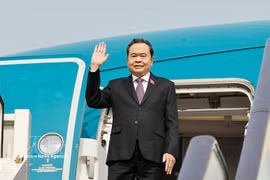
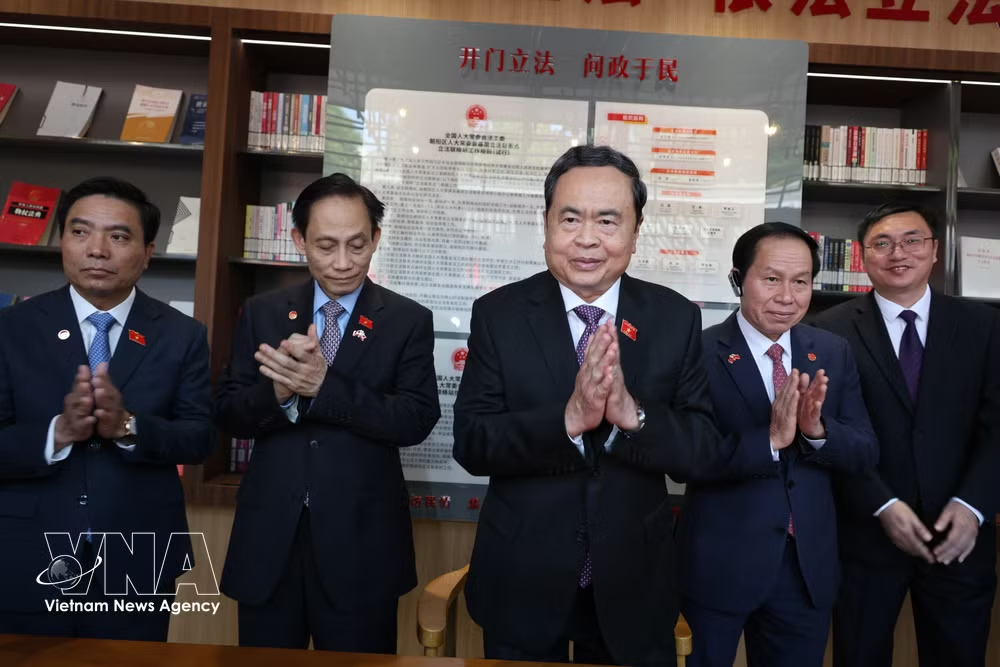
Beijing (VNA) - National Assembly (NA) President Tran Thanh Man toured the Nanmofang township legislative liaison station in Beijing’s Chaoyang district shortly after arriving for an official visit to China on October 11.

NA President Man was briefed on effective and innovative approaches the station uses to collect public feedback on draft legal documents. Those give deputies to people’s congresses at all levels more chances to engage voters and feed public concerns into the drafting, review and adoption of policy documents.

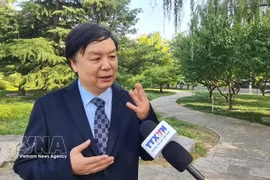
The top Vietnamese legislator later co-chaired a discussion with Wang Dongming, Vice Chairman of the Standing Committee of China’s National People’s Congress (NPC), on legislative affairs, grassroots democracy and other issues of shared interest.

Li Xiuling, Chairman of the Standing Committee of the Beijing Municipal People’s Congress, praised the visit’s significance, noting that the guest’s first stop was at the grassroots to learn about legislative work and voter engagement mechanisms. That matters for the two countries to share experience in building socialist democracy, he said.

Describing China’s “whole-process people’s democracy”, Li said the model spans more than 70 years and covers the people’s congress system, political consultation, multiparty cooperation under the Communist Party of China (CPC) leadership, and regional ethnic autonomy. It runs through the entire cycle of elections, consultation, decision-making, implementation and oversight.
vnanet-l.jpg
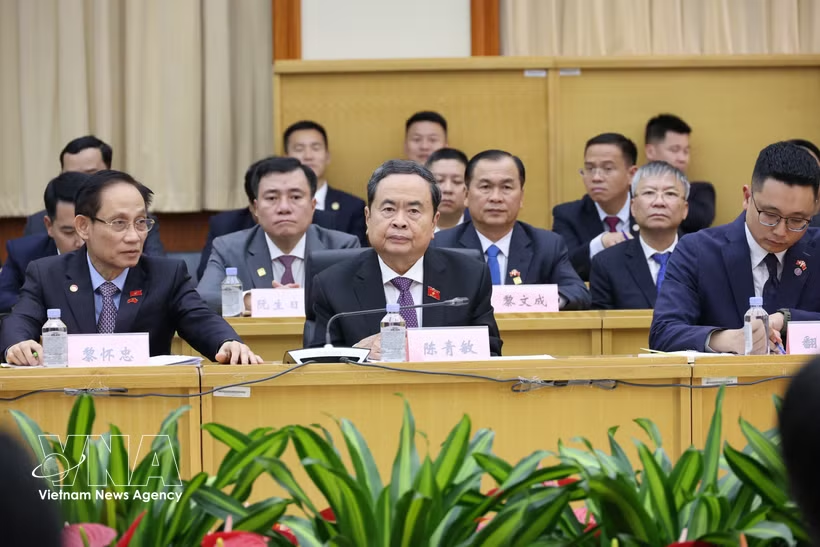
NA President Tran Thanh Man and the Vietnamese delegation attend an experience-sharing seminar with Beijing’s people’s congresses on October 11. (Photo: VNA)

China consistently combines CPC leadership, the people’s role as masters of the country and law-based governance, creating distinctive advantages for the socialist system with Chinese characteristics. The model grew out of integrating Marxist principles with China’s realities and traditional culture, he said.

On Beijing’s own practices, Li said grassroots legislative liaison stations and “deputies’ homes” have been set up across the city. Linked to the city’s 12345 public service hotline, they collect public feedback on everything from draft policy and legal documents to pressing issues in daily life. They have become an innovative way to put whole-process people’s democracy into practice and bring legislative work closer to communities across the capital.

NA President Man said his visit aims to turn high-level consensus into concrete action, lift cooperation between the Vietnamese NA and China’s NPC, deepen political trust and make legislative cooperation a pillar of ties between the two Parties and countries.

Praising the model of bringing legislative work closer to grassroots communities, voters and the public in Nanmofang and Beijing at large, he said Vietnam attaches importance to legislative work in building a socialist rule-of-law state of the people, by the people and for the people. That includes listening to experts, intellectuals, businesses, voters and the general public, especially those directly affected by policies and laws.

Channels for public feedback at the grassroots level keep expanding. Beyond traditional face-to-face formats such as seminars, discussions and conferences, online platforms and digital and smart technologies are increasingly used to make consultations more democratic, objective and inclusive and improve policies and laws.

According to him, the Vietnamese NA is shifting its legislative mindset from management to enabling development, aiming to create an optimal policy and legal environment for rapid and sustainable growth. Treating digital transformation as a key, ongoing task, it has taken the lead in using artificial intelligence and virtual assistants to draft and refine the legal system.
vnanet-e.jpg
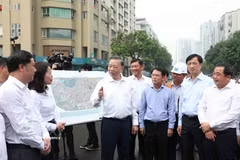
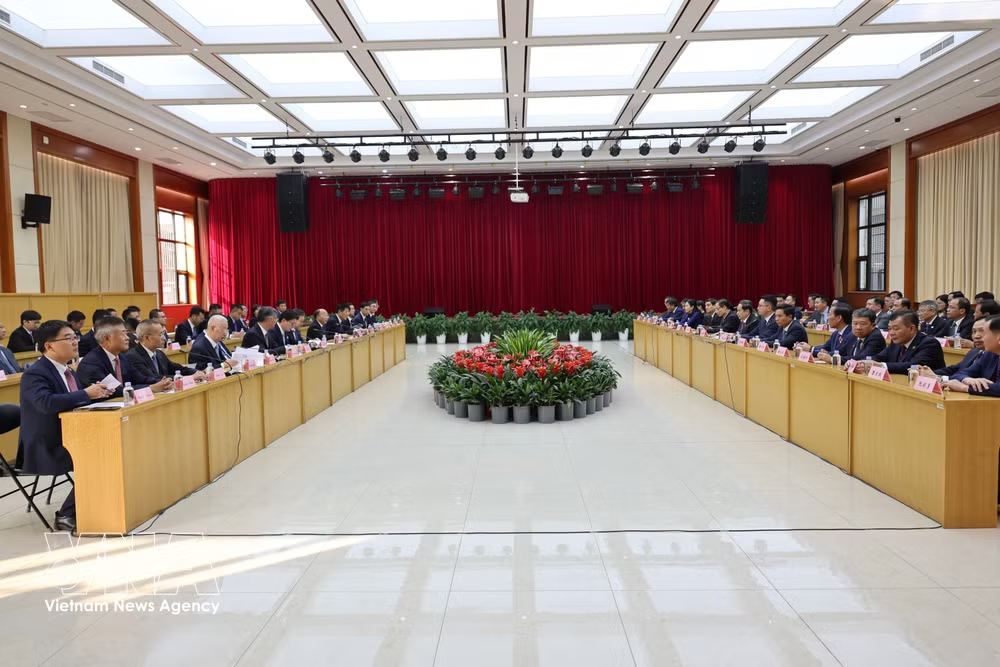
NA President Tran Thanh Man visits the Nanmofang township legislative liaison station (Photo: VNA)

He said effective legislative practices offer valuable opportunities for cooperation and experience-sharing between the two legislatures, particularly between their specialised committees, consultative and local people’s congress bodies, and among elected representatives.

Established in 2022, the Nanmofang station has become a model for gathering public opinion on draft laws and related policies. People’s congresses at various levels have so far adopted 177 opinions and feedback items covering 30 draft laws, contributing to legislative work./.
​

VNA

See more

A building collapses and vehicles are damaged following an earthquake in Penonomé, Coclé province, central Panama, on October 9. (Photo: Xinhua)

Vietnam sends condolences to Panama over serious earthquake

General Secretary of the Communist Party of Vietnam Central Committee and President To Lam on October 11 sent a message of condolences to Panamanian President José Raúl Mulino Quintero following an earthquake on October 9 that injured many people and caused heavy damage.

Ambassador Do Hung Viet, Permanent Representative of Vietnam to the UN (Photo published by VNA)

Vietnam pledges to advance rule of law at home, uphold law-based global order at UN

As it updates its legal framework, Vietnam has also put in place rules governing digital technologies, personal data protection, cybersecurity, artificial intelligence and digital transformation. The country upgraded its National Legal Database and expanded digital platforms to broaden access to legal information, education and aid.

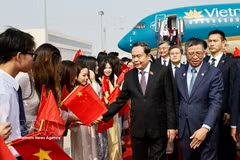
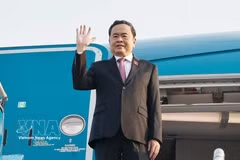
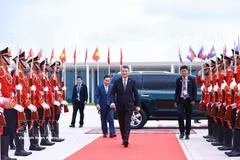
President of the National Assembly (NA) Tran Thanh Man and a high-ranking Vietnamese delegation arrive at Beijing Capital International Airport at noon on October 11 (local time), beginning an official visit to China. (Photo: VNA)

NA President arrives in Beijing, beginning official visit to China

Vietnam–China relations have continued to develop, particularly following reciprocal visits by General Secretary of the Communist Party of Vietnam Central Committee and President To Lam and General Secretary of the Communist Party of China Central Committee and President of China Xi Jinping.

National Assembly President Tran Thanh Man leaves Hanoi on October 11 for an official visit to China. (Photo: VNA)

National Assembly President departs for official visit to China

The visit aims to further implement the foreign policy set out at the 14th National Party Congress, enhance the effectiveness of cooperation between Vietnam’s National Assembly and the National People’s Congress of China, and reaffirm the pivotal role of parliamentary cooperation in the overall Vietnam-China comprehensive strategic cooperative partnership.

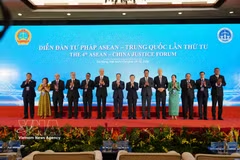
Officials pose for a group photo at the opening ceremony of the fourth ASEAN–China Justice Forum in Da Nang on October 10, 2026. (Photo: VNA)

Da Nang hosts fourth ASEAN–China Justice Forum

The forum offers a venue for participants to share experience in handling cross-border criminal cases and civil and commercial disputes, as well as to explore ways for more effective cooperation in line with national laws and international treaties.

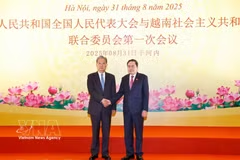
President of the National Assembly Tran Thanh Man (right) and Chairman of the Standing Committee of the National People’s Congress of China Zhao Leji at the first session of the Cooperation Committee between the two legislative bodies in Hanoi on August 31, 2025 (Photo: VNA)

Top legislator’s visit to step up Vietnam–China parliamentary ties

NA President Tran Thanh Man's visit is expected to mark further progress in cooperation between the two Parties and countries, as well as between their parliaments, helping to further develop the Comprehensive Strategic Cooperative Partnership and the Vietnam–China community with a shared future that carries strategic significance.

Prime Minister Le Minh Hung leaves Phnom Penh at noon October 10, concluding the wo-day official visit to Cambodia. (Photo: VNA)

PM Le Minh Hung wraps up official visit to Cambodia

PM Le Minh Hung’s first official visit to Cambodia as head of the Vietnamese Government is an important diplomatic activity, demonstrating the high priority that the Party, State and Government of Vietnam attach to relations with Cambodia.

Prime Minister Le Minh Hung meets with staff of the Vietnamese Embassy and representatives of the Vietnamese community in Cambodia on October 10, 2026. (Photo: VNA)

PM pledges continued support for Vietnamese community in Cambodia

Sharing the difficulties facing Vietnamese-origin people in Cambodia, PM Le Minh Hung said the Vietnamese Government will continue to urge Cambodia to provide favourable conditions for the community to stabilise their lives and secure sustainable livelihoods.

Prime Minister Le Minh Hung meets with Cambodian King Norodom Sihamoni at the Royal Palace in Phnom Penh on October 10, 2026. (Photo: VNA)

Vietnamese PM pays courtesy visits to Cambodian King, Queen Mother

King Norodom Sihamoni voiced firm confidence that under the leadership of the Communist Party of Vietnam, headed by General Secretary and President To Lam, and through the dedicated efforts by the Vietnamese Government, National Assembly, and people, the country will continue to achieve even greater accomplishments in its national construction and development.