NA President’s China visit to drive high-level strategic exchanges: Expert

The outcomes of NA President Man’s visit and the second session will give the comprehensive strategic cooperative partnership new momentum in institutional mechanisms, substantive cooperation and regional coordination.

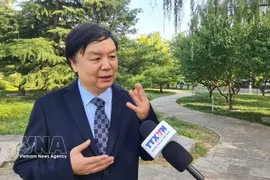
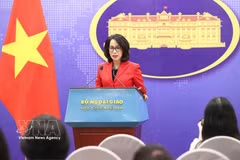
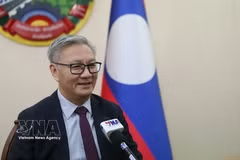
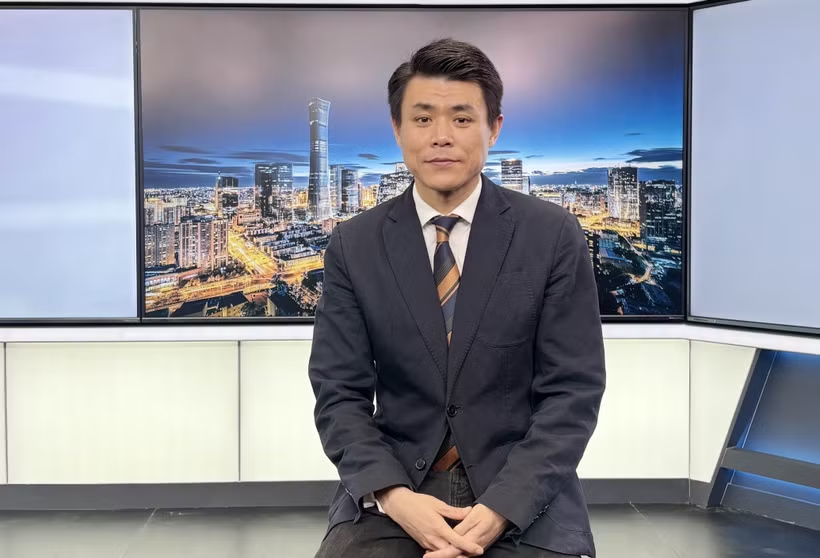
Journalist Wei Wei, a Vietnam studies expert and head of the Vietnamese language service of China Media Group (Photo published by VNA)

Beijing (VNA) – National Assembly President Tran Thanh Man’s official visit to China and co-chairing of the second session of the two legislatures’ Cooperation Committee marks an important mechanism to realise the common perceptions by their high-ranking Party leaders and complete the chain of high-level exchanges of significant strategic value.

It was stated by journalist Wei Wei, a Vietnam studies expert and head of the Vietnamese language service of China Media Group in an interview recently granted to Vietnam News Agency reporters based in Beijing.

Wei said the visit, from October 11 to 15, will consolidate political trust between the two legislatures and open more channels to convey strategic common understandings. Both countries are socialist states, and parliamentary exchanges complement top-level strategic contacts.

The session aims to carry the two Party chiefs’ shared vision of a Vietnam-China Community with a shared future of strategic significance down to the parliamentary level. The two sides will share experience in state governance, democracy building and the rule of law. They will also reaffirm core political stances, including mutual respect, adherence to the one-China principle, and proper management and settlement of differences. The goal is to keep bilateral ties on a steady, correct course.

The trip will also give economic and trade ties, connectivity and emerging industries a firmer legal footing. Two-way trade remains above 250 billion USD, and industrial and supply chains are growing more closely linked.

Lawmakers will focus on cross-border trade, customs clearance, digital economy, new energy and agriculture. They will seek to clear institutional barriers and speed delivery of cooperation agreements. The Cooperation Committee mechanism should also help refine laws on investment protection, border cooperation and intellectual property, among others.

Wei said the visit will also widen and deepen people-to-people exchanges. The two sides will use the Cooperation Committee to propel regular contacts among local elected bodies, youth, media outlets and cultural establishments, while carrying forward the shared revolutionary heritage. That should improve mutual understanding, particularly among the youth. He stressed the role of legislatures in strengthening the popular base for bilateral friendship and rooting it more firmly among their people.

He said the outcomes of NA President Man’s visit and the second session will give the comprehensive strategic cooperative partnership new momentum in institutional mechanisms, substantive cooperation and regional coordination. That, in turn, will advance the building of the Vietnam-China Community.

First, the two sides will upgrade regular cooperation mechanisms between their legislatures and complete the institutional framework of ties. The session will lock in a regular, long-term dialogue between the National People’s Congress of China and the Vietnamese NA. It will create a multi-tiered network linking senior leaders, Governments, legislatures, and the Chinese People’s Political Consultative Conference with the Vietnam Fatherland Front.

As a specialised forum, the Cooperation Committee can serve as a regular platform to discuss major bilateral issues and conduct oversight-level exchanges on border management, security and trade cooperation. That will create a full cycle running from “high-level shared understandings – institutionalisation through legislation – local delivery”.

Second, both sides will raise the quality of cooperation across fields to unlock shared development gains. Building on the parliamentary dialogue, they will push ahead with upgrades to border gates, cross-border logistics, agricultural trade and industrial chain cooperation in manufacturing.

In emerging areas such as the “new-generation three new products” and digital economy, the legislatures can speed up coordinated supportive policies, draw more two-way corporate investment and expand cooperation among border provinces, lifting incomes in border areas. Legislative coordination will also help settle trade disputes and improve the business climate, so that gains from trade and investment reach more people in both countries, he said.

Third, they will bolster regional multilateral coordination to maintain peace and stability. With the regional landscape complex and unpredictable, the legislatures will align their stances and keep talking on regional issues within ASEAN and other frameworks. They will rely on dialogue and consultation to properly manage and settle differences.

The two sides will work to uphold ASEAN centrality, support each other in multilateral mechanisms, jointly advance the interests of developing countries, foster a peaceful, secure and supportive environment for development, and boost joint work in regional issues, Wei added./.
​

VNA

See more

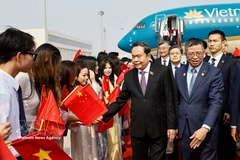
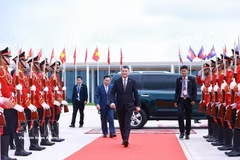
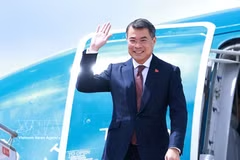
President of the National Assembly (NA) Tran Thanh Man and a high-ranking Vietnamese delegation arrive at Beijing Capital International Airport at noon on October 11 (local time), beginning an official visit to China. (Photo: VNA)

NA President arrives in Beijing, beginning official visit to China

Vietnam–China relations have continued to develop, particularly following reciprocal visits by General Secretary of the Communist Party of Vietnam Central Committee and President To Lam and General Secretary of the Communist Party of China Central Committee and President of China Xi Jinping.

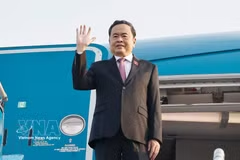
National Assembly President Tran Thanh Man leaves Hanoi on October 11 for an official visit to China. (Photo: VNA)

National Assembly President departs for official visit to China

The visit aims to further implement the foreign policy set out at the 14th National Party Congress, enhance the effectiveness of cooperation between Vietnam’s National Assembly and the National People’s Congress of China, and reaffirm the pivotal role of parliamentary cooperation in the overall Vietnam-China comprehensive strategic cooperative partnership.

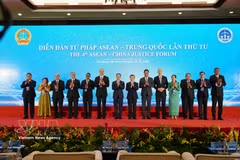
Officials pose for a group photo at the opening ceremony of the fourth ASEAN–China Justice Forum in Da Nang on October 10, 2026. (Photo: VNA)

Da Nang hosts fourth ASEAN–China Justice Forum

The forum offers a venue for participants to share experience in handling cross-border criminal cases and civil and commercial disputes, as well as to explore ways for more effective cooperation in line with national laws and international treaties.

Prime Minister Le Minh Hung leaves Phnom Penh at noon October 10, concluding the wo-day official visit to Cambodia. (Photo: VNA)

PM Le Minh Hung wraps up official visit to Cambodia

PM Le Minh Hung’s first official visit to Cambodia as head of the Vietnamese Government is an important diplomatic activity, demonstrating the high priority that the Party, State and Government of Vietnam attach to relations with Cambodia.

Prime Minister Le Minh Hung meets with staff of the Vietnamese Embassy and representatives of the Vietnamese community in Cambodia on October 10, 2026. (Photo: VNA)

PM pledges continued support for Vietnamese community in Cambodia

Sharing the difficulties facing Vietnamese-origin people in Cambodia, PM Le Minh Hung said the Vietnamese Government will continue to urge Cambodia to provide favourable conditions for the community to stabilise their lives and secure sustainable livelihoods.

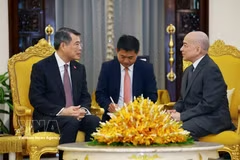
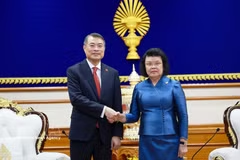
Prime Minister Le Minh Hung meets with Cambodian King Norodom Sihamoni at the Royal Palace in Phnom Penh on October 10, 2026. (Photo: VNA)

Vietnamese PM pays courtesy visits to Cambodian King, Queen Mother

King Norodom Sihamoni voiced firm confidence that under the leadership of the Communist Party of Vietnam, headed by General Secretary and President To Lam, and through the dedicated efforts by the Vietnamese Government, National Assembly, and people, the country will continue to achieve even greater accomplishments in its national construction and development.

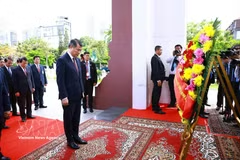
Prime Minister Le Minh Hung pays tribute to late Cambodian King Norodom Sihanouk (Photo: VNA)

PM pays tribute to King Norodom Sihanouk, lays wreaths at Cambodian monuments

Prime Minister Le Minh Hung’s official visit to Cambodia on October 9-10, at the invitation of Prime Minister Hun Manet, marks a particularly significant diplomatic milestone. It underscores the consistent priorities of Vietnam’s foreign policy in the new term, including proactive engagement, strengthened political trust and a stronger focus on translating bilateral commitments into tangible outcomes.

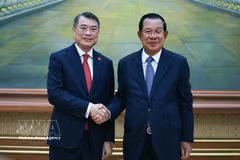
Prime Minister Le Minh Hung (left) and CPP President and President of the Cambodian Senate Hun Sen ( Photo: VNA)

Prime Minister meets with Cambodian People's Party, Senate leader

To further advance bilateral ties in the new era, the two leaders agreed to continue making full use of existing cooperation mechanisms across all channels, including meetings between the two Parties, promote exchanges between young leaders and youth from both countries, and expand cooperation between their legislative, executive and judicial bodies, people’s organisations and localities.

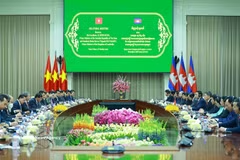
Prime Minister Le Minh Hung holds talks with his Cambodian counterpart Hun Manet in Phnom Penh on October 9. (Photo: VNA)

Vietnam, Cambodia seek to bolster all-round ties

The two PMs expressed their satisfaction with the positive development of Vietnam-Cambodia relations in recent years. Political ties have continued to be consolidated, with political trust strengthened through regular high-level visits and contacts.

Prime Minister Le Minh Hung arrives at Techo International Airport in Phnom Penh on the afternoon of October 9, beginning an official visit to Cambodia at the invitation of Cambodian Prime Minister Hun Manet. (Photo: VNA)

PM arrives in Phnom Penh, starting official visit to Cambodia

This is PM Hung’s first official visit to Cambodia. It holds particular significance, demonstrating the high priority that the Party, State and Government of Vietnam attach to relations with Cambodia and contributing to further deepening the bilateral ties of “good neighbourliness, traditional friendship, comprehensive cooperation and long-term sustainability”.