Vietnam pledges to advance rule of law at home, uphold law-based global order at UN

As it updates its legal framework, Vietnam has also put in place rules governing digital technologies, personal data protection, cybersecurity, artificial intelligence and digital transformation. The country upgraded its National Legal Database and expanded digital platforms to broaden access to legal information, education and aid.

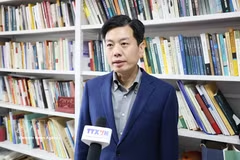
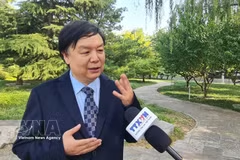
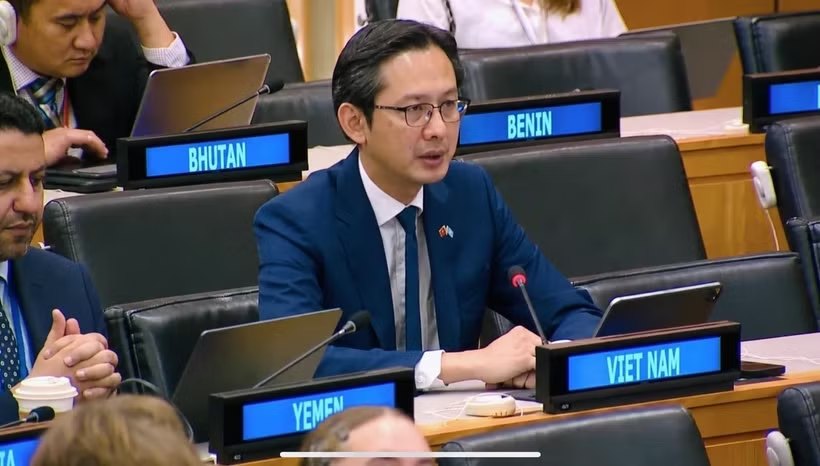
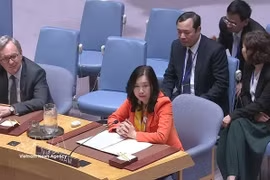
Ambassador Do Hung Viet, Permanent Representative of Vietnam to the UN (Photo published by VNA)

New York (VNA) – Vietnam remains steadfast in advancing the rule of law at home and working closely with partners to uphold an international order based on international law, said Ambassador Do Hung Viet, Permanent Representative of Vietnam to the United Nations (UN).

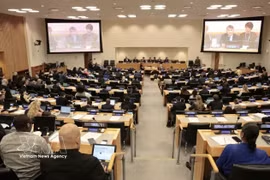
Viet spoke at a meeting of the UN General Assembly’s Legal Committee (Committee 6) during its 81st session in New York on October 7-10, which took up the agenda item “Rule of law at the national and international levels”.

He stressed that international law’s effectiveness and credibility hinge on states interpreting and applying it in good faith, consistently and without selectivity. That applies in particular to the core principles of the UN Charter, including sovereign equality, respect for territorial integrity, non-interference in internal affairs, the ban on the threat or use of force, peaceful settlement of disputes, and good-faith fulfillment of international obligations through concrete action.

Turning to maritime issues, he affirmed that the 1982 UN Convention on the Law of the Sea (UNCLOS) provides the legal framework for all activities at sea. All maritime claims and conduct, as well as the settlement of maritime disputes, including those in the East Sea, must comply with UNCLOS. Until disputes are finally settled, the parties involved should exercise restraint, manage differences responsibly and avoid actions that could escalate or further complicate the situation.

Linking the rule of law at the international and national levels, he outlined Vietnam’s recent drive to overhaul law-making and enforcement. The effort includes reviewing thousands of legal documents for amendment, replacement or repeal to address overlaps and inconsistencies and clear barriers to development; continued improvements to criminal and fisheries legislation, stronger copyright and intellectual property protection, and wider legal outreach to citizens and enterprises.

As it updates its legal framework, Vietnam has also put in place rules governing digital technologies, personal data protection, cybersecurity, artificial intelligence and digital transformation. The country upgraded its National Legal Database and expanded digital platforms to broaden access to legal information, education and aid, he said.

On Vietnam’s contributions to the rule of law internationally, he said the country was the third in the world to ratify the UN Convention against Cybercrime (Hanoi Convention). It is also preparing for full and effective implementation of the Agreement on the Conservation and Sustainable Use of Marine Biological Diversity of Areas beyond National Jurisdiction (BBNJ Agreement), and continues to contribute actively to international legal forums and bodies.

Participants affirmed that the rule of law underpins peace, security, international cooperation and sustainable development, and called for peaceful dispute settlement, justice and judicial access. They praised the role of UN bodies in codifying and progressively developing international law, and urged more substantive dialogue and timely exchanges between Committee 6 and member states so that international law reflects the perspectives and legal practices of different regions and legal systems, particularly the contributions of developing countries.

The Legal Committee is one of six main committees of the UN General Assembly, comprising all 193 member states. It considers legal matters and promotes the codification and progressive development of international law. The UN General Assembly has taken up “the rule of law at the national and international levels” item annually since 2006./.
​

VNA

See more

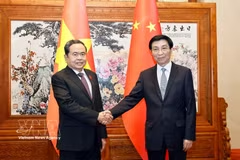
National Assembly President Tran Thanh Man (left) meets with Chairman of the National Committee of the Chinese People’s Political Consultative Conference Wang Huning in Beijing on October 11. (Photo: VNA)

Vietnam, China to boost legislative, people-to-people exchanges

To further consolidate the three pillars of political, material and social foundations underpinning ties between the two Parties and countries, NA President Man proposed maintaining exchanges at all levels, strengthening national defence-security ties, and supporting each other’s development and international standing.

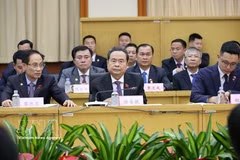
NA President Tran Thanh Man (centre) attends an experience-sharing seminar with Beijing’s people’s congresses on October 11. (Photo: VNA)

NA President visits Beijing legislative liaison station

Praising the model of bringing legislative work closer to grassroots communities, voters and the public in Nanmofang and Beijing at large, National Assembly (NA) President Tran Thanh Man said Vietnam attaches importance to legislative work in building a socialist rule-of-law state of the people, by the people and for the people. That includes listening to experts, intellectuals, businesses, voters and the general public, especially those directly affected by policies and laws.

A building collapses and vehicles are damaged following an earthquake in Penonomé, Coclé province, central Panama, on October 9. (Photo: Xinhua)

Vietnam sends condolences to Panama over serious earthquake

General Secretary of the Communist Party of Vietnam Central Committee and President To Lam on October 11 sent a message of condolences to Panamanian President José Raúl Mulino Quintero following an earthquake on October 9 that injured many people and caused heavy damage.

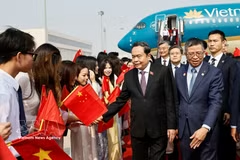
President of the National Assembly (NA) Tran Thanh Man and a high-ranking Vietnamese delegation arrive at Beijing Capital International Airport at noon on October 11 (local time), beginning an official visit to China. (Photo: VNA)

NA President arrives in Beijing, beginning official visit to China

Vietnam–China relations have continued to develop, particularly following reciprocal visits by General Secretary of the Communist Party of Vietnam Central Committee and President To Lam and General Secretary of the Communist Party of China Central Committee and President of China Xi Jinping.

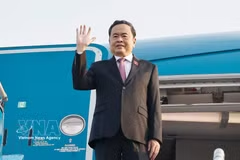
National Assembly President Tran Thanh Man leaves Hanoi on October 11 for an official visit to China. (Photo: VNA)

National Assembly President departs for official visit to China

The visit aims to further implement the foreign policy set out at the 14th National Party Congress, enhance the effectiveness of cooperation between Vietnam’s National Assembly and the National People’s Congress of China, and reaffirm the pivotal role of parliamentary cooperation in the overall Vietnam-China comprehensive strategic cooperative partnership.

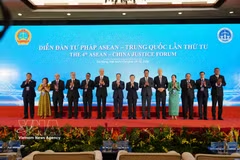
Officials pose for a group photo at the opening ceremony of the fourth ASEAN–China Justice Forum in Da Nang on October 10, 2026. (Photo: VNA)

Da Nang hosts fourth ASEAN–China Justice Forum

The forum offers a venue for participants to share experience in handling cross-border criminal cases and civil and commercial disputes, as well as to explore ways for more effective cooperation in line with national laws and international treaties.

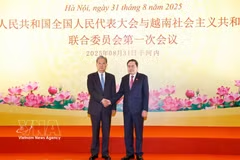
President of the National Assembly Tran Thanh Man (right) and Chairman of the Standing Committee of the National People’s Congress of China Zhao Leji at the first session of the Cooperation Committee between the two legislative bodies in Hanoi on August 31, 2025 (Photo: VNA)

Top legislator’s visit to step up Vietnam–China parliamentary ties

NA President Tran Thanh Man's visit is expected to mark further progress in cooperation between the two Parties and countries, as well as between their parliaments, helping to further develop the Comprehensive Strategic Cooperative Partnership and the Vietnam–China community with a shared future that carries strategic significance.

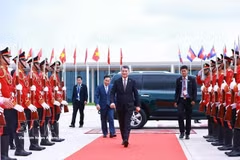
Prime Minister Le Minh Hung leaves Phnom Penh at noon October 10, concluding the wo-day official visit to Cambodia. (Photo: VNA)

PM Le Minh Hung wraps up official visit to Cambodia

PM Le Minh Hung’s first official visit to Cambodia as head of the Vietnamese Government is an important diplomatic activity, demonstrating the high priority that the Party, State and Government of Vietnam attach to relations with Cambodia.

Prime Minister Le Minh Hung meets with staff of the Vietnamese Embassy and representatives of the Vietnamese community in Cambodia on October 10, 2026. (Photo: VNA)

PM pledges continued support for Vietnamese community in Cambodia

Sharing the difficulties facing Vietnamese-origin people in Cambodia, PM Le Minh Hung said the Vietnamese Government will continue to urge Cambodia to provide favourable conditions for the community to stabilise their lives and secure sustainable livelihoods.

Prime Minister Le Minh Hung meets with Cambodian King Norodom Sihamoni at the Royal Palace in Phnom Penh on October 10, 2026. (Photo: VNA)

Vietnamese PM pays courtesy visits to Cambodian King, Queen Mother

King Norodom Sihamoni voiced firm confidence that under the leadership of the Communist Party of Vietnam, headed by General Secretary and President To Lam, and through the dedicated efforts by the Vietnamese Government, National Assembly, and people, the country will continue to achieve even greater accomplishments in its national construction and development.