NA Standing Committee debates draft Law on Urban and Rural Planning

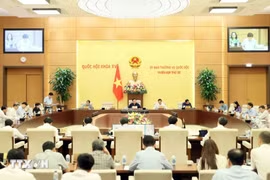
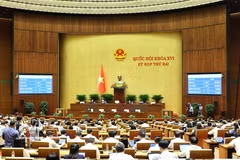
The National Assembly (NA) Standing Committee on April 22 debated the draft Law on Urban and Rural Planning as part of its 32nd session.
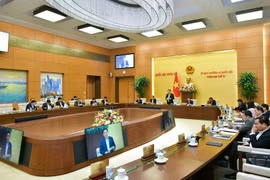
NA Standing Committee debates draft Law on Urban and Rural Planning ảnh 1Minister of Construction Nguyen Thanh Nghi presents the proposal on the draft Law on Urban and Rural Planning at the session. (Photo: VNA)
Hanoi (VNA) – The National Assembly (NA) StandingCommittee on April 22 debated the draft Law on Urban and Rural Planning as partof its 32nd session.

Presenting the proposal on the bill, Minister ofConstruction Nguyen Thanh Nghi said that the draft law aims to create a legalfoundation and a synchronous, comprehensive, unified management tool to adjusturban and rural planning activities, fix relevant problems in reality, meetrequirements for the country's new development stage, enhance the effectivenessand efficiency of state management, and ensure the harmony of interests amongthe State, people and society.

The bill includes adjustments and amendments to anumber of existing legal regulations that are no longer suitable to reality, hesaid.

Particularly, the draft law also consistsregulations to increase the decentralisation to People’s Committees ofprovinces and centrally-run cities during the process of development,verification and approval of general urban planning schemes, said Nghi.

In his verification report, Chairman of the NA'sCommittee for Economic Affairs Vu Hong Thanh said that the committee agreed onthe necessity to promulgae the law, underlining that the consolidation ofregulations on urban and rural planning into one law is appropriate, aiming toensure uniformity in general direction in urban and rural control, managementand development as well as the harmony and cohesion between urban and ruralspaces, supporting the overall development of localities, regions and the wholecountry.

Thanh stressed the need for the bill to havesuitable and strategic visions in urban planning with respect to market rulesand principles of sustainable development, taking people and quality of life asthe centre and urban culture and civilisation as the foundation fordevelopment, while harmoniously combining the process of urbanisation and urbandevelopment with industrialisation, modernisation, new-style rural areabuilding, economic restructuring, social development management, and ensuringnational defence and security.

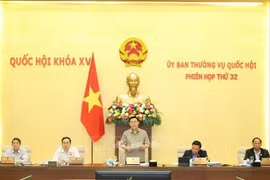
NA Standing Committee debates draft Law on Urban and Rural Planning ảnh 2NA Chairman Vuong Dinh Hue (middle) and NA Vice Chairmen at the session. (Photo: VNA)
He also reminded the drafting agency to add theassessments of specific impacts of new regulations of the bill, along with thesummary on regulations related to decentralisation on local planningadjustments.

Addressing the session, NA Chairman Vuong Dinh Huesaid that the draft Law on Urban and Rural Planning was built on the basis ofinheriting, developing and unifying the urban planning regulations in the UrbanPlanning Law 2009 and regulations on construction planning and rural planningin the Construction Law 2014. In addition, the draft law contributes toconcretising the Planning Law and specifying a new issue as well as removingdifficulties in implementing related laws.

He said that the bill should review and clarifythe issue of climate change adaptation planning, criteria and standards forurban planning associated with population density and infrastructure, as wellas planning adjustments to suit the reality.

The NA leader also asked for coherence among the billand other related laws.

At the session, the Minister of Constructionacknowledged all ideas from members of the NA Standing Committee for completingthe bill, pledging that the ministry will review and specify all contents andsubmit a report to the committee soon./.

VNA

See more

Toshiro Nishizawa, a Senior Fellow at Graduate School of Public Policy under the University of Tokyo in an interview with the Vietnam News Agency (VNA)'s correspondent in Japan (Photo: VNA)

Top leader’s visit to deepen Vietnam-Japan strategic cooperation: expert

The upcoming visit to Japan by General Secretary of the Communist Party of Vietnam Central Committee and President To Lam is expected to give fresh impetus to the Vietnam-Japan Comprehensive Strategic Partnership, reflecting the strategic priorities of both countries, according to a Japanese expert.

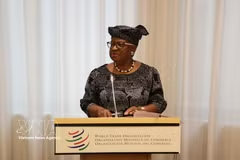
WTO Director-General Ngozi Okonjo-Iweala speaks at the event (Photo: VNA)

WTO hails Vietnam’s 20-year journey since accession

Joining the WTO was a strategic choice for Vietnam, closely associated with its Doi Moi (Renewal) process, opening-up policy and international economic integration. Over the past two decades, international economic integration has become a driving force for institutional reforms, trade expansion, foreign investment attraction and enhancement of the country's international standing.

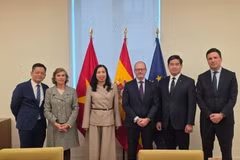
Vietnamese Deputy Minister of Foreign Affairs Le Thi Thu Hang (third, left) and other delegates at the political consultation (Photo: The Ministry of Foreign Affairs)

Vietnam, Spain seek to deepen Strategic Partnership

Vietnam asked Spain to continue voicing its support for and urging the European Commission (EC) to swiftly lift the IUU “yellow card” imposed on Vietnamese seafood, while actively encouraging EU member states to ratify the EU-Vietnam Investment Protection Agreement (EVIPA) at an early date.

Standing Deputy Minister of Foreign Affairs Nguyen Minh Vu (Photo: Ministry of Foreign Affairs)

Top leader's official visit to Japan carries three major strategic implications: Deputy FM

The visit, the first to Japan by the leader in his new capacity and the first visit to Japan by a General Secretary of the Communist Party of Vietnam in 11 years, will first set the overall strategic direction for bilateral relations in the new period, enabling leaders of the two countries to identify long-term cooperation orientations and priority areas that meet the development needs of both sides.

A performance at the 2026 Cultural and Artistic Exchange Programme for the Spring Border Festival between Lao Cai (Vietnam) and Honghe (China) (Illustrative image. Source: VNA)

Party directive calls for strengthening people-to-people diplomacy

People-to-people diplomacy is a key, regular task of the entire political system and people. People’s organisations, citizens, businesses, entrepreneurs, intellectuals, artists and overseas Vietnamese are at its centre and are the principal actors and direct participants in implementation, according to a new directive of the Party Central Committee's Secretariat.

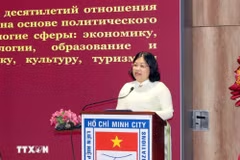
Nguyen Truong Nhat Phuong, Vice Chairwoman of the Ho Chi Minh City People's Council and President of the city's Vietnam-Russia Friendship Association, speaks at the gathering. (Photo: VNA)

Ho Chi Minh City seeks to strengthen cooperation with Russian localities

The Russian October Revolution laid the foundation for the longstanding friendship between Vietnam and Russia. Despite ups and downs of history, the traditional Vietnam-Russia friendship has been strengthened and nurtured by generations, with bilateral ties elevated to a Comprehensive Strategic Partnership.

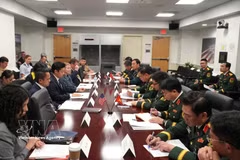
An overview of the 14th Vietnam–US Defence Policy Dialogue. (Photo: VNA)

14th Vietnam–US Defence Policy Dialogue held in Washington DC

Deputy Minister of National Defence Nguyen Truong Thang called for greater sharing of information, documents and memorabilia concerning Vietnamese servicemen killed or missing in action, as well as support in strengthening DNA identification capacity to accelerate Vietnam's 500-day campaign to intensify the search for, collection and identification of the remains of fallen soldiers.

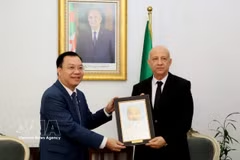
Vietnamese Ambassador to Algeria Vu Duy Long presents a portrait of President Ho Chi Minh to Abdelkrim Benmbarek, Secretary-General of Algeria’s National Liberation Front (FLN). (Photo: VNA)

Algeria holds a special place in Vietnamese hearts: Ambassador

The elevation of Vietnam–Algeria ties to a Strategic Partnership in November 2025 reflects strong political trust and the determination to usher bilateral cooperation into a new phase. The immediate priority is to translate this framework into concrete programmes and projects, particularly in defence, security, the economy, trade, investment, energy, agriculture, science and technology, said Ambassador Vu Duy Long.