Party directive calls for strengthening people-to-people diplomacy

People-to-people diplomacy is a key, regular task of the entire political system and people. People’s organisations, citizens, businesses, entrepreneurs, intellectuals, artists and overseas Vietnamese are at its centre and are the principal actors and direct participants in implementation, according to a new directive of the Party Central Committee's Secretariat.

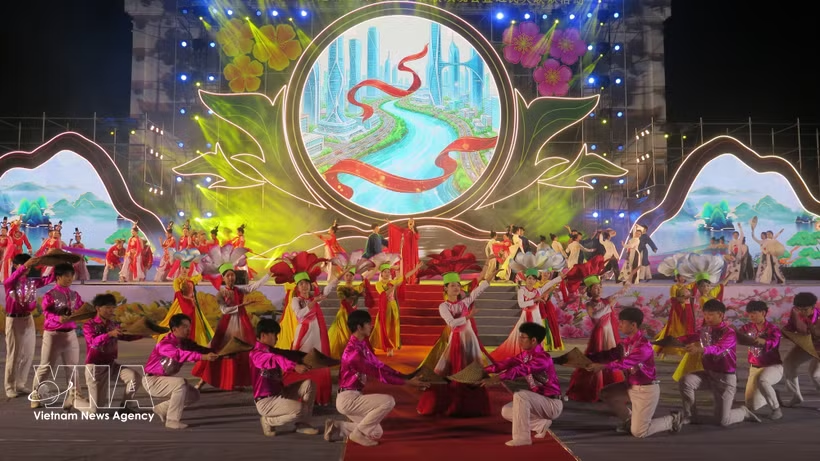
A performance at the 2026 Cultural and Artistic Exchange Programme for the Spring Border Festival between Lao Cai (Vietnam) and Honghe (China) (Illustrative image. Source: VNA)

Hanoi (VNA) - Standing Member of the Party Central Committee's Secretariat Tran Cam Tu has signed a directive on strengthening and elevating people-to-people diplomacy.

The Secretariat's Directive No. 16-CT/TW, dated November 2, states that nearly five years after the implementation of Directive No. 12-CT/TW, dated January 5, 2022, on strengthening the Party’s leadership and improving the effectiveness of people-to-people diplomacy in the new situation, the work has achieved positive results.

It has helped promote and expand friendly and cooperative relations with people in other countries, enhance Vietnam’s role and standing in regional and international people-to-people mechanisms and forums, and mobilise resources for national development. However, people-to-people diplomacy still faces a number of limitations and shortcomings. Awareness of its strategic position and role remains remains inadequate and lacks depth. Approaches and methods of implementation have been slow to change.

Efforts to mobilise support for Vietnam among people in other countries on several important issues have yet to make significant breakthroughs. Coordination remains insufficient, and resources are fragmented, preventing the political system and the public as a whole from fully harnessing their collective strength.

The directive specifies tasks and solutions to promote people-to-people diplomacy, including continuing to deepen understanding and bring about a strong shift in awareness of the strategic position and role of people-to-people diplomacy as one of the three pillars of foreign affairs, alongside Party diplomacy and State diplomacy, which together form the combined strength of Vietnam’s comprehensive, modern and professional diplomacy.

It underlines that people-to-people diplomacy is a key, regular task of the entire political system and people. People’s organisations, citizens, businesses, entrepreneurs, intellectuals, artists and overseas Vietnamese are at its centre and are the principal actors and direct participants in implementation.

It calls for strengthening the Party’s comprehensive leadership and the State’s unified management, ensuring consistent orientations and close, coordinated and effective cooperation among the three pillars of foreign affairs.

The directive highlights the need to uphold sincerity, trust and mutual respect in relations with people in other countries, placing importance on building trust and long-term relationships. Vietnam will strengthen ties with traditional friends while expanding and deepening relations with partners, particularly neighbouring countries, and comprehensive strategic, strategic and important partners.

At the same time, it also calls for maintaining a global network of support for Vietnam and expanding networks of friends and partners along with renewing thinking on the implementation of people-to-people diplomacy, making far-reaching changes to the methods of implementing people-to-people diplomacy, ensuring that activities are driven by practical needs, and closely linking people-to-people diplomacy with national development tasks and the enhancement of national soft power.

Particularly, the directive points to the need to renew and modernise people-to-people channels of external information, promote the achievements of Doi Moi (Renewal) cause, spread the image of a Vietnam rich in cultural identity, and step up the application of digital technology and artificial intelligence, and make effective use of cyberspace and new media platforms.

At the same time, it is necessary to consolidate organisational structures and coordination mechanisms, and ensure that resources for people-to-people diplomacy are commensurate with the country’s new position and strength, it says.

The directive also details measures to ensure the effective implementation of the tasks and solutions./.

VNA
See more

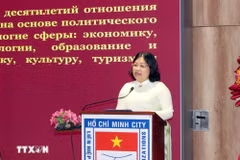
Nguyen Truong Nhat Phuong, Vice Chairwoman of the Ho Chi Minh City People's Council and President of the city's Vietnam-Russia Friendship Association, speaks at the gathering. (Photo: VNA)

Ho Chi Minh City seeks to strengthen cooperation with Russian localities

The Russian October Revolution laid the foundation for the longstanding friendship between Vietnam and Russia. Despite ups and downs of history, the traditional Vietnam-Russia friendship has been strengthened and nurtured by generations, with bilateral ties elevated to a Comprehensive Strategic Partnership.

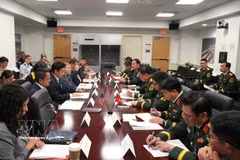
An overview of the 14th Vietnam–US Defence Policy Dialogue. (Photo: VNA)

14th Vietnam–US Defence Policy Dialogue held in Washington DC

Deputy Minister of National Defence Nguyen Truong Thang called for greater sharing of information, documents and memorabilia concerning Vietnamese servicemen killed or missing in action, as well as support in strengthening DNA identification capacity to accelerate Vietnam's 500-day campaign to intensify the search for, collection and identification of the remains of fallen soldiers.

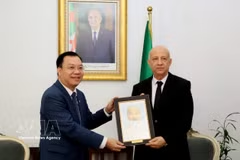
Vietnamese Ambassador to Algeria Vu Duy Long presents a portrait of President Ho Chi Minh to Abdelkrim Benmbarek, Secretary-General of Algeria’s National Liberation Front (FLN). (Photo: VNA)

Algeria holds a special place in Vietnamese hearts: Ambassador

The elevation of Vietnam–Algeria ties to a Strategic Partnership in November 2025 reflects strong political trust and the determination to usher bilateral cooperation into a new phase. The immediate priority is to translate this framework into concrete programmes and projects, particularly in defence, security, the economy, trade, investment, energy, agriculture, science and technology, said Ambassador Vu Duy Long.

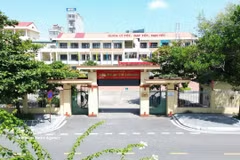
Le Hong Phong Lower Secondary School in Ha Long ward, Quang Ninh city. Public science and technology organisations, public educational institutions, and non-profit private educational institutions are expected to be exempt from tax in accordance with government regulations. (Photo: VNA)

Amendments considered for rules on income, non-agricultural land use taxes

The draft law incorporates provisions on corporate and personal income tax exemptions for income generated from providing catering services for educational institutions and medical establishments, cases of non-agricultural land use tax exemption for educational institutions, and non-agricultural land use tax exemption for ethnic minorities.

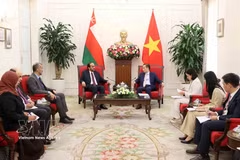
Minister of Foreign Affairs Le Hoai Trung receives Undersecretary for Political Affairs at the Foreign Ministry of Oman Khalifa bin Ali bin Issa Al-Harthy in Hanoi on November 5. (Photo: VNA)

Vietnam, Oman urged to open diplomatic missions soon

Minister of Foreign Affairs Le Hoai Trung praised the outcomes of the fifth political consultation between the two foreign ministries, held on November 4, and called on them to strengthen coordination, build political trust and promote exchanges of high-level and other delegations.

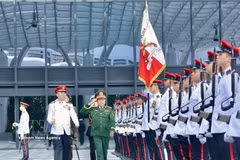
General Nguyen Tan Cuong (R) and Vice Admiral Aaron Beng inspect the guard of honour. (Photo: VNA)

Vietnam, Singapore enhance defence cooperation

Highlighting the positive development of relations between the two countries and their militaries, General Nguyen Tan Cuong, Member of the Central Military Commission’s Standing Board, Chief of the VPA General Staff and Deputy Minister of National Defence, noted that Vietnam and Singapore share strategic interests and considerable potential for cooperation, as well as a common commitment to peace, stability and prosperity.