Nine disaster-resilient homes handed over under Vietnam Special Build 2026

The Home Matters Special Build programme reflects the organisation’s core values of connecting people across geographical and social boundaries to build not only homes but also stronger communities and hope, thus raising awareness of the urgent need for safe and disaster-resilient housing.

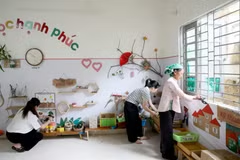
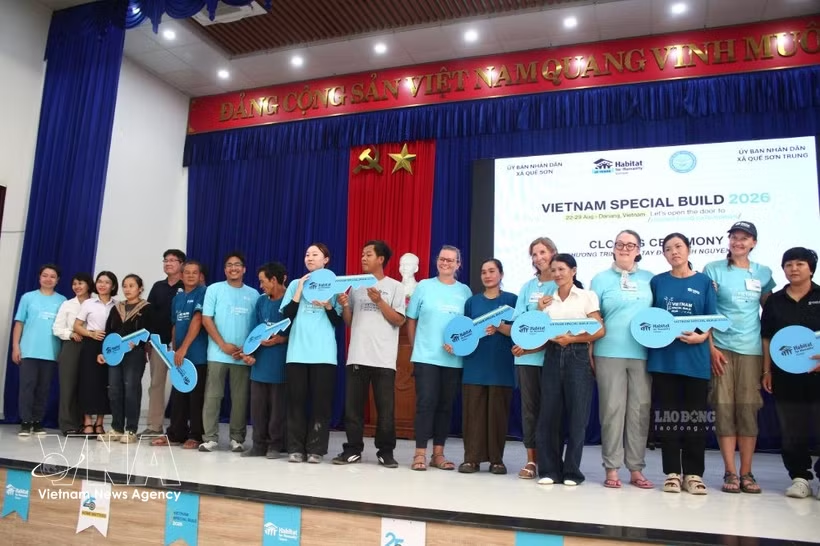
Habitat for Humanity Vietnam (HFHV) hands over nine disaster-resilient houses to low-income and vulnerable families in central Da Nang city as part of the Vietnam Special Build 2026 programme (Photo: VNA)

Da Nang (VNA) – Habitat for Humanity Vietnam (HFHV) on August 28 handed over nine disaster-resilient houses to low-income and vulnerable families in central Da Nang city as part of the Vietnam Special Build 2026 programme, highlighting the importance of safe and climate-resilient housing for communities vulnerable to natural disasters.

The handover ceremony and farewell event for international volunteers, themed “Home Matters,” took place as part of the programme held from August 22-29 in Que Son and Que Son Trung communes, which are among the most disaster-prone areas in the country.

The event marked the return of Habitat for Humanity’s Special Build programme to the Asia-Pacific region for the first time since 2019, coinciding with the 25th anniversary of Habitat for Humanity Vietnam’s efforts to build homes, communities and hope across the country.

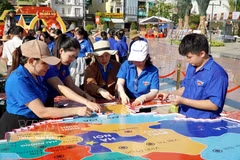
The programme brought together volunteers from Habitat for Humanity Metro Denver and Habitat for Humanity in the Asia-Pacific, students from Japan, employees of corporate partners Thrivent, Eaton and TTI, and other volunteers from the US, Australia, Belgium and Singapore. Working with local volunteers, they completed and handed over nine disaster-resilient houses, benefiting 16 low-income and vulnerable families in the locality.

The programme also provided opportunities for dozens of employee volunteers from Vietnamese businesses to join practical community service activities.

According to Nguyen Van Hue, Country Director of HFHV, the Home Matters Special Build programme reflects the organisation’s core values of connecting people across geographical and social boundaries to build not only homes but also stronger communities and hope, thus raising awareness of the urgent need for safe and disaster-resilient housing.

Over the past 25 years, HFHV has reached 320,000 people, built or repaired more than 36,000 homes, and mobilised 9,380 volunteers since 2012 to promote affordable housing and community development. The organisation has also supported thousands of families through housing finance solutions, safe-housing training and climate-resilience initiatives.

Habitat for Humanity International began operating in Vietnam in 2001 to promote access to safe, sustainable and affordable housing. Over nearly 25 years, it has worked with state agencies, local authorities, communities and thousands of families to improve housing conditions, expand access to clean water and sanitation, reduce disaster risks and strengthen climate resilience.

Its programmes have supported more than 36,000 households and reached disadvantaged communities across the country. /.
VNA

See more

Da Nang steps up search, rescue efforts for missing fishing boat

Da Nang steps up search, rescue efforts for missing fishing boat

The vessel departed An Hoa port in Nui Thanh commune on July 29 with 49 crew members. Its last position, recorded by its vessel monitoring system at 12:54pm on August 25, was about 17.6 nautical miles from the maritime boundary in Vietnamese waters, 540 nautical miles south-southeast of Son Tra peninsula and 35 nautical miles west of An Bang island in the Truong Sa special zone of Khanh Hoa province.

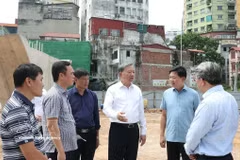
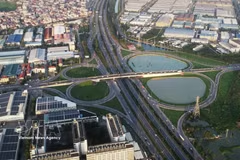
General Secretary of the Communist Party of Vietnam (CPV) Central Committee and President To Lam (third, right) inspects the Hoang Cau–Voi Phuc section of the Ring Road No. 1 project. (Photo: VNA)

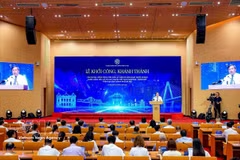
Top leader inspects key transport, education infrastructure projects in Hanoi

General Secretary of the Communist Party of Vietnam (CPV) Central Committee and President To Lam stressed that education should aim at comprehensive development, with schools meeting required standards and balancing academic studies with arts, sports and foreign languages to create an enjoyable learning environment.

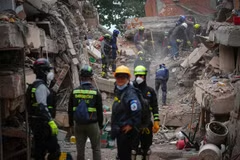
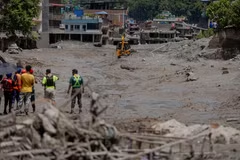
Rescue teams search for victims after floods and landslides in Nuwakot, Nepal, on August 27, 2026 (Photo: Xinhua/VNA)

Vietnamese citizen missing in Nepal disaster

A Vietnamese citizen is among those missing following flash floods and landslides that struck northern Nepal, in an area bordering Tibet, China, on August 26, according to a notice from the Nepal Tourism Board.

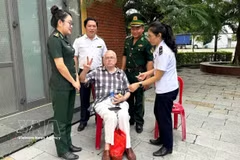
Eugene Grosman, born in 1945, a US citizen (centre) receives prompt first aid and medical assistance from border guard and health quarantine forces after showing signs of a stroke at Lao Bao International Border Gate in Quang Tri province. (Photo: VNA)

US tourist receives timely emergency care at Lao Bao International Border Gate

A US tourist named Eugenne Grosman, born in 1945, was completing immigration procedures after travelling from Laos into Vietnam when he suddenly developed symptoms of low blood sugar and dizziness, showed signs of a possible stroke, and collapsed at the Lao Bao International Border Gate in the central province of Quang Tri.

Tran Trung Kien, Secretary General of the Vietnam-Japan Economic Cooperation Promotion Association (VJECPA), talks to the Vietnam News Agency. (Photo: VNA)

OVs can become substantive economic bridges between Vietnam, Japan: expert

Tran Trung Kien, Secretary General of the Vietnam-Japan Economic Cooperation Promotion Association (VJECPA) noted that Japan has many strengths that match Vietnam’s development needs, particularly in technology, manufacturing, supporting industries, automation, high-tech agriculture, healthcare, elderly care, education and training, digital transformation, green industry and the circular economy.

The elegant, luxurious interiors of Ha Long Bay’s modern cruise fleet enhance visitors’ premium travel experience. (Photo: VNA)

Ha Long Bay dazzles in spectacular night show

Vice Chairman of the Quang Ninh provincial People’s Committee Nguyen Van Cong said Ha Long Bay is not only a world-renowned heritage site but also a valuable resource for creating new tourism experiences. The province pursues the principle of “conserving for development and developing to reinvest in conservation,” while expanding the Ha Long – Yen Tu – Bai Tu Long tourism chain and developing the nighttime economy and cultural industries.

An OV family in Washington DC, the US, watch a live broadcast of the 80th National Day celebrations in 2025. (Photo: VNA)

Resolution raises expectations for greater OV contributions

While the earlier resolution focused on encouraging OV resources, providing support and enhancing the great national solidarity, Resolution No. 23-NQ/TW places greater emphasis on accompanying OVs, creating favourable mechanisms and effectively mobilising resources from OV communities to assist with the homeland's development.

Editor-in-Chief Ninh Hong Nga speaks at the working session with the Cambodian delegation. (Photo: VNA)

Vietnam, Cambodia strengthen cooperation in journalism

A delegation of Cambodian journalists is visiting Vietnam to exchange experiences in digital transformation in journalism and explore ways to boost cooperation in external information and promote the images of Vietnam.

Vietnamese workers in Changwon, the Republic of Korea, pose for a photo with representatives of the organisers and sponsors at a legal consultation session aimed at raising Vietnamese workers’ awareness of relevant laws in Changwon. (Photo: VNA)

Overseas employment must become channel for developing Vietnam’s human resources: official

Under the revised Law on Vietnamese Guest Workers under Contract, priority is given to sending trained workers with professional and technical qualifications abroad so that they can improve their incomes, gain access to advanced technology and modern governance practices, and develop vocational skills, foreign languages, labour discipline and industrial working styles.