Overseas employment must become channel for developing Vietnam’s human resources: official

Under the revised Law on Vietnamese Guest Workers under Contract, priority is given to sending trained workers with professional and technical qualifications abroad so that they can improve their incomes, gain access to advanced technology and modern governance practices, and develop vocational skills, foreign languages, labour discipline and industrial working styles.

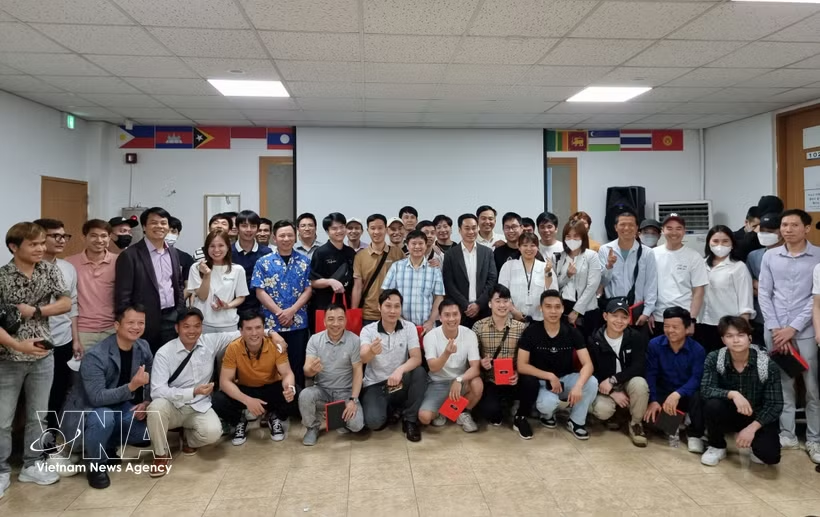
Vietnamese workers in Changwon, the Republic of Korea, pose for a photo with representatives of the organisers and sponsors at a legal consultation session aimed at raising Vietnamese workers’ awareness of relevant laws in Changwon. (Photo: VNA)

Hanoi (VNA) – Sending Vietnamese workers abroad should be viewed not merely as a means of creating jobs and raising incomes, but also as a channel for developing human resources for the country, Deputy Minister of Home Affairs Vu Chien Thang has said.

In an interview with the Vietnam News Agency on the revised Law on Vietnamese Guest Workers under Contract, recently passed by the 16th National Assembly, Thang said the new law reflected a shift in policy thinking. While overseas employment was traditionally associated mainly with jobs, income generation and poverty reduction, the revised one places greater emphasis on training, skills accumulation and national human resources development.

Under the revised law, priority is given to sending trained workers with professional and technical qualifications abroad so that they can improve their incomes, gain access to advanced technology and modern governance practices, and develop vocational skills, foreign languages, labour discipline and industrial working styles.

This approach is particularly important as Vietnam is accelerating science and technology development, innovation, digital transformation and productivity growth, Thang said, noting that workers exposed to advanced production environments abroad could acquire knowledge, skills and experience that domestic training alone might not provide. When they return, these assets could become an important resource for the domestic economy.

He stressed that the focus should therefore not simply be on how many workers are sent abroad, but on the value they can bring back.

To prevent overseas employment from becoming a one-way flow of human resources, the revised law also strengthens connections between returning workers and the domestic labour market. The Ministry of Home Affairs is studying a strategy on sending Vietnamese workers abroad that will be aligned with the national human resources development strategy and economic diplomacy orientations. It is also researching mechanisms to recognise workers’ qualifications, occupational skills and skills profiles in line with national occupational skills standards.

The official said the greater concern was not a “brain drain” but a waste of human resources. Workers who return with improved technical skills, foreign languages and experience can strengthen the country’s human resources in the medium and long term, provided that their skills are properly recognised and used.

He said the number, structure and destination markets of Vietnamese workers abroad must be balanced with domestic labour demand and the needs of strategic industries in each period. At the same time, Vietnam needs to create sufficient opportunities at home to encourage skilled workers to return. According to Thang, the revised law also marks a shift from responding to existing market advantages to proactively preparing human resources for sectors identified as national development priorities. Depending on development requirements, these could include manufacturing, digital technology, semiconductors, logistics and high-tech agriculture.

He said this “proactive commissioning” of human resources should be closely linked with economic diplomacy, including negotiations and labour cooperation agreements with other countries, as well as programmes combining training, overseas employment and recognition of qualifications.
vna-potal-dua-lao-dong-ra-nuoc-ngoai-phai-tro-thanh-mot-kenh-phat-trien-nguon-nhan-luc-8986830.jpg
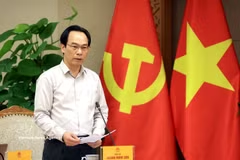
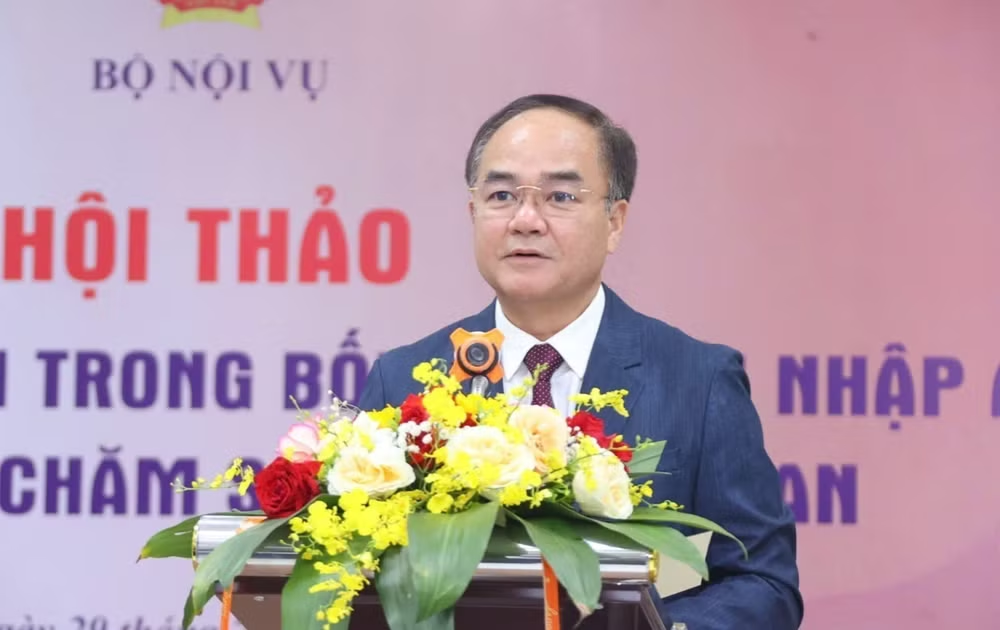
Deputy Minister of Home Affairs Vu Chien Thang (Photo published by VNA)

To ensure that overseas employment truly serves as a training channel, the deputy minister stressed the need to manage the entire process from preparation and training before departure to skills recognition and employment after workers return. Workers’ employment histories, occupations, positions, duration of employment and destination markets should be recorded in specialised databases, enabling their skills to be matched with suitable jobs at home.

He stressed that workers returning from abroad should bring home not only savings but also a recognised “skills asset” that can be effectively used in the domestic labour market. Greater connectivity among employment service centres, local authorities and businesses will help translate overseas experience into value, particularly for foreign-invested enterprises and supporting industries.

Thang also emphasised that prioritising trained workers should not become a barrier for low-skilled ones. Instead, it should encourage Vietnamese workers to improve their skills and qualifications while strengthening the overall quality of the national workforce.

Ultimately, he said the success of the policy should not be measured by the number of workers sent abroad alone, but by the quality of the labour flow, their protection and safety, and, most importantly, what they achieve after returning home. The most important goal would be whether Vietnamese workers are respected abroad and valued when they return, and whether they can contribute their skills, experience and resources to the country’s development./.
VNA

See more

A view of a workshop on advancing gender equality in the public sector amid the restructuring and streamlining of the political system in Hanoi on September 15 (Photo: VNA)

Vietnam seeks to advance gender equality amid public-sector reform

Organisational restructuring presents an opportunity to review personnel standards, procedures and working methods. If gender considerations are integrated into the process, it can help remove long-standing barriers, make better use of female talent and build a fairer and more accountable working environment.

Some of the suspects arrested in the case (Photo: Quang Ninh city's Public Security Department)

Quang Ninh police bust 38.4 million USD transnational cybercrime ring

Quang Ninh city's Public Security Department warned individuals, agencies and businesses not to publicly disclose or provide personal information or bank account details on social media, and urged organisations and businesses to strictly comply with regulations on protecting customers’ personal data.

Teachers and children at Hoa Hong Kindergarten in Ha Giang 2 ward, Tuyen Quang province (Photo: VNA)

Vietnam to provide tuition support for preschoolers

Eligible children will be entitled to tuition exemptions, reductions or support, assistance with learning costs and other benefits in accordance with laws on education, children, people with disabilities, ethnic affairs and social assistance.

More than 100 delegates, including nearly 30 delegates from countries in Asia and Africa, attend the event. (Photo courtesy of the ActionAid)

Ecological agriculture for sustainable future

The workshop “Ecological agriculture for a sustainable future”, organised by ActionAid International in Vietnam, emphasised that women and young people must be the subjects and leaders of change, rather than merely participants or beneficiaries.

International delegates attend the 7th national congress of the Vietnam Union of Friendship Organisations in Hanoi on September 14. (Photo: VNA)

Phan Anh Son re-elected VUFO president

For the 2026–2031 term, the Vietnam Union of Friendship Organisations (VUFO) will follow the motto “Proactive adaptation, creative breakthroughs, practical effectiveness”.

Deputy Prime Minister Pham Thi Thanh Tra encourages the staff of the Centre for DNA Identification. (Photo: VNA)

Identifying martyrs’ remains requires whole political system’s efforts: Deputy PM

Deputy Prime Minister Pham Thi Thanh Tra inspected the practical implementation of DNA identification technology at the Centre for DNA Identification under the Institute of Biology of the Vietnam Academy of Science and Technology, and the Military Institute of Forensic Medicine under the Military Medical Department of the Ministry of National Defence on September 14.

Doan Duc Hao, Director of the Department of Youth Affairs and Gender Equality under the Ministry of Home Affairs, speaks at a working session with a 16-member delegation of young Korean civil servants in Hanoi on September 14, 2026. (Photo: VNA)

Vietnam, RoK promote cooperation, youth’s role

Le Thi Viet Lam, Deputy Director of the Department of International Cooperation under the Ministry of Science and Technology, said Vietnam wishes to continue building an ecosystem that connects the State, research institutes, universities and businesses, enabling them to share resources and create value. This is also an area in which Vietnam is interested in learning from Korean experience.

To operate Metro Line No. 1 (Ben Thanh–Suoi Tien), Ho Chi Minh City Urban Railway Company No. 1 (HURC1) currently employs 700 people to keep nearly 200 train trips running each day. (Photo: nhandan.vn)

Ho Chi Minh City addresses manpower shortage for urban railway development

Under the human resources training scheme serving the development of the urban railway network approved by the municipal People’s Committee, the city will need around 70,000 workers by 2030 to support investment in and development of its metro system, including project management personnel, operations and maintenance staff, engineers, technical workers, consultants and designers.