Hanoi (VNA) - The remarkable and comprehensive achievements Vietnam has attained over nearly 40 years of “Doi moi” (Renewal), coupled with the rapid advancements of the Fourth Industrial Revolution, have created a historic opportunity for the country to enter a new era – the era of the nation’s rise.
This evolving reality places an urgent demand on Vietnam to pursue a fundamental transformation of its political system to build a truly streamlined and effective apparatus capable of meeting the challenges of this new revolutionary stage.
However, hostile and reactionary forces and political opportunists have continued to spread distorted and subversive allegations which deliberately misrepresent the nature of these reforms to sow doubt among the people, incite dissatisfaction, and undermine national unity in an attempt to obstruct the country's progress.
On February 14, 2025, immediately after the Politburo issued Conclusion No. 126-KL/TW on key tasks and measures to further streamline the organisational structure of the political system in 2025, hostile and reactionary forces and political opportunists launched a "toxic media campaign" aimed at discrediting the Party and State of Vietnam.
First and foremost, it is important to acknowledge the fact that the current state apparatus remains cumbersome and overlapping, leading to inefficiency in operation. The duplication of functions among agencies and units, along with the existence of multiple intermediate layers, has resulted in sluggishness and inflexibility in decision-making and policy implementation.
The overlap and unclear delineation of functions and responsibilities also lead to a lack of accountability, jurisdictional encroachment, mutual obstruction, and even the "neutralisation" of each other’s roles. This fosters a culture of responsibility-shifting, creates room for misconduct, hinders development, creates fertile ground for corruption, and undermines governance effectiveness.
For example, in the case of food safety, a single product may fall under the management of three ministries: Health, Industry and Trade, and Agriculture and Rural Development (now Agriculture and Environment). Therefore, when a food safety incident occurs, it is unclear which agency is responsible, delaying the handling process and eroding public and business confidence.
The issue of a cumbersome and overlapping State apparatus is not merely a matter of organisation, as it has wide-ranging impacts on citizens' rights, business efficiency, and the overall development of the national economy.
Therefore, continuing to restructure the apparatus, streamline organisational units, and clearly define functions, responsibilities, and focal agencies is an urgent requirement for building a modern administrative system that truly serves the people and enterprises.
In addition, the financial burden created by this cumbersome structure is enormous. According to data released by the Ministry of Home Affairs in 2023, the total number of officials, civil servants, and public employees across the political system was approximately 2.5 million, with the majority being public service employees. Regular expenditures for the administrative apparatus account for a significant portion of the state budget. Statistics from the Ministry of Finance show that, for years, regular spending has made up around 65–70% of total state expenditures, with the bulk allocated to salaries and allowances for officials, civil servants, and public employees.
This financial burden is by no means insignificant for the national budget, especially at a time when Vietnam must prioritise resources for development investment, climate change response, and tackling global challenges such as pandemics, digital transformation, and energy transition.
In the context of limited budgets, streamlining the state apparatus is a prerequisite for easing financial pressure and ensuring more efficient resource allocation.
Moreover, the institutional reform and downsizing of the state apparatus are an inevitable requirement amidst international integration and the Fourth Industrial Revolution. As Vietnam deepens its global integration, building a modern, transparent, and flexible public administration becomes a key factor in attracting investment and enhancing national competitiveness.
The country has also set ambitious development goals, including reaching a GDP growth rate of at least 8% in 2025 and aiming for double-digit growth in the following years, as part of its broader vision to achieve high-income status by 2045. A bloated and sluggish state system cannot keep pace with the rapid changes of the digital age and the demands of modern governance.
In addition, streamlining the apparatus is a vital step in the fight against corruption and other negative phenomena.

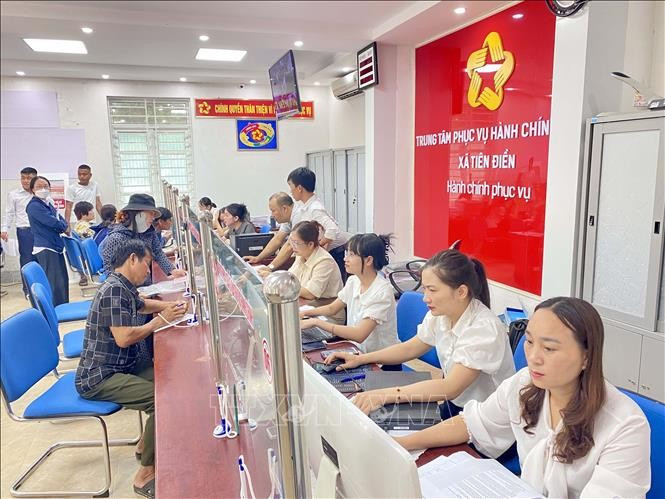
Citizens carry out administrative procedures at the public administrative service centre in Tan Ninh ward of Tay Ninh province (formerly Ward 3 of Tay Ninh city). (Photo: VNA)
Despite these undeniable facts, hostile and reactionary forces and political opportunists refuse to acknowledge the necessity and legitimacy of these reforms. They falsely claim that Vietnam's reforms are "superficial" or "incomplete" as they exclude political restructuring, and that merging state bodies solves nothing. This is a dangerous fallacy, an intentional distortion that undermines Vietnam's reform efforts. Such allegations are designed to incite public distrust in the Party’s leadership and sabotage the country’s ongoing renewal process.
Over the course of nearly 40 years since the launch of the renewal process at the 6th National Party Congress in 1986, the country has achieved remarkable, comprehensive, and historically significant accomplishments across multiple sectors. From a war-torn, impoverished, and underdeveloped nation, Vietnam has transformed into one of the most dynamic and promising economies in the Asia-Pacific. In 2024, Vietnam’s economy reached over 476 billion USD, placing it among the 32 largest economies in the world. Per capita income increased from under 100 USD in 1988 to nearly 5,000 USD last year. The poverty rate has dramatically decreased from over 70% in 1986 to below 3% today (based on the multidimensional poverty standard).
Vietnam is now among the top 20 countries in terms of trade volume, and since 2019, it has consistently ranked among the top 20 economies attracting the most foreign direct investment (FDI). The country is also one of the world’s top 10 recipients of remittances. With exports surpassing 405.53 billion USD, Vietnam is now among the top 20 exporting nations globally.
National defence, security, and public order remain firmly ensured, while the social welfare system continues to improve, with over 92% of the population now covered by health insurance.
In foreign affairs, Vietnam has established diplomatic relations with 193 countries, remained an active member of many international organisations, and played a constructive role in promoting peace and cooperation both regionally and globally. Vietnam’s successful hosting of major events such as the summits of ASEAN, the World Economic Forum (WEF), and the Asia-Pacific Economic Cooperation (APEC), as well as its performance as a non-permanent member of the United Nations Security Council for two terms clearly demonstrate its growing international reputation.
Reality proves that Vietnam’s political renewal has been conducted with clear principles, suited to the country’s historical conditions, culture, and practical development needs. Vietnam could not enjoy such stable development and international integration achievements without renewing political thinking, organisational structures, legal system, and state management. Political renewal is a key component of Vietnam’s comprehensive renewal model, which retains its unique national identity.
History shows that every genuine revolution, whether political, economic, or social, requires sacrifice, often significant sacrifice. The current revolution to streamline the State apparatus and renew the political system in Vietnam is no exception. This sacrifice involves giving up personal positions, benefits, and stability for a greater cause: the efficient operation of a lean, effective state apparatus that better serves the people and businesses. Tens of thousands of officials, civil servants, and public employees have chosen to step down, transfer roles, retire early, or decline reappointment, not due to incompetence, but out of a commitment to the common good over personal interest, and a recognition that an oversized apparatus would hinder national development.
Streamlining this apparatus is not a superficial change or a mere reactionary measure, nor is it a “half-hearted reform” as distorted by hostile forces. On the contrary, this deep, cautious, and persistent administrative revolution, which arises from the urgent demands of the country’s development reality, will undoubtedly contribute to the nation’s comprehensive renewal process and serve the long-term interests of the people and the country./.