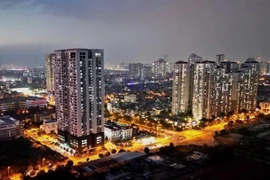
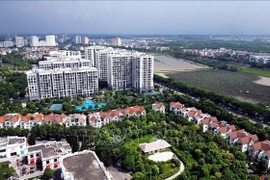
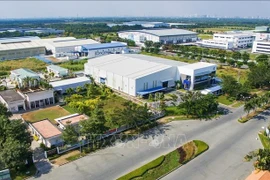
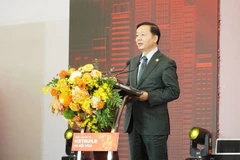
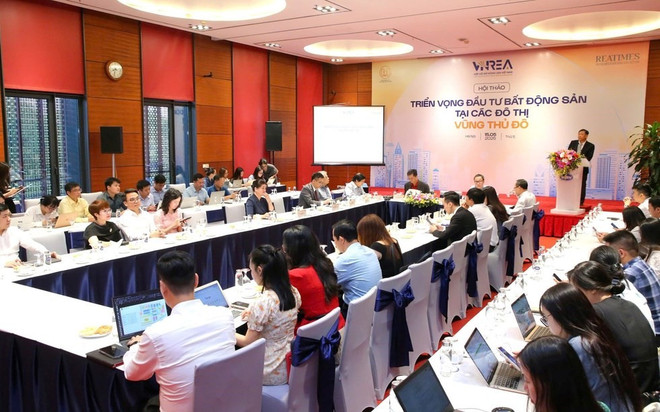
Hanoi (VNA) – Provincial mergers that make the number of provinces and cities in Vietnam reduce from 63 to 34 is not simply an administrative reform, but an opportunity to restructure the socio-economic space, said President of the Vietnam National Real Estate Association (VNREA) Nguyen Van Khoi.
The merger will bring huge space for urban development and have a positive impact on the real estate market, he said.
According to experts, the provincial mergers will accelerate the urbanisation rate. The real estate market in the Capital Region is expected to have a strong transformation.
The Capital Region, including Hanoi and nine neighbouring provinces of Hai Duong, Hung Yen, Vinh Phuc, Bac Ninh, Ha Nam, Hoa Binh, Phu Tho, Bac Giang, and Thai Nguyen, is identified as a socio-economic development linkage area.
Khoi said that in the coming time, satellite urban areas will become the focal point of investment waves. Thanks to increasingly complete connection infrastructure and abundant land funds, in recent years, the provinces neighbouring Hanoi have strongly attracted investment capital into real estate.
According to data from the Vietnam Real Estate Research Institute, the level of interest and investment in real estate in urban areas of the Capital Region increased sharply in the period of late 2024 and early 2025. This trend continued in the first quarter of 2025 when demand rose in areas along the Ring Road 4 and industrial corridors connecting Hanoi with Bac Giang, Hung Yen, and Hai Duong.
Clearly, cash flow and demand are shifting to satellite cities, turning satellite cities into the centre of the market.
Satellite cities have advantages of large land funds and reasonable prices compared to Hanoi’s inner areas. At the same time, the improved inter-regional transport infrastructure has shortened the distance between Hanoi and neighbouring provinces. A series of key projects have been implemented including Ring Road 3, Ring Road 4, inter-provincial expressways (Hanoi - Hai Phong, Hanoi - Lao Cai, Hanoi - Thai Nguyen) and the future urban railway system connecting the core area with the suburbs. Thanks to that, it is more and more convenient for people to live in Bac Ninh, Hung Yen or Vinh Phuc and work in Hanoi.
In addition, escalating real estate prices, high population density, and environmental pollution in the inner city of Hanoi have inspired people to look to satellite cities for fresher, higher-quality living spaces. This trend not only helps reduce pressure on the city centre, but also opens up development opportunities for surrounding provinces.
Dr. Nguyen Van Dinh, Vice President of VNREA and President of the Vietnam Association of Real Estate Brokers (VARS) assessed that real estate in the Capital Region is entering a period of strong transformation, towards sustainability, multi-functionality and inter-regional connectivity.
Hanoi continues to be the growth engine, leading key areas such as finance - banking, logistics, innovation and startups. Meanwhile, satellite provinces are promoting the role of production - logistics belt, providing premises, labour, supporting industrial services, especially for high-tech industry.
After the process of merging administrative units and streamlining the apparatus, the Capital Region will operate more flexibly and effectively, maintaining its contribution to the national GDP at 25-28% by 2030.
Regarding infrastructure development, the regional connectivity strategy is being clearly shaped. The belt routes play the role of connecting the main axis of the whole region, while the expressway and inter-provincial metro are the connecting circuits of satellite cities. Public transport will be prioritised for development, creating faster and more convenient movement between Hanoi and neighbouring provinces.
An inter-regional real estate market will be formed, eliminating boundaries of localities, Dinh predicted.
SGO Homes General Director Le Dinh Chung said that in the 2021 – 2025 period, hundreds of thousands of billions of VND have been allocated to invest in the transport system, opening up many new development opportunities.
In areas with completed and under-construction transport infrastructure, real estate values have recorded a stable growth rate of 15 - 20% in just 12 months. In particular, the Hanoi - Hung Yen connection axis is witnessing a sharp increase in urbanisation, with real estate growth 1.5 times higher than the average of the whole market, becoming a new hot spot in the investment wave of the Capital Region.
The biggest advantage of emerging real estate markets is the large land fund. This is the key factor that helps localities attract major developers such as Vingroup, Ecopark, Phu My Hung or Hoa Phat to participate in developing large-scale projects.
Moreover, land price level in emerging areas is still competitive, 3-5 times lower than in Hanoi depending on location and development potential. This creates a "double opportunity" for both investors and buyers: helping businesses optimize project development costs while expanding access to housing for the majority of people, Chung cited.
In addition, local authorities in many provinces and cities have also actively introduced preferential tax policies, supported investors in access to infrastructure and simplified legal procedures. The open investment environment contributes to shortening project implementation time and improving the efficiency of land exploitation in emerging markets.
With this advantage, the Capital Region is gradually forming a "new development belt" of the real estate market in the North./.