Thailand establishes national semiconductor committee

Thailand prepared a target strategy to become ASEAN’s semiconductor and advanced electronics industry hub and to make ‘Made-in-Thailand chips’ a reality by 2050, focusing on attracting 2.5 trillion THB (76 billion USD) in investment and developing more than 230,000 highly skilled personnel.

Bangkok (VNA) - The Thai government has established the National Semiconductor and Advanced Electronics Policy Committee to promote the development of the country's semiconductor industry and advance its ambition of becoming a regional hub for semiconductor and advanced electronics manufacturing in ASEAN.

The committee comprises the Prime Minister as chair and Ekniti Nitithanprapas, Deputy Prime Minister, as vice-chair. Members include the ministers of foreign affairs, higher education, science, research and innovation (MHESI); digital economy and society; energy; and industry, among others.

The order aligns with the government’s policy, as stated to Parliament, to restructure the Thai economy so it can grow and compete sustainably, strengthen the country’s growth potential and move beyond the middle-income trap by building competitiveness in existing industries while creating new key economic engines such as digital, AI, robotics, semiconductors, high-value processed food, clean energy, biotechnology, modern automotive, medical and healthcare sectors.

Many future industries use semiconductors as important devices and components, making it necessary to attract investment and lay down a sustained and serious strategy to drive the country’s semiconductor industry.

Earlier, Thailand prepared a target strategy to become ASEAN’s semiconductor and advanced electronics industry hub and to make ‘Made-in-Thailand chips’ a reality by 2050, focusing on attracting 2.5 trillion THB (76 billion USD) in investment and developing more than 230,000 highly skilled personnel.

The policy will strengthen supply chains for the country’s target industries, support the development of personnel and investment-enabling factors, and lead to overall industrial restructuring and the building of the country’s capacity to become a key semiconductor and advanced electronics production base in the ASEAN region in the future./.


VNA

See more

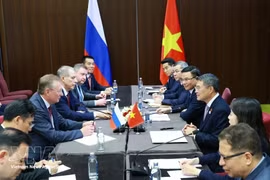
Leaders attend the opening ceremony of the ASEAN-Russia Business Forum, held in Kazan on June 17, 2026, on the sidelines of the ASEAN-Russia Commemorative Summit. (Photo: VNA)

ASEAN, Russia promote broad-based economic cooperation

In a message delivered to the ASEAN-Russia Business Forum, held in the city of Kazan on the sidelines of the ASEAN-Russia Commemorative Summit, Putin said the sides have accumulated substantial experience in multifaceted cooperation, built strong partnerships, and laid a solid foundation for further expanding cooperation.

(Photo: https://thainews.prd.go.th/)

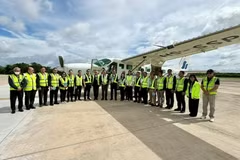
Thailand targets Krabi-Phuket seaplane launch in 2026

The ministry is also establishing a Strategic Integration Committee for the Development of Water-Based Aircraft Operations to coordinate implementation, develop operational guidelines, and ensure compliance with aviation safety standards.

Indonesia eyes becoming regional gold finance hub

Indonesia eyes becoming regional gold finance hub

In the long term, Indonesia aims not only to export raw gold but also to establish itself as a regional gold finance hub, generating greater value-added for its economy and enhancing its role in the global financial system.

A passenger train operated by State-owned railway operator PT Kereta Api Indonesia (KAI) departs from Tugu station in Yogyakarta city, Indonesia (Photo: VNA)

Indonesia tests biofuel for trains

KAI Vice President for Corporate Communications Anne Purba said the transition to B50 biofuel will be carried out in phases and undergo a rigorous testing process to meet the operational requirements of the railway industry, which demands high reliability and continuous operation.

Aircraft park at Suvarnabhumi Airport of Thailand. (Photo: AFP/VNA)

Thailand targets regional aviation hub status by 2029

Thailand is embarking on a wave of aviation infrastructure projects to capitalise on its strategic location between the world’s two most populous markets China and India, thereby cementing Thailand’s role as a key transit and logistics hub in ASEAN and Asia.