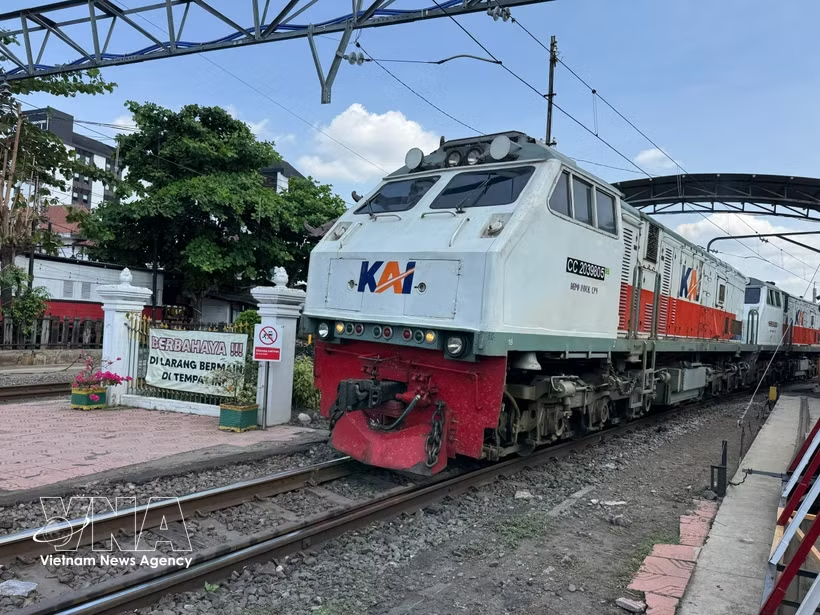
Jakarta (VNA) – State-owned railway operator PT Kereta Api Indonesia (KAI) is proceeding with trials of B50 biofuel for locomotives and train generator systems to ensure operational safety while supporting energy transition goals and reducing carbon emissions.
KAI Vice President for Corporate Communications Anne Purba said the transition to B50 biofuel will be carried out in phases and undergo a rigorous testing process to meet the operational requirements of the railway industry, which demands high reliability and continuous operation.
KAI, in collaboration with Indonesia’s Ministry of Energy and Mineral Resources, began trials of B50 in April. The programme is currently in the monitoring and evaluation phase before any large-scale deployment is considered. Tests were conducted on a CC206 locomotive hauling the Sembrani train and on the generator system of the Bogowonto train. Evaluation criteria include fuel consumption, operational efficiency, emissions and the ability to operate under high-load conditions.
According to KAI, the transition from B35 to B50 biofuel is one of the key programmes in its 2025–2030 decarbonisation strategy. The programme is expected to reduce nearly 134,000 tonnes of carbon dioxide equivalent (CO2e) emissions, contributing significantly to the company's overall emissions reduction target of nearly 167,000 tonnes.
Alongside the energy transition, the company is also strengthening its data-driven emissions measurement efforts. Results of a lifecycle assessment conducted in cooperation with the National Research and Innovation Agency (BRIN) show that the KRL Jabodetabek urban rail system emits only about 34.03 grams of CO2e per passenger-kilometre.
Anne said testing B50 biofuel is an important step in helping KAI maintain stable transport operations while gradually transitioning to lower-emission energy sources./.