Timor-Leste seeks quality investment to enhance competitiveness

ASEAN membership could help Timor-Leste expand market access, strengthen investor confidence and promote regional economic integration, while providing impetus for institutional reforms and improvements to the business environment.

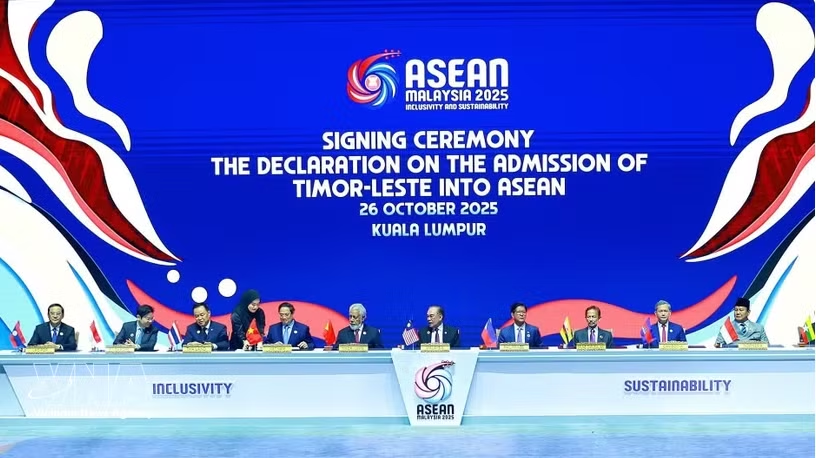
At the signing ceremony for the declaration on the admission of Timor-Leste into ASEAN in Kuala Lumpur in 2025 (Photo: VNA)

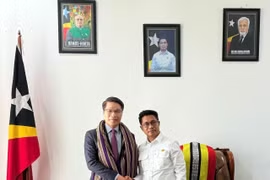
Jakarta (VNA) – Timor-Leste’s Minister of Commerce and Industry Filipus Pereira has stressed that the country’s ASEAN integration should not be viewed simply as a way to expand markets, but also as an opportunity to strengthen the capacity of people, businesses and domestic institutions, while attracting quality investment to enhance the country’s competitiveness.

He made the remarks at a policy dialogue themed “Building Resilient Trade and Investment Frameworks in a Diverse Global Landscape”, held on the sidelines of the 11th Belt and Road Summit in Hong Kong (China).

According to Pereira, Timor-Leste’s micro, small and medium-sized enterprises (MSMEs) still face constraints in accessing finance, technology, market information, quality standards and digital tools. The government is therefore working to enhance export capacity and attract investment, while encouraging a shift from raw-material exports to developing higher value-added products and services, particularly in agriculture, fisheries and resource extraction.

Pereira also highlighted the potential of e-commerce and digital trade to help Timor-Lesste's small economy overcome geographical constraints by connecting domestic producers with consumers in regional and international markets. To support trade and investment, he said the country needs to further improve customs procedures, infrastructure, connectivity, standards, regulatory transparency and the investment environment.

Regarding foreign investment attraction, the Timor-Leste government is shifting its focus from simply securing capital to prioritising projects that can create jobs, transfer technology and skills, support domestic businesses and strengthen long-term production capacity. Such quality investment, Pereira noted, should generate broader economic impacts rather than simply provide additional capital.

Timor-Leste has identified three key priorities: diversifying products and markets to reduce dependence on external factors; enabling MSMEs to participate more deeply in regional trade; and prioritising investment projects that bring technology, professional skills, innovation and long-term production capacity.

Against this backdrop, it sees ASEAN as a platform for learning, building capacity and gradually integrating into regional value chains. The World Bank’s Timor-Leste Economic Report 2026 also assessed that ASEAN membership could help the country expand market access, strengthen investor confidence and promote regional economic integration, while providing impetus for institutional reforms and improvements to the business environment./.

VNA

See more

Consumers select goods at a supermarket in Kuala Lumpur. (Photo: VNA)

Malaysian consumers tighten non-essential spending

CIMB Securities Sdn Bhd analyst Walter Aw Lik Hsin said shoppers are increasingly seeking cheaper products, convenience and value, while cutting back on clothing, lifestyle goods and other non-essentials.

Cambodian Chamber of Commerce president Kith Meng (right) meets with Malaysian ambassador to Cambodia Shaharuddin Onn on September 14. (Photo: phnompenhpost.com)

Cambodia, Malaysia pledge increased trade, investment cooperation

The General Department of Customs and Excise (GDCE) reported that Cambodia-Malaysia trade totaled 1.07 billion USD from January to August 2026, up 55.5% from the same period last year. Cambodia exported 151.76 million USD worth of goods to Malaysia, up 71.8%, while imports reached 921.19 million USD, an increase of 53.1%.

Smoke rises from a land fire in South Sumatra, Indonesia (Photo: Xinhua/VNA)

Indonesia: Thick smoke from forest fires disrupts flights

In a written statement on September 14, the Indonesian Ministry of Forestry said the latest monitoring data shows a significant decrease in so-called “high-confidence” hot spots, strongly suspected to be caused by forest fires, in Central Kalimantan and West Kalimantan.

Thailand upgrades GDP growth to 2.5% in 2026

Thailand upgrades GDP growth to 2.5% in 2026

Thailand's economic recovery will follow a K-shaped model, with growth concentrated in high-tech industries and large companies, according to the Centre for Economic and Business Forecasting at the University of the Thai Chamber of Commerce (UTCC).

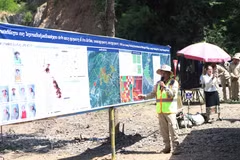
A pepresentatives of UXO Lao programme briefs on mine survey and clearance in Luang Prabang province (Photo: VNA)

International delegates inspect UXO clearance efforts in Laos

To realise the Convention on Cluster Munitions’s goals, the Lao Government has incorporated all international targets into its “Safe Path Forward III 2021–2030” national strategy and stayed committed to its national Sustainable Development Goal 18 – “Lives Safe from UXO”.

The forum on ASEAN's role in the Indo-Pacific region and prospects for cooperation with Argentina takes place on September 10 (Photo: VNA)

ASEAN highlights its central role in Indo-Pacific

The Ambassador of Indonesia, the country holding the rotating chairmanship of ASEAN in Argentina, stressed that maintaining peace and stability, along with an open, transparent regional environment based on mutual respect, are fundamental conditions for a peaceful, inclusive, and prosperous Indo-Pacific.

A street in Bangkok, Thailand. (Illustrative photo: Xinhua/VNA)

Thailand’s business activity shows signs of gradual recovery

As of August 31, Thailand had more than 1 million active legal entities with total registered capital of 24.13 trillion THB. The service sector accounted for the largest share, with 552,830 entities, or 54.48%, followed by wholesale and retail with 332,791 entities (32.79%) and manufacturing with 129,215 (12.73%).

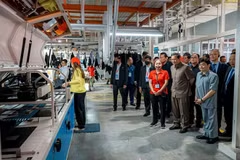
Prime Minister Hun Manet (front row, centre) and Labour and Vocational Training Minister Heng Sour (front row, right) visit a garment factory in Preah Sihanouk province. MLVT (Photo: khmertimeskh.com)

Cambodia records 7,458 more enterprises in three years

A Cambodian official said that the growth should not be assessed solely by the number of newly established enterprises and facilities, but also by their contributions to investment, production, job creation and household incomes.