Top legislator calls for building regular, elite, modern external security force

The NA Chairman stressed that under all circumstances, the force must remain absolutely loyal to the Party, the nation and the people, while upholding the principle of the Party’s absolute, direct and comprehensive leadership – specifically through the Central Public Security Party Committee and the leadership of the Ministry of Public Security.

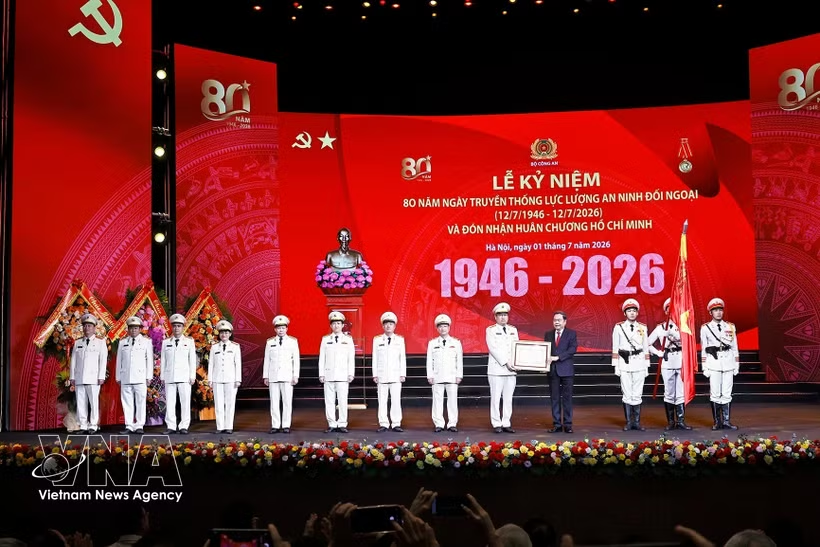
National Assembly Chairman Tran Thanh Man presents the Ho Chi Minh Order to the external security force at the ceremony in Hanoi on July 1, in recognition of its outstanding contributions to the revolutionary cause of the Party and the nation. (Photo: VNA)

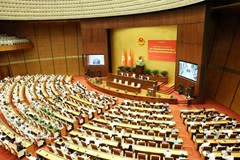
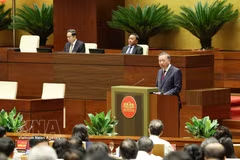
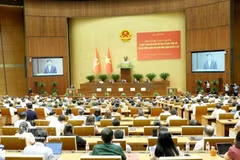
Hanoi (VNA) – National Assembly (NA) Chairman Tran Thanh Man highlighted the importance of building a regular, elite and modern external security force while addressing a ceremony in Hanoi on July 1 marking the 80th anniversary of the force’s traditional day (July 12, 1946 – 2026).

Party General Secretary and State President To Lam, Prime Minister Le Minh Hung, Permanent Member of the Party Central Committee’s Secretariat Tran Cam Tu, along with incumbent and former Party and State leaders, sent baskets of flowers to the ceremony to congratulate the force.

Delivering remarks on behalf of Party and State leaders, Chairman Man commended and congratulated the external security force for its sustained efforts and achievements over the past years, noting its contribution to the cause of national construction and protection.

He stressed that under all circumstances, the force must remain absolutely loyal to the Party, the nation and the people, while upholding the principle of the Party’s absolute, direct and comprehensive leadership – specifically through the Central Public Security Party Committee and the leadership of the Ministry of Public Security.

The top legislator also called for close coordination with relevant forces, ministries, sectors and local authorities.

The NA Chairman urged the force to proactively implement professional measures to gather intelligence and enhance analysis, assessment and forecasting of international and regional developments. He emphasised the need to prevent attempts to influence policy and interfere in domestic affairs by hostile forces.

He further instructed the force to provide strategic policy advice to the Party and State in responding to geopolitical developments, ensuring preparedness and preventing surprises, while identifying and neutralising threats to national security beyond national borders and within cyberspace.
vnanet-tran-thanh-man-external-security-force.jpg
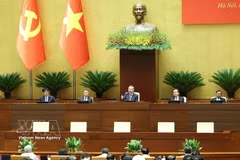
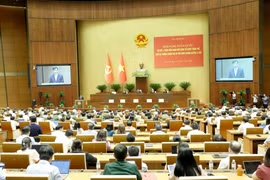
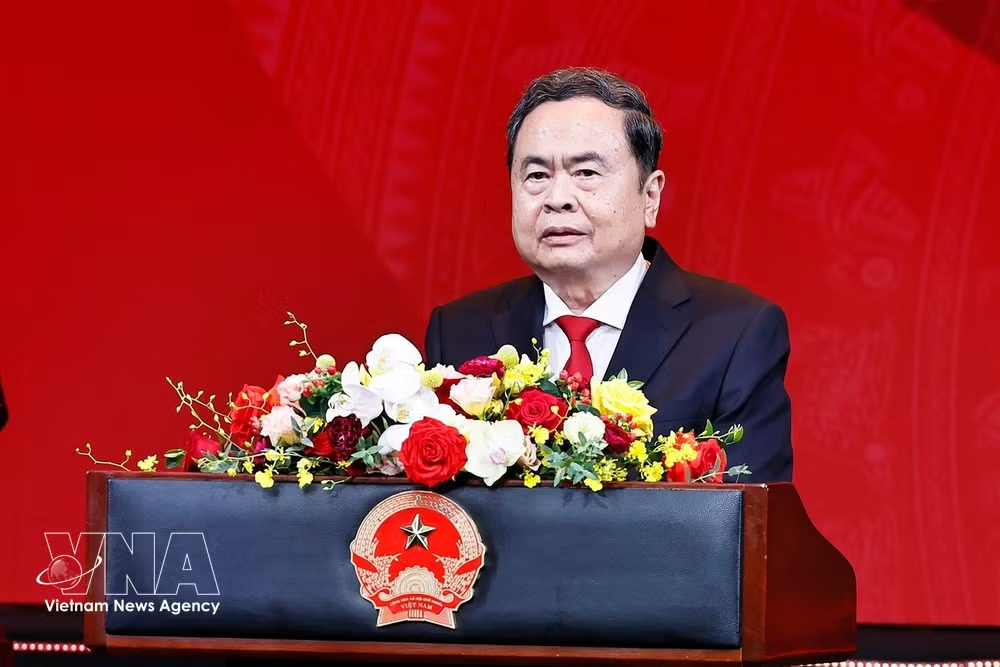
National Assembly Chairman Tran Thanh Man addresses the ceremony in Hanoi on July 1 marking the 80th anniversary of the external security force’s traditional day (July 12, 1946 – 2026). (Photo: VNA)

At the same time, the top legislator called for continued innovation in operational mindset and organisational methods, with greater attention to monitoring and preventing risks of policy deviation and misuse of international cooperation, treaties and agreements that could undermine national sovereignty, interests and security.

Chairman Man also highlighted the importance of building a professional, elite and modern people’s public security force in general and external security force in particular.

Priority should be given to developing personnel with strong political mettle, professional expertise, foreign language skills and knowledge of international law, alongside the ability to master advanced technologies and modern technical systems.

He added that organisational structures should remain streamlined and operate efficiently to meet increasingly complex requirements in a multipolar international environment and an era of rapid digital transformation.

On international security cooperation, the leader called for deeper and more substantive engagement with foreign security and police agencies as well as international organisations, based on the principles of respect for national independence, sovereignty and interests.

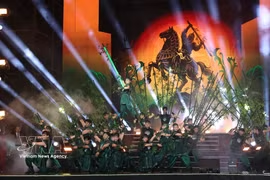
At the ceremony, on behalf of the Party and State leaders, Chairman Man presented the Ho Chi Minh Order to the force in recognition of its outstanding contributions to the revolutionary cause of the Party and the nation./.
VNA

See more

Party General Secretary and State President To Lam (centre) chairs the conference. (Photo: VNA)

Politburo sets six priorities for implementing Resolution No. 57

After 18 months of implementing Resolution No. 57, ministries, sectors and localities have adopted innovative and effective approaches that have generated positive momentum, while winning broad support from businesses, the scientific community and the public for policies on science, technology, innovation and digital transformation.

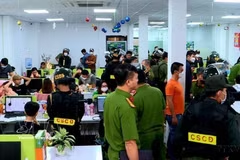
Police in Tan Binh district, Ho Chi Minh City, in coordination with the Department of Cybersecurity and High-Tech Crime Prevention under the Ministry of Public Security, searched multiple locations and placed 86 suspects in temporary criminal detention for investigation into alleged telecom and online fraud. (Photo: VNA)

New Cybersecurity Law strengthens protection of citizens' rights in digital age

The law also introduces more comprehensive provisions on data security, information system protection and measures to prevent, detect and address cybersecurity violations. It prioritises prevention, enhances early warning and incident response capabilities, and links cybersecurity with maintaining social order and security amid rapid digital transformation.

An overview of the the July 1 national conference reviewing the one-year operation of the three-tier administration model (Photo: VNA)

Localities propose reforms to improve three-tier government model

A Hanoi official called for further decentralisation to commune-level authorities in line with resource allocation, continued streamlining of organisational structures to eliminate unnecessary intermediary layers, further refining the Party organisations’ model to align with the state administrative system, greater autonomy for non-business public service units, and wider participation of businesses and social organisations in delivering suitable public services.

Party General Secretary and State President To Lam addresses the conference on July 1. (Photo: VNA)

New administrative system must deliver new governance capacity: Top leader

The Party and State leader described the restructuring as a broad, complex and far-reaching reform affecting almost every agency and public servant from the central to grassroots levels. While praising the significant initial achievements, he stressed that the results marked only the beginning and warned against complacency.

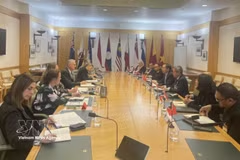
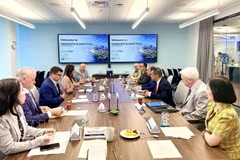
An overview of the working session between ASEAN Committee in Canberra and the Australian Department of Home Affairs (Photo: VNA)

ASEAN Committee in Canberra seeks closer cooperation with Australia's Home Affairs Department

Vietnamese Ambassador to Australia Pham Hung Tam proposed that Australia extend the visa validity period for ASEAN graduates of master's degree programmes from two years to three years in the country from two years to three years. He also urged Australia to soon grant transit visa exemptions for Vietnamese citizens, similar to those already available to nationals of several other ASEAN countries.

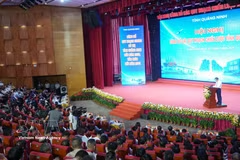
The June 30 conference announcing a series of strategic plans of Quang Ninh and receive recognition of Quang Ninh as a tier-1 urban area. (Photo: VNA)

Quang Ninh unveils strategic plans, sets sights on becoming national urban hub

Under a master plan, Quang Ninh's urban development will be organised around three corridors, four socio-economic zones and five growth centres, including Ha Long, Van Don, Mong Cai, Quang Yen, and the Yen Tu–Ha Long Bay heritage complex. The province will adopt a multi-centre urban model placing people and heritage, including Ha Long Bay and the Yen Tu scenic complex, at its core.

Vietnamese Ambassador to the US Nguyen Quoc Dung (fourth, right) chairs a business rountable with three leading economic promotion organisations of Minnesota. (Photo: VNA)

Vietnamese, US localities strengthen cooperation across multiple fields

Vietnamese Ambassador to the US Nguyen Quoc Dung called on the state to continue supporting the Vietnamese community in Minnesota, encourage local businesses to expand investment and operations in Vietnam, and promote sister-city and sister-province partnerships between Minnesota and Vietnamese localities.

The conference reviews the one-year implementation of the overall organisational model of the political system and the three-tier administration model. (Photo: VNA)

Conference reviews one-year implementation of three-tier administration model

The event was held in a hybrid format, with the main venue at the Dien Hong Hall of the National Assembly building and online connection to 3,651 venues across ministries, central agencies, socio-political organisations, and headquarters of provincial, municipal, commune, ward and special-zone administrations nationwide.

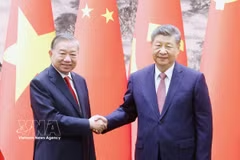
General Secretary of the Communist Party of Vietnam Central Committee and President of Vietnam To Lam (L) and General Secretary of the Communist Party of China Central Committee and President of China Xi Jinping at the signing ceremony of cooperation documents between the two countries during the former’s state visit to China in April 2026. (Photo: VNA)

Congratulations extended on Communist Party of China’s 105th founding anniversary

In the message, the CPV Central Committee congratulated the CPC on its achievements over the past 105 years in uniting and leading the Chinese people to overcome numerous difficulties and challenges and secure remarkable accomplishments. These include the founding of the People's Republic of China, the implementation of the reform and opening-up policy, the advancement of socialism with Chinese characteristics into a new era, and the improvement of the role and international standing of the Party and State.

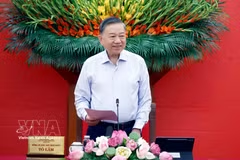
Party General Secretary and State President To Lam speaks at the first meeting of the Central Steering Committee for Foreign Affairs and International Integration. (Photo: VNA)

Foreign affairs should better serve national development: Top leader

Party General Secretary and State President To Lam underscored that Vietnam’s development goals for 2030, with a vision to 2045, require foreign affairs and international integration to become more proactive, with stronger forecasting capacity, timely and accurate policy advice, and swift action.

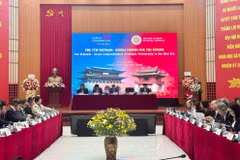
A view of the 7th Vietnam–Korea Forum for the Future (Photo: baochinhphu.vn)

Vietnam, RoK seek to strengthen scientific research cooperation

The forum provided a platform for academic exchange, policy dialogue and networking among research institutions, policymakers, experts, scholars and relevant organisations from both countries. It also aimed to put forward policy recommendations to further advance the Vietnam–RoK Comprehensive Strategic Partnership in the new development phase.

Head of the CPV Central Committee's Commission for Internal Affairs Le Minh Tri (R) and Chinese Ambassador to Vietnam He Wei. (Photo: VNA)

Party official hosts Chinese Ambassador

Vietnam and China further consolidate strategic mutual trust between the two Parties and countries, effectively turn the important common perceptions reached by their top leaders into action, and carry out bilateral diplomatic programmes.