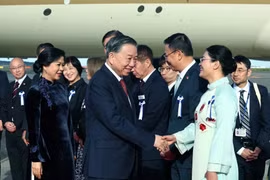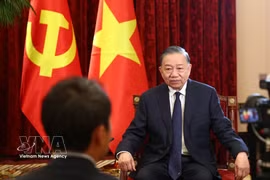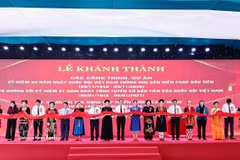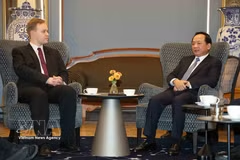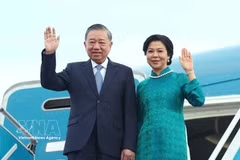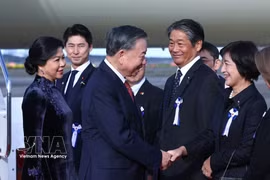
Hanoi (VNA) – General Secretary of the Communist Party of Vietnam (CPV) Central Committee and President To Lam, his spouse and a high-ranking Vietnamese delegation are paying an official visit to Japan from November 8-11 at the invitation of the Japanese State.
The visit is expected to further deepen ties through Party, State, parliamentary and people-to-people channels, while creating breakthroughs in economic, financial, scientific and technological cooperation, innovation, education and training, digital and green transformation, and supply chain diversification, thereby contributing to a peaceful and stable environment for development in both countries.
More than five decades of friendship and trust
The relationship between Vietnam and Japan has been built on shared cultural values, long-term common interests and the close bonds between their people. Since establishing diplomatic relations on September 21, 1973, the two countries have developed into reliable strategic partners and sincere friends who respect and support each other.
Over more than five decades, bilateral ties have been continuously elevated, from the Reliable, Long-term Stable Partnership in 2002 to the Strategic Partnership for Peace and Prosperity in Asia in 2009, the Extensive Strategic Partnership for Peace and Prosperity in Asia in 2014, and the Comprehensive Strategic Partnership for Peace and Prosperity in Asia and the World in November 2023.
The latest upgrade reflects a high level of political trust and the maturity of bilateral relations, opening up opportunities for more substantive and effective cooperation across various fields for the benefit of both peoples and for peace, stability and prosperity in the region and the world.
In recent years, the Comprehensive Strategic Partnership has developed comprehensively and substantively through Party, Government, parliamentary and people-to-people channels, as well as cooperation among ministries, sectors and localities. Political trust has continued to grow, underpinned by shared strategic interests.
The two sides have maintained regular high-level exchanges. The two countries have also maintained and expanded substantive dialogue mechanisms, including the Vietnam-Japan Cooperation Committee, co-chaired by the two foreign ministers; the Joint Committee on Trade, Energy and Industry; the Vietnam-Japan Joint Initiative; and the ministerial-level Agricultural Dialogue. Political, diplomatic, security and defence cooperation has also been strengthened through regular dialogue mechanisms, including the 2+2 Deputy Foreign Minister and Deputy Defence Minister Dialogue established in December 2025.
Economically, Japan remains one of Vietnam's leading partners. It is the country's largest provider of official development assistance (ODA) and labour cooperation partner, its third-largest foreign investor, and its fourth-largest trading and tourism partner.
Bilateral trade reached approximately 52 billion USD in 2025, up 11% from 2024, and stood at 33.7 billion USD in the first eight months of 2026, an increase of 27% year on year. The two countries aim to raise two-way trade to 60 billion USD by 2030.
As of July, Japan had 5,800 valid investment projects in Vietnam, with total registered capital of 80.4 billion USD, ranking third among 154 countries and territories investing in the country, after the Republic of Korea and Singapore.
Cooperation in emerging areas, including digital transformation, green transition and renewable energy, has also made progress. Japan's strengths in advanced technology, modern management, semiconductors, AI, clean energy and green finance complement Vietnam's dynamic economy, young workforce and growing pool of skilled workers. These advantages provide considerable room for expanded cooperation.
Human resources development, local-level partnerships and people-to-people exchanges remain bright spots in bilateral relations. The two countries have established more than 100 partnerships between localities. More than 10 major festivals were held in Vietnam and Japan in 2026, helping promote mutual understanding and cultural exchanges. The Vietnamese community in Japan numbers nearly 700,000, including an increasing number of intellectuals and highly skilled workers, with around 7,000 Vietnamese IT engineers currently working in the country.
Visit to create fresh momentum for the Comprehensive Strategic Partnership
Against the backdrop of bilateral relations enjoying their strongest development to date, the official visit by General Secretary and President Lam, his spouse and the high-ranking delegation holds special significance.
It is the first visit to Japan by a Vietnamese leader holding both the positions of Party General Secretary and State President, the first by a CPV General Secretary in 11 years and the first by a Vietnamese State President in three years. Coming as both countries have new leadership teams and are pursuing ambitious development and growth targets, the visit demonstrates Vietnam's high regard for Japan as one of its foremost and long-term comprehensive strategic partners.
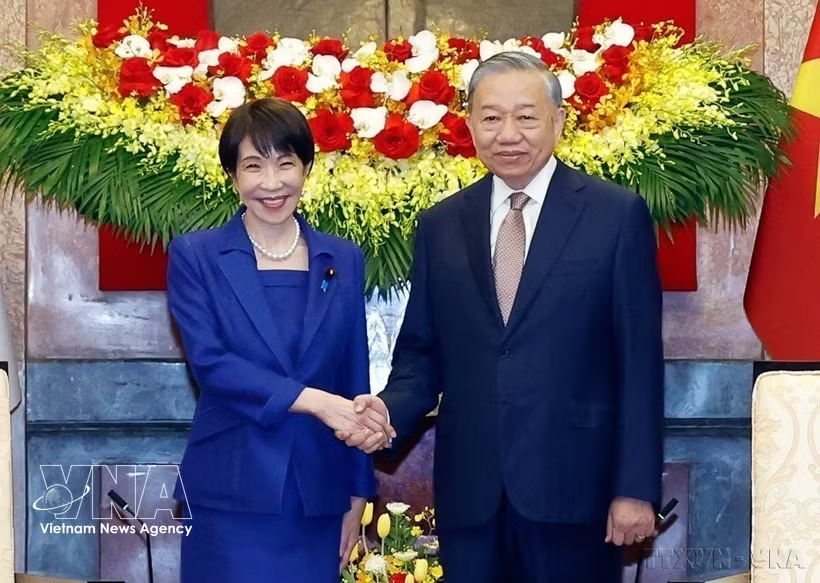
During the visit, the Vietnamese top leader is scheduled to attend an official welcome ceremony, meet Emperor Naruhito, hold talks with Prime Minister Sanae Takaichi, meet the Presidents of Japan's House of Councillors and House of Representatives, deliver a policy speech at the Japanese Parliament, visit Kanagawa prefecture and attend other important diplomatic activities.
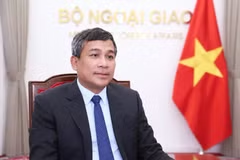
Foreign Ministry spokesperson Pham Thu Hang said the visit aims to consolidate the Vietnam-Japan Comprehensive Strategic Partnership, with a focus on promoting substantive and comprehensive cooperation in key areas, particularly politics, underpinned by high political trust, as well as economics, investment and trade.
The two countries' leaders are also expected to discuss ways to expand cooperation in emerging fields such as innovation, green and digital transformation, and high-quality human resources, alongside established areas including education, training and labour.
These are fields in which Japan has considerable experience and strengths, while Vietnam has growing demand and significant potential for cooperation, she noted.
The spokesperson expressed her belief that the visit will provide strong momentum for translating agreements and commitments reached by leaders at all levels into broader and more effective cooperation, contributing to the development and growth goals of both countries and to peace, cooperation and development in the region and the world.
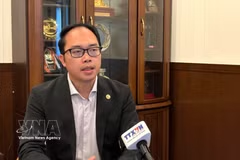
Vietnamese Ambassador to Japan Pham Quang Hieu said the visit takes place at a time when both countries are facing new development requirements. Vietnam is accelerating industrialisation and modernisation towards its two centenary development goals in 2030 and 2045, while Japan is pursuing new growth drivers by linking economic development with science and technology and strengthening its position in key economic and technological sectors.
The message of the visit, he said, is to establish a new framework for cooperation at a higher level, open up new development opportunities in strategic fields with a long-term vision, and ensure that the benefits of cooperation are shared by the people of both countries.
Japanese Ambassador to Vietnam Ito Naoki described the visit as highly significant in further advancing friendship and cooperation within the framework of the Comprehensive Strategic Partnership. Taking place shortly after Japanese Prime Minister Takaichi Sanae's visit to Vietnam in May, it reflects the importance both countries attach to their bilateral relationship. He noted that General Secretary and President Lam's visit in the first year of his five-year term as General Secretary of CPV Central Committee also demonstrates the Party's strong commitment to ties with Japan.
Ito said the two sides will focus on three major areas, namely strengthening cooperation to contribute to regional peace and stability; advancing economic security, supply chain resilience and innovation, with priorities including AI, semiconductors, digital transformation, green transformation, critical minerals, food security and agriculture; and promoting people-to-people and cultural exchanges.
Building on a solid foundation of political trust and fruitful cooperation, Vietnam-Japan relations are entering a phase of deeper strategic engagement. The visit is expected to establish a higher-level framework for bilateral cooperation, unlock new opportunities in strategic areas and strengthen the Comprehensive Strategic Partnership as a foundation for both countries to realise their development goals and aspirations./.