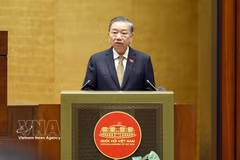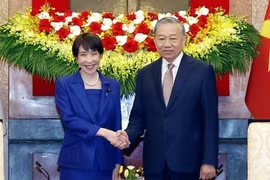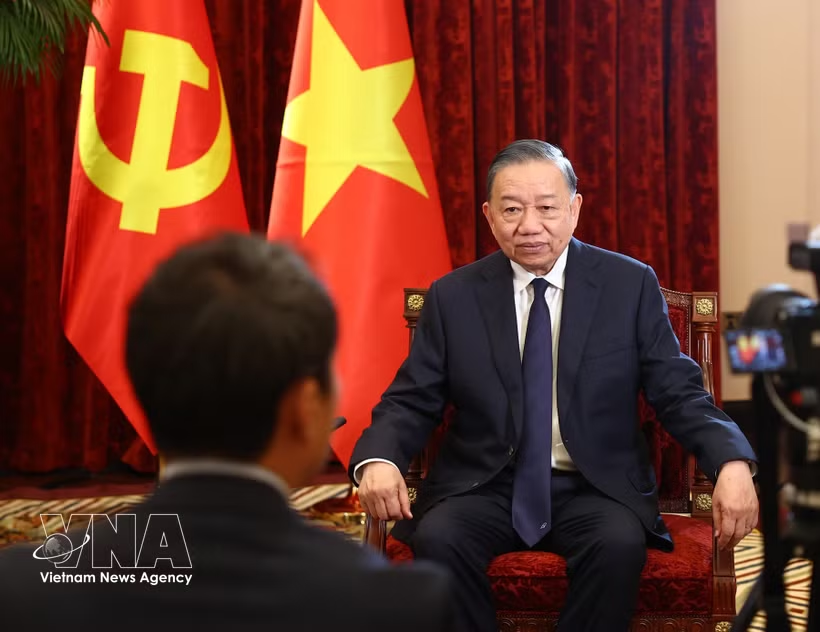
Hanoi (VNA) - General Secretary of the Communist Party of Vietnam Central Committee and President To Lam has granted an interview to Japan's public media organisation, Nippon Hoso Kyokai (NHK), ahead of his official visit to Japan.
The Vietnam News Agency respectfully presents a translation of the interview.
Reporter: What are the main objectives of your upcoming official visit to Japan? What are your expectations for the future development of Vietnam-Japan relations, particularly in the areas of economy, investment and human resource development?
General Secretary and President To Lam: I believe this visit to Japan will further concretise the potential and cooperation outcomes and strengthen the longstanding ties between our two countries to ensure that the friendship nurtured across generations continues to bring lasting benefits to the people of both countries. Vietnam and Japan have a history of people-to-people exchanges dating back more than 400 years.
Vietnam has always regarded Japan as one of its most important and long-term comprehensive strategic partners. We highly value Japan’s help for Vietnam to achieve its two centenary strategic goals. Building on this foundation, I look forward to working with Japanese leaders to deepen mutual trust, agree on long-term cooperation priorities and generate fresh momentum for the Comprehensive Strategic Partnership for Peace and Prosperity in Asia and the world.
We are pleased to see bilateral trade reaching nearly 50 billion USD in the first 10 months of 2026, moving towards the early realisation of the 80 billion USD target, with efforts to raise it to 100 billion USD, by 2030. Japan currently has around 5,800 investment projects in Vietnam, with total active capital of 80.4 billion USD.
I hope these achievements will be further strengthened by the growth of Vietnamese enterprises, the long-term commitment of Japanese businesses and the development of higher-value products jointly created by the two sides.
To achieve this, we hope Japanese businesses will expand their investment, research and product development in Vietnam, while working with Vietnamese enterprises to participate more deeply in value chains. Cooperation in advanced industries, semiconductors, artificial intelligence and clean energy should go hand in hand with workforce training and improvements in technological and management capabilities. For its part, Vietnam attaches importance to building a transparent, stable and predictable business environment, while promptly addressing legitimate concerns raised by businesses. Trust must be nurtured through concrete actions and the success of each cooperation project.
In terms of human resources, my hope is that every Vietnamese person studying and working in Japan will have opportunities to acquire knowledge, improve professional skills, develop their careers and have their legitimate rights and interests protected. We also wish to see more Japanese experts, scientists and young people come to Vietnam to work, conduct research and start businesses. It is people who understand, trust and maintain close ties with both countries who will carry our friendship forward. I expect this visit to create fresh momentum for the Vietnam-Japan Comprehensive Strategic Partnership, serving the interests of both countries’ people and contributing to peace, stability, cooperation and prosperity in the Asia-Pacific region and the world. Our new vision is to build a partnership in which the two countries stand alongside and create together, exercise strategic autonomy, pursue effective and mutually beneficial cooperation for the well-being of our people and workers.
Reporter: Amid growing uncertainty in the international environment, what diplomatic approach will Vietnam adopt to address challenges and achieve its goals of rapid and sustainable development in the new period?
General Secretary and President To Lam: Vietnam has chosen an approach that is steadfast in principle, proactive in action and sincere in cooperation. Our national history has given us a profound understanding of the value of peace and the aspiration to rise. We understand that we cannot wait for global uncertainty to subside before pursuing development. Instead, we must proactively create the conditions for the country to move forward amid difficulties and volatility.
First and foremost, Vietnam remains steadfast in its foreign policy of independence, self-reliance, resilience, peace, friendship, cooperation and development. We pursue the diversification and multilateralisation of external relations, while placing the highest priority on national interests on the basis of the fundamental principles of international law and the United Nations Charter.
Strategic autonomy means having the capacity to independently determine our development path and the ability to implement those decisions. This capacity is built on strong domestic foundations, public consensus and extensive, stable international relations. The more volatile the world becomes, the more Vietnam values consistency in principles, sincerity in cooperation and responsibility in honouring its commitments.
We will deepen relations with our partners and seek common interests to strengthen cohesion, while persistently addressing differences through dialogue and peaceful means. Diplomacy must take the lead in identifying and preventing risks, maintaining channels of communication and preparing response measures at an early stage. Vietnam values the role of the United Nations and ASEAN’s solidarity and centrality. We stand ready to contribute to keeping peace and addressing common challenges. We believe a country's standing is built on the trust it earns and the contributions it makes to the international community.
In terms of development, our expectation is that every opportunity generated through foreign relations will help the country, its people and businesses strengthen their own capabilities. Therefore, cooperation in technology, human resources, green finance, energy and infrastructure must go hand in hand with institutional reform and stronger capacity to absorb and master knowledge and technology. We will support businesses in expanding markets and participating more deeply in value chains, while diversifying sources of supply and partners to reduce potentially vulnerable dependencies. The effectiveness of international integration should be reflected in higher productivity, stronger businesses and better jobs for the people.
With Japan, I am confident that the foundation of the Comprehensive Strategic Partnership and high-level political trust will enable the two countries to continue standing alongside one another, creating together and sharing both opportunities and responsibilities. Our goal is a country with sufficient autonomy, resilience and trusted friends such as Japan, and making increasingly practical contributions to the international community. All these efforts stem from our desire to see the people of both countries enjoy greater happiness, have more opportunities to realise their potential, and ensure that future generations can look to the future with confidence./.
VNA