Value chains, private sector key to elevating Vietnam’s agricultural standing

As Vietnam enters a new development phase, value-chain linkages, private-sector growth and deeper international integration are emerging as key drivers for enhancing the competitiveness and global standing of its agricultural products.

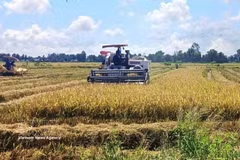
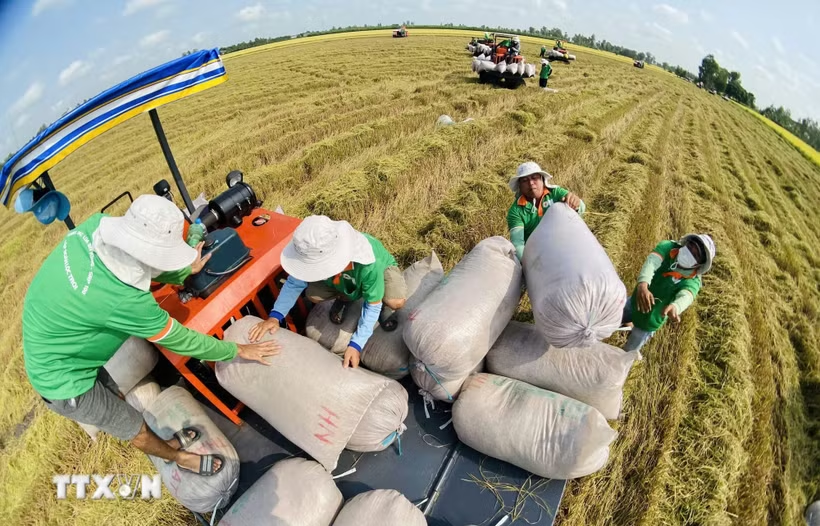
Vietnam its position as one of the world's top three rice exporting countries. (Photo: VNA)

Hanoi (VNA) – Fifty-one years after national reunification, Vietnam’s agricultural sector has transformed from a food-deficient economy into a major supplier of agricultural products, ensuring domestic food security while contributing to global food supplies.

Record export revenues and leading positions in commodities such as rice, coffee, fruits and vegetables, cashew nuts, seafood and forestry products reflect not only economic success but also a shift toward an agricultural economy driven by value creation and market demand.

As Vietnam enters a new development phase, value-chain linkages, private-sector growth and deeper international integration are emerging as key drivers for enhancing the competitiveness and global standing of its agricultural products.

A major shift in production mindset

In 1975, Vietnam’s agricultural sector faced severe difficulty. Rice output stood at 5.49 million tonnes with an average yield of 2.11 tonnes per hectare. Limited food supplies forced the country to import the equivalent of 880,000 tonnes of paddy rice, while agricultural exports generated less than 100 million USD annually.

More than five decades later, Vietnam has become one of the world’s top rice exporters and developed a diversified agricultural sector. Vietnamese products are now present in over 200 countries and territories, including some of the world’s most demanding markets.

Exports of agriculture, forestry and fishery products reached 70.09 billion USD in 2025, and the sector is targeting 73–74 billion USD this year.

These achievements have been supported by institutional reforms and a fundamental shift in development thinking. Agriculture is no longer viewed solely as cultivation and harvesting but as an economic sector where value creation, market orientation and supply-chain development play decisive roles.
nong-nghiep.jpg
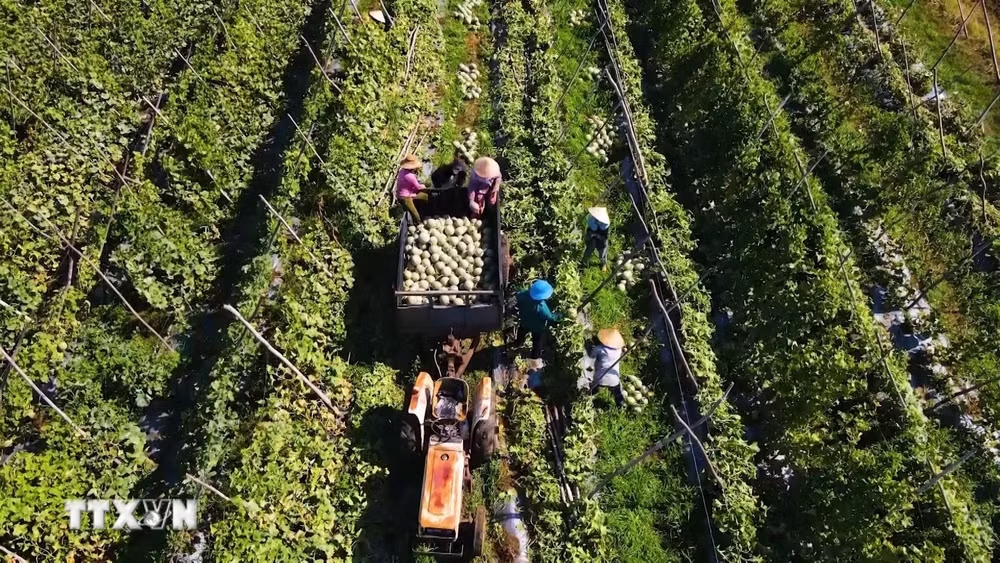
Vietnam is developing a modern, ecological agriculture sector with farmers at its centre (Photo: VNA)

Guided by the Party Central Committee’s Resolution No. 19-NQ/TW and the Government’s strategy for sustainable agricultural and rural development, Vietnam is pursuing a modern, ecological and competitive agricultural sector centred on farmers and integrated value creation.

However, fragmented production and weak linkages continue to limit value addition and increase vulnerability to market fluctuations. As a result, restructuring production around value chains has become a key priority.

Lai Chau province offers a notable example. Farmers have gradually shifted from small-scale production to participating in concentrated raw-material zones linked to market demand. The northwestern province has developed commodity production areas covering tea, cinnamon, macadamia, fruit trees and rice, while expanding aquaculture and cold-water fish farming.

It is also promoting the development of Lai Chau ginseng as a strategic product, aiming to expand cultivation and strengthen quality standards and branding.

Expanding markets, strengthening competitiveness

The agricultural sector is expected to gain new momentum from the Politburo’s Resolution No. 68-NQ/TW on private-sector development, which identifies the private sector as an important driver of the economy.

The resolution is expected to encourage greater investment in technology, processing and value-added production, helping enterprises participate more deeply in global value chains.

At the same time, Vietnam is strengthening international cooperation to expand export markets and enhance product value. Agricultural ties with China continue to deepen through improved market access, traceability systems and customs procedures, while cooperation with India, Malaysia, the Philippines, Japan and other partners is also expanding.

These efforts reflect Vietnam’s ambition not only to export agricultural products but also to secure a stronger position in global supply chains.

After 51 years of development, Vietnam’s agricultural sector has achieved remarkable progress. Moving forward, the focus will increasingly shift from volume-based growth to value-based growth, with value-chain development, private-sector participation, international integration and brand building serving as the foundations for sustainable agricultural development in the years ahead./.
VNA

See more

A corner of Phu Quoc special zone in An Giang province (Photo: VNA)

An Giang aims to become leading maritime economic hub

Under the province's master plan for 2021–2030 with a vision to 2050, An Giang will prioritise investment in five strategic sectors: strategic infrastructure; processing industries and clean energy; trade, services, logistics and border-gate economy; high-quality tourism; and high-tech agriculture, ecological development and the circular economy.

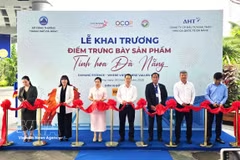
Chairman of Da Nang city People's Committee Nguyen Manh Hung and delegates at the opening ceremony of the product showcase space at the International Passenger Terminal of Da Nang International Airport. (Photo: VNA)

Da Nang opens showcase for signature local products at airport

Speaking at the opening ceremony, Deputy Director of the municipal Department of Industry and Trade Do Thi Quynh Tram said Da Nang is home to a wide range of distinctive OCOP products, rural industrial goods and local specialities. The new exhibition spaces will help connect high-quality local products with consumers, particularly tourists, while enhancing brand recognition and promoting the city’s image.

Deputy Prime Minister Ho Quoc Dung speaks at the meeting (Photo: VNA)

Deputy PM calls for long-term strategy for sustainable fisheries development

Localities that have acted decisively have made clear progress while those taking a passive approach continue to see violations, Deputy PM Ho Quoc Dung said, adding that closer coordination among ministries, sectors and local authorities is needed to establish a unified nationwide fisheries management system.

Participants in the business forum held in Veracruz state of Mexico on July 27 (Photo: VNA)

Vietnam, Mexico step up business connectivity

The Trade Office invited Veracruz businesses to attend the Vietnam International Sourcing Expo 2026, a major trade promotion event hosted by Vietnam’s Ministry of Industry and Trade, to explore partnership and sourcing opportunities with Vietnamese manufacturers and exporters.

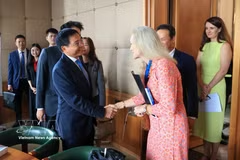
Deputy PM Nguyen Van Thang (L) meets with WTO Deputy Director-General Jennifer DJ Nordquist (Photo: VNA)

Deputy PM seeks WTO, WEF’s more support to Vietnam

As an active WTO member, Vietnam has been making active contributions to the organisation's agenda, including ratifying the first phase of the Agreement on Fisheries Subsidies, negotiating entry into the expanded Information Technology Agreement (ITA2), and preparing for its next Trade Policy Review scheduled for late 2026, Deputy Prime Minister Nguyen Van Thang said.

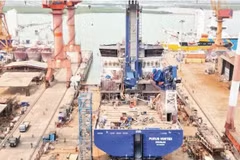
A modern commissioning service operation vessel for the offshore wind industry under construction at Ha Long shipyard. (Photo: nhandan.vn)

Shipbuilding helps shape Vietnam's maritime ecosystem, capabilities

Shipbuilding is increasingly viewed as an important component of Vietnam's marine economy. More than simply a manufacturing sector, it forms part of an integrated industrial ecosystem closely linked with metallurgy, mechanical engineering, electrical and electronic industries, automation, information technology and maritime logistics.

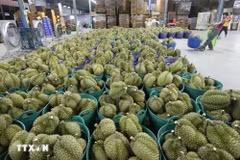
Vietnam's durian exports are expected to exceed 2 billion USD by the end of July. (Photo: VNA)

Durian exports recover despite mounting price pressure

If the Central Highlands harvest proceeds smoothly and pending issues related to growing-area and packing-house codes are resolved promptly, exports could generate an additional 2 billion USD in the remaining months of the year, pushing the whole-year figure beyond 4 billion USD, up from 3.8 billion USD last year.

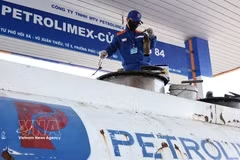
At a Petrolimex station. Petrolimex said it was increasing fuel procurement, adjusting distribution and moving supplies between regions to ensure fuel supply across its system. (Photo: VNA)

Ministry orders fuel supply inspections amid localised shortages

The ministry has taken steps to immediately inspect locations reporting shortages and identify the cause. Localities where shortages are taking place must examine the entire supply chain, including contracts between retailers and wholesalers, actual supply volumes, delivery schedules and the reasons for any failure to provide fuel.

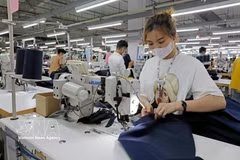
Garment production for export to the US market at TAL Vinh Phuc Garment Company. (Photo: VNA)

New US tariff policy should be based on objective, comprehensive assessment

This progress has been built on mutual respect, transparency and Vietnam's sustained efforts to improve its legal framework and comply with international standards. However, the US' recent tariff decision appears to overlook realities regarding Vietnam's labour environment and manufacturing practices.

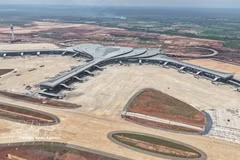
The construction site of Long Thanh International Airport in July 2026. (Photo: VNA)

Long Thanh Airport's second runway to be completed in September

According to the Airports Corporation of Vietnam (ACV), after 14 months of construction, the cement concrete pavement for the runway and taxiways has been substantially completed. Contractors are mobilising hundreds of workers and construction equipment to finish the remaining works on schedule.