Policy reform needed to unlock green credit for digital agriculture

Shifting agricultural lending from collateral-based requirements to cash-flow assessment, linked with insurance and value chains, is emerging as a key solution to support Vietnam’s transition to digital and green agriculture, experts said at a workshop on agricultural credit policy on April 24.

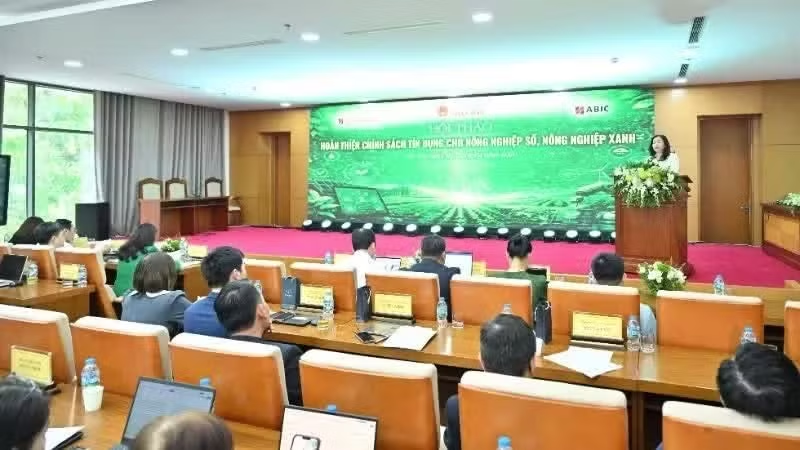
Participants in the workshop (Photo: VietnamPlus)

Hanoi (VNA) – Shifting agricultural lending from collateral-based requirements to cash-flow assessment, linked with insurance and value chains, is emerging as a key solution to support Vietnam’s transition to digital and green agriculture, experts said at a workshop on agricultural credit policy on April 24.

At the workshop on improving credit policies for digital and green agriculture, organised by the Dai bieu Nhan Dan (People’s Representatives) newspaper, policymakers, bankers, and businesses highlighted persistent barriers that continue to limit access to finance despite growing credit flows into the agricultural sector.

The discussion was held as a step to implement the Politburo’s Resolution No. 57-NQ/TW on science – technology development, innovation, and national digital transformation.

Institutional bottlenecks and risk-sharing mechanisms

Statistics show that outstanding loans to the agriculture and rural development sector reached about 4.2 quadrillion VND (nearly 159.6 billion USD) by the start of 2026, up more than 14% year-on-year and accounting for over 22% of total credit in the economy. This funding is currently providing direct support to more than 14.6 million beneficiaries nationwide.

Green credit also expanded to nearly 780 trillion VND by the end of 2025, mainly focusing on renewable energy, clean energy, and green agriculture.

These figures point to a clearer reorientation of capital towards priority sectors.

However, experts noted that the challenge lies less in the volume of credit than in its structure and quality. Current lending practices remain heavily dependent on traditional collateral requirements and do not adequately reflect the needs of modern agriculture, which requires long-term financing, flexibility, and close integration with value chains.

Ta Dinh Thi, Vice Chairman of the National Assembly's Committee for Science, Technology and Environment, said credit plays the key role in agricultural transformation, but institutional bottlenecks, administrative procedures, limited risk-sharing mechanisms, and weak insurance coverage continue to hinder capital flows.

He stressed that agricultural transformation involves not only changes in production methods but a comprehensive shift in mindset and action, with financing across the entire value chain being the decisive factor.

Agricultural credit still heavily dependent on collateral

Nguyen Quang Huy, head of the finance – banking faculty at the Nguyen Trai University, said agricultural credit still relies heavily on collateral, particularly real estate. This poses difficulties for farmers and businesses operating on leased land, which is often not accepted as loan security.

He also pointed to fragmented lending and limited value-chain linkages, saying insufficient digital skills among farmers and cooperatives have also slowed the transition.
9.jpg
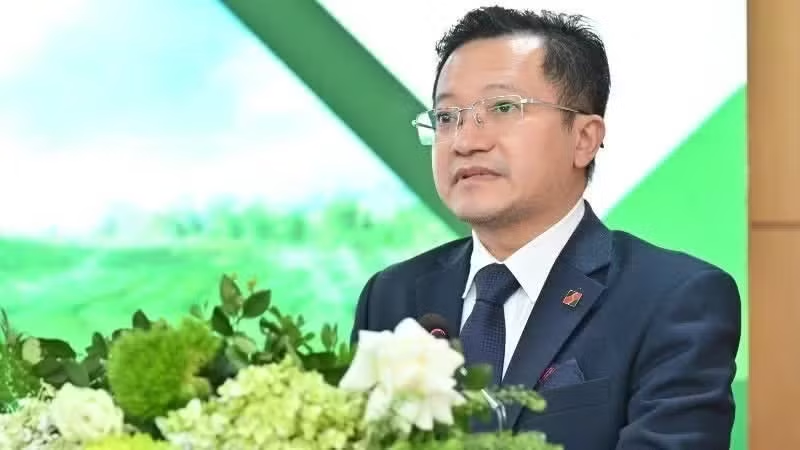
Nguyen Quang Ngoc, deputy head of Agribank’s Credit Policy Department, speaks at the seminar. (Photo: VietnamPlus)

Against this backdrop, Agribank has emerged as a notable example thanks to its new approach. With outstanding loans to the agricultural and rural sectors reaching 1.26 quadrillion VND, accounting for around 64% of its total loan portfolio, the bank is serving about 2.7 million customers, more than 90% of whom are individuals in rural areas.

The bank has gradually shifted from collateral-based lending to assessing borrowers based on cash flow and the viability of production plans, helping expand access to finance for those lacking collateral.

Nguyen Quang Ngoc, deputy head of Agribank’s Credit Policy Department, said the focus has evolved from simply helping people obtain loans to ensuring that capital is used efficiently to generate sustainable incomes and reduce poverty.

From the business perspective, Nguyen Van Long, Chairman and General Director of the Nhat Long JSC, said modern agriculture requires substantial investment in technology, infrastructure, processing, and traceability systems while production cycles are long and face high risks. Yet enterprises still face difficulties accessing credit because of collateral requirements, unsuitable loan terms, and limited risk-sharing mechanisms.

Agricultural insurance – missing element

Agricultural insurance was also identified as a crucial missing element.

Le Dinh Huy, Deputy General Director of Agribank Insurance Corporation (ABIC), described insurance as an essential risk-management tool for both farmers and lenders amid increasing climate-related risks.

10.jpg
Agribank is among the banks allocating substantial financial resources to green agriculture. (Photo: VietnamPlus)

For farmers, insurance is a "lifeline" that helps stabilise finances and maintain production after natural disasters or epidemics. With this protection, they can confidently invest, adopt technology, and adhere to production standards.

For banks, insurance can act as a form of "trust-based collateral". When a loan is insured, credit institutions can confidently disburse funds, even to customers lacking collateral.

Experts agreed that without effective risk management tools, green and digital agricultural credit will struggle to reach its full potential.

Building an integrated ecosystem that combines supportive policies, flexible financing, insurance, and stronger production capacity will be essential to accelerating the sector’s sustainable transformation./.
VNA

See more

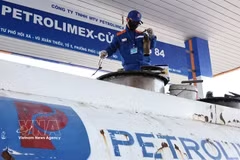
At a Petrolimex station. Petrolimex said it was increasing fuel procurement, adjusting distribution and moving supplies between regions to ensure fuel supply across its system. (Photo: VNA)

Ministry orders fuel supply inspections amid localised shortages

The ministry has taken steps to immediately inspect locations reporting shortages and identify the cause. Localities where shortages are taking place must examine the entire supply chain, including contracts between retailers and wholesalers, actual supply volumes, delivery schedules and the reasons for any failure to provide fuel.

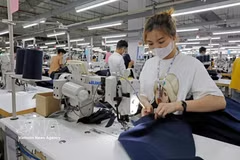
Garment production for export to the US market at TAL Vinh Phuc Garment Company. (Photo: VNA)

New US tariff policy should be based on objective, comprehensive assessment

This progress has been built on mutual respect, transparency and Vietnam's sustained efforts to improve its legal framework and comply with international standards. However, the US' recent tariff decision appears to overlook realities regarding Vietnam's labour environment and manufacturing practices.

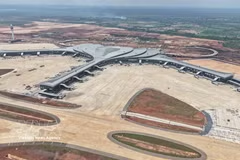
The construction site of Long Thanh International Airport in July 2026. (Photo: VNA)

Long Thanh Airport's second runway to be completed in September

According to the Airports Corporation of Vietnam (ACV), after 14 months of construction, the cement concrete pavement for the runway and taxiways has been substantially completed. Contractors are mobilising hundreds of workers and construction equipment to finish the remaining works on schedule.

Illustrative image (Photo: VNA)

Vietnam introduces special policies to strengthen anti-money laundering framework

Issued on July 24, Resolution No. 66.23/2026/NQ-CP amends and supplements a number of provisions in the 2022 Law on Anti-Money Laundering and related guiding documents. The revisions focus on key areas, including the definition of beneficial ownership, verification of customer information, transparency of legal arrangements, risk-based customer classification and the frequency of updating customer information.

International buyers explore products at the Vietnam International Sourcing Expo 2025. (Photo: VNA)

Nordic businesses look to Vietnam for deeper trade, supply-chain cooperation

VIS 2025 enabled Nordic businesses to directly explore Vietnamese suppliers while facilitating deeper engagements with management agencies, localities, industry associations, seaports, factories and logistics partners. The programme showed that Vietnam-Nordic cooperation is expanding beyond trade to supply-chain development, investment, logistics and digital transformation.

Phu Quoc airport’s 3,300m runway lights up ahead of landmark flight inspections

Phu Quoc airport’s 3,300m runway lights up ahead of landmark flight inspections

Viewed from above, Runway No. 2 has taken clear shape within the overall layout of Phu Quoc International Airport. Measuring 3,300 metres long and 45 metres wide, the new runway has been built parallel to the existing one. Its pavement and markings have been completed, and the project is now undergoing final technical inspections. At night, the lighting system has been switched on at full intensity for testing.

Villas left unoccupied for years. (Photo: diendandoanhnghiep.vn)

Taxes proposed on vacant land, speculative deals

A key proposal is to introduce a mechanism to regulate windfall gains from differences in land values, while imposing high taxes on vacant land and property transactions conducted within a short period.

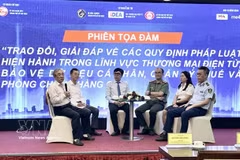
Panellists at the conference (Photo: VNA)

Ho Chi Minh City promotes safe, transparent e-commerce ecosystem

Ho Chi Minh City is stepping up efforts to build a safer and more transparent e-commerce ecosystem as authorities accelerate implementation of the new E-commerce Law, which aims to strengthen consumer protection, enhance platform accountability and support the sustainable growth of Vietnam's digital economy.

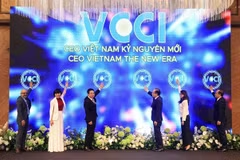
Minister of Foreign Affairs Le Hoai Trung (third, right), VCCI Chairman Ho Sy Hung (third, left), and representatives of government agencies and educational institutions attend the launch ceremony of the programme. (Photo courtesy of VCCI)

Vietnam launches programme to develop globally competitive CEOs

The Vietnam Chamber of Commerce and Industry (VCCI) on July 25 launched a Vietnam business leadership development programme 2026-2030 (CEO Vietnam The New Era), to build a new generation of internationally competitive chief executive officers (CEOs) in Vietnam.

Spokeswoman of the Ministry of Foreign Affairs Pham Thu Hang (Photo: MoFA)

Vietnam strictly prohibits all forms of forced labour: Foreign Ministry

Vietnam will continue working with the US in a constructive and cooperative spirit, while urging the US side to fully take into account the measures Vietnam has adopted when adjusting tariffs on Vietnamese goods, consistent with the actual situation and Vietnam's ongoing legislative and enforcement push.

The fourth Vietnam International Logistics Exhibition (VILOG 2026) will take place in Ho Chi Minh City from July 30 to August 1, 2026. (Illustrative photo: vilog.vn)

Vietnam's flagship logistics exhibition returns with smart, sustainable focus

The exhibition comes as Vietnam cements its position as one of Asia's fastest-growing manufacturing and logistics hubs, with demand increasing for more integrated, technology-driven supply chain solutions. It also reflects the sector's ongoing push towards greater competitiveness and deeper participation in global value chains.