
Hanoi (VNA) – The Vietnamese National Assembly (NA) has adopted amendments to the employment law, expanding the scope of unemployment insurance coverage and keeping monthly benefit payments at 60% of the average salary on which the individual pays unemployment insurance over the six months prior to job termination.
Under the revised Employment Law, workers with fixed-term contracts of one month or longer must now participate in unemployment insurance, an expansion from the previous requirement of three months or longer.
Additionally, part-time workers who earn a monthly salary equal to or higher than the minimum salary base for compulsory social insurance contributions are now also included as participants in unemployment insurance. This change aligns with the 2024 Social Insurance Law.
The revised law grants the NA Standing Committee the authority to extend unemployment insurance coverage to other groups with stable employment and regular income, which could bring app-based drivers, online workers, and other emerging categories of workers into the insurance scheme in the coming time.
Besides, it sets the monthly unemployment allowance at 60% of the average salary on which the individual pays unemployment insurance over the six months prior to job termination. It is capped at five times the region-based minimum wage.
There were proposals to raise the minimum unemployment benefit rate to 65% with the possibility for the Government’s adjustment up to 75% during major economic crises and pandemics. However, the NA Standing Committee kept it unchanged, given the balance between unemployment insurance revenue and expenditure, along with international standards.
According to the committee, the unemployment insurance fund accumulated surpluses in previous years because of annual State budget allocations and few workers claiming benefits. Since 2020, contributions and payouts have balanced.
Vietnam's unemployment insurance framework aligns with international practices observed in countries with successful unemployment or employment insurance systems, including Canada, the Republic of Korea, Japan, and Thailand. International standards suggest that unemployment benefits should not be less than 45% of previous income or the minimum wage, while the minimum benefit period should be 12 weeks within a 12-month period.
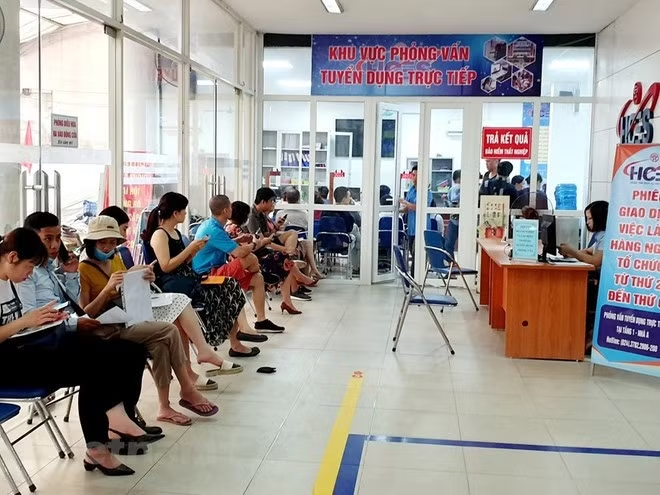
The Labour Code requires employers to provide severance pay for workers employed for 12 months or longer at half a month's salary per year of service, plus unemployment compensation equivalent to one month's salary per year of service, with a minimum of two months' salary.
The revised law also confirms that unemployment benefits will be paid for a maximum period of 12 months. Workers who have contributed to unemployment insurance for 12 to 36 months are eligible for three months of benefits, with an additional month of benefits granted for every subsequent 12 months of contributions.
According to the NA Standing Committee, unemployment insurance is designed as short-term protection with a high risk-sharing characteristic. Regulations on the maximum benefit period and capped benefit rates are intended to ensure the financial health of the unemployment insurance fund.
Regarding eligibility for the unemployment benefits, workers who lose their jobs are entitled to support, except in cases where they unilaterally and illegally terminate their labour contracts under the Labour Code, or retire upon reaching pension eligibility./.