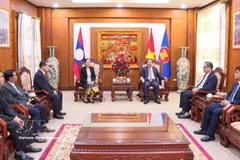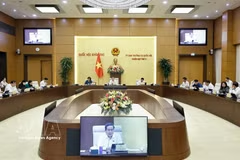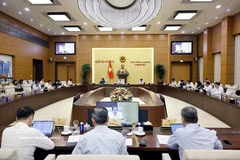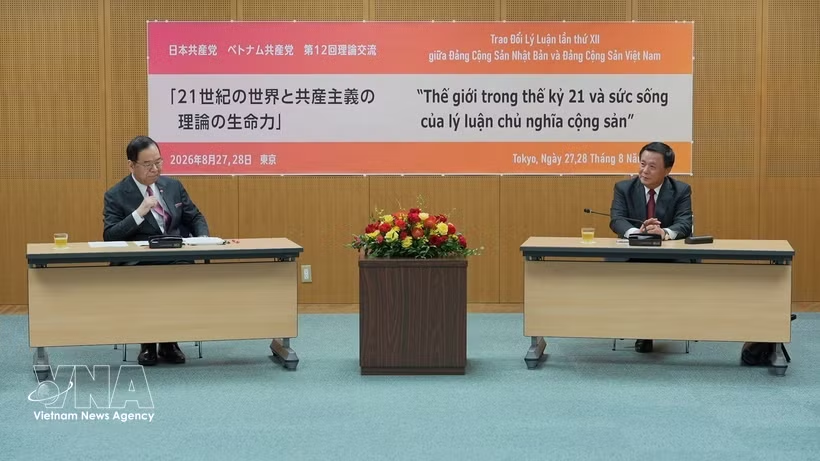
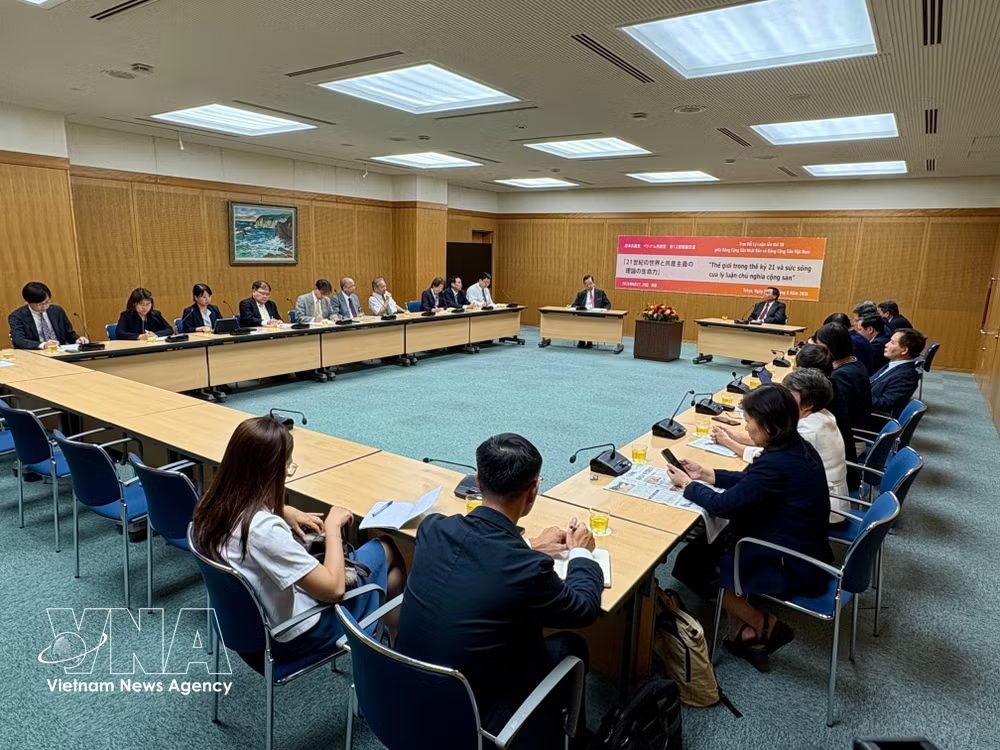
Tokyo (VNA) – A delegation of the Communist Party of Vietnam (CPV), led by Prof. Dr. Nguyen Xuan Thang, Member of the Political Bureau and Chairman of the Central Council for Theoretical Studies, held the 12th theoretical exchange with the Japanese Communist Party (JCP) in Tokyo on August 27-28, focusing on the vitality of communism in the digital era and emerging challenges posed by advances in science, technology and artificial intelligence (AI).
In his opening remarks at the exchange, which was held under an agreement between the two parties, Thang said the world is undergoing pivotal changes, with breakthroughs in science and technology, particularly AI and digital transformation which are reshaping productive forces, work patterns, social structures and governance methods. They are offering new development opportunities while raising issues concerning employment, inequality, social justice and human control over technology, he noted.
Sharing Vietnam’s development orientations, Thang said the Southeast Asian nation’s development model in the new period represents a self-reliant, modern, inclusive, creative, humane, sustainable and internationally integrated model, with people placed at the centre, as both the subject and the goal of development.
For his part, Tanaka Yu, Vice Chairman of the Presidium and acting head of the Secretariat of the JCP Central Committee, who led the Japanese delegation, congratulated the CPV on the successful organisation of its 14th National Party Congress.
He spoke highly of the theoretical exchange mechanism established between the two parties in 2007, saying that it has helped the two sides share theoretical research and practical experience, exchange views on emerging issues, and strengthen their traditional friendship.
The two sides discussed in depth the impacts of science, technology and AI on productive forces and emerging issues facing people and society. The Japanese side raised concerns over the misuse of AI in military affairs and warfare, as well as the risk of humans losing control of technology when AI is driven by profit, stressing the need for stronger international cooperation in establishing principles and frameworks for AI governance.
Participants also exchanged theoretical and practical issues in the digital era; the development of productive forces under the impact of science, technology and AI; and the relationship between productive forces, social progress and justice, and human development. They also shared experience in the renewal and development processes of their respective parties.
The two sides agreed to hold the 13th theoretical exchange in Vietnam in 2027.
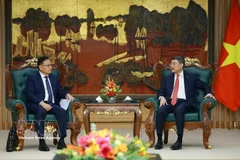
As part of the exchange, the Vietnamese delegation met with Chairman of the JCP Central Committee Shii Kazuo.
Earlier, on August 22-26, Thang held meetings with senior leaders of the Liberal Democratic Party (LDP) of Japan.
The two sides agreed to further promote cooperation through Party, parliament and government channels, work towards a new cooperation agreement between the CPV and the LDP, and study the establishment of annual exchanges between their leaders and specialised agencies.
Thang also attended a scientific exchange programme with the National Graduate Institute for Policy Studies (GRIPS) on economic development and social management in ageing societies, as well as the boom of AI and quantum technology and its impacts on society and global governance.
He also met Prof. Kenichi Ohno from GRIPS and visited Vietnamese IT company Rikkei, which operates six offices across Japan./.