Berlin (VNA) - Vietnam has written a great success story, as it has come a long way, from going through a difficult past to becoming a modern nation, that is entering an era of growth, and developing positively in the economic, social, and political fields, according to Rolf Schulze, President of the Germany - Vietnam Association and former German Ambassador to Vietnam.
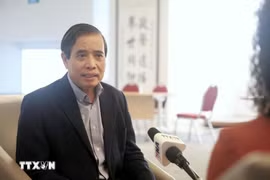
Sharing the same view, Dr. Kambiz Ghawami, President of the World University Service (WUS) Germany, affirmed that over the past 80 years, Vietnam has developed from a nation standing on the sidelines of international politics to a country that is respected and committed to pursuing multilateralism.
Vietnam was right to demonstrate that many of today's challenges stem from a lack of respect for international law, he told the Vietnam News Agency (VNA)’s correspondents in Berlin on the occasion of the country’s 80th National Day (September 2, 1945 - 2025).
Dr. Ghawami also recalled that the international community had twice elected Vietnam as a non-permanent member of the United Nations Security Council, which reflected its recognition of the Southeast Asian nation's important role in global peace and security.
According to the economist, because Vietnam fully understands war crimes from its own history, the country's reminders to the international community about respecting international law are always reliable.
Regarding Vietnam’s socio-economic achievements after 40 years of “Doi Moi” (Renewal), he said that what impressed him most are the significant advancements Vietnam has made in education over the past four decades, partly thanks to reforms initiated between 2006 and 2010. He believed that investing in education is a very promising path, and the recent decision by the Vietnamese Government and discussions in the National Assembly about reducing tuition fees and expanding preschool education for children aged 3 to 5 are important steps forward for the country’s future development.
Meanwhile, Schulze expressed his admiration for the work spirit and ethics of the Vietnamese people, noting that they always solve problems flexibly, in a practical manner, with a forward-looking attitude and optimism.
He assessed that Vietnam currently has a well-trained workforce, increasingly developed infrastructure, and an industry on the rise. Another very important factor is Vietnam’s political stability, he said, believing that all these are achievements that Vietnam can be proud of.
The President of the Germany - Vietnam Association also mentioned that Vietnam was the first country to achieve 5 out of the 8 United Nations Millennium Development Goals (MDGs) by 2015, particularly in poverty reduction, universal education, healthcare, and women’s empowerment, and is a pioneering, active country in implementing the Sustainable Development Goals (SDGs) for 2030.
To successfully fulfil the 17 SDGs in the coming period, Dr. Ghawami proposed Vietnam invest more in human resources, science and technology, healthcare, and infrastructure. Additionally, he suggested that Vietnam should design school curricula so that the SDGs are closely integrated with educational values for sustainable development, similar to how Germany has successfully implemented the "Education for Sustainable Development” framework over the past years.
According to Dr. Ghawami, for Vietnam to successfully enter the new era, a number of strategic approaches are needed in four key areas, including strengthening political and economic autonomy and diversifying partnerships, having confidence in digital transformation, enhancing the responsibility at all levels, and consolidating national pride in a globalised world./.
Vietnam affirms proactive role in global cultural cooperation
An international conference discussing heritage preservation and the development of cultural and creative industries reaffirmed Vietnam’s proactive role in global cultural cooperation and its commitment to safeguarding heritage while fostering sustainable cultural industries.