Vietnamese bird’s nests see opportunities to enter Chinese market

Vietnamese bird's nests see great potential for export to Chinese market as people in China and Chinese communities in other countries across the world spend about 5 billion USD on bird’s nests and products made from them.
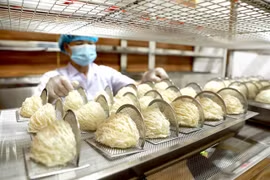
Vietnamese bird’s nests see opportunities to enter Chinese market ảnh 1Illustrative photo (Photo: baodautu.vn)
Hanoi (VNA) – Vietnamese bird's nests see great potential for export to Chinese market as people in China and Chinese communities in other countries across the world spend about 5 billion USD on bird’s nests and products made from them.

The Ministry of Agriculture and Rural Development and the General Administration of Customs of China signed a protocol on requirements for quarantine, inspection and veterinary hygiene for bird’s nests of Vietnam to be exported to China.

The protocol, which took effect in November last year, is said to be a condition for Vietnamese bird’s nests to conquer the Chinese market after Malaysia, Indonesia, and Thai;and.

In Central Highland provinces, swiftlet farms have registered for production area codes and completing documents in line with the protocol. Authorities also support enterprises in registering for exporting bird’s nests to China.

Nguyen Dung, Vice President of the Vietnam Farms and Agricultural Enterprises Association, said that China opening door to Vietnamese bird’s nests via official channels brings opportunities to the local bird’s nest industry.

Exports to China and countries with big Chinese communities like the US, Australia, and New Zealand is a way to increase the value of the product.

Currently, bird’s nests are considered one of the most expensive foods in the world.

He said that to prosper in the business,  swiftlet farmers need to connect with cooperatives and companies to obtain international certifications, which will help their products to be sold for good prices.
Individuals and units in the bird’s nest industry should also diversify products to better reach potential consumers.

According to the Vietnam association of swiftlet farms, almost all the farms in Vietnam harvest and process the nests by themselves and then sell in a small scale. As a result, although Vietnam has nests brands, their quality fails to meet international standards.

Currently, Vietnam mostly exports raw bird’s nests with low value through unofficial channels.

According to the Ministry of Agriculture and Rural Development, there were about 23,600  swiftlet farms in 42 out of 63 localities across the country.

The country sees a production of about 200 tonnes of bird’s nests and exports over 120 tonnes worth 450 million USD each year.

Tran Phuong Tuan, director of Vietnam Bird’s Nests Company (VinBirdnest) said that the protocol relating to the export of Vietnamese bird’s nests to China brings opportunities for the industry as China is the world's largest market for bird's nests.

When the market is activated, the bird's nest industry of Vietnam will be restructured, creating higher added value, helping to improve the income and profits for bird nest farmers and processors./.

VNA
See more

Germany’s Karcher Group puts its cleaning equipment manufacturing plant into operation at the the Tam Hiep Port and Logistics Industrial Park in Nui Thanh commune, Da Nang city (Photo: VNA)

Da Nang boosts FDI attraction to drive industrial growth

The central city of Da Nang is ramping up efforts to attract foreign direct investment, leveraging its upgraded infrastructure and welcoming business environment to boost industrial growth and establish a new economic driver.

Vietnamese Ambassador to Mozambique Tran Thi Thu Thin (third from right) poses with IAM Director and staff (Photo published by VNA)

Vietnam, Mozambique seek stronger agricultural ties

Vietnamese Ambassador to Mozambique Tran Thi Thu Thin praised the industry’s potential and its contribution to the economy, livelihoods and exports in the southeastern African nation. She also shared Vietnam’s experience in developing the industry, particularly in boosting processing capacity and adding value to products.

A solar power system installed on the roof of a factory operating in the rice sector in Truong Xuan commune, Dong Thap province. (Photo: VNA)

Rooftop solar power helps businesses go green

Dong Thap Power Company reported that as of September 2026, the province had 6,150 rooftop solar customers, with total installed capacity of 287.09 MWp. Of these, 751 customers operated self-produced and self-consumed systems with a combined capacity of 42.76 MWp.

Tourists shop at Ngoc Hien Pearl Farm in Phu Quoc city, An Giang province. (Photo: VNA)

Vietnam seeks to boost shopping tourism

Shopping tourism remains underdeveloped in Vietnam despite its potential to attract visitors and boost revenue. Diversifying dining, shopping and entertainment services while extending stays would help increase tourist spending.

The booth of Gia Binh International Airport at Routes World 2026 (Photo: baoquocte.vn)

Gia Binh airport seeks global airline partnerships at Routes World 2026

Participation in Routes World, an annual route development forum, is intended to help Gia Binh establish relationships with international carriers and strategic partners before the airport becomes operational and position it to participate in the development of future regional and international air links.