Hanoi (VNA) – As Vietnam's economy undergoes profound transformation, expanding access to international capital and raising corporate governance standards have become increasingly essential for businesses seeking sustainable growth.
Vietnam's stock market is no longer confined to domestic trading floors in Hanoi and Ho Chi Minh City. It is increasingly looking outward, strengthening links with global financial institutions and leading international exchanges.
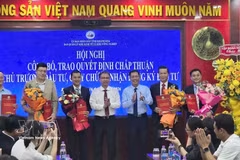
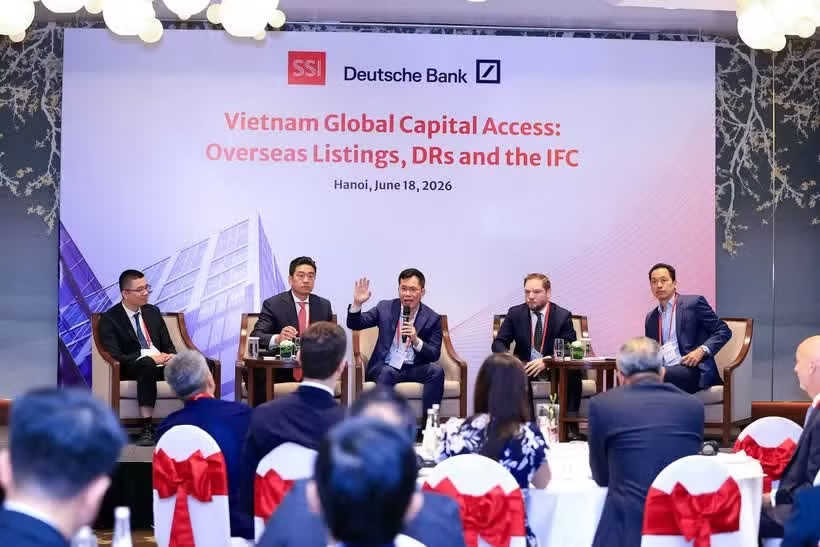
On June 18, SSI Securities Corporation and Deutsche Bank jointly organised a seminar on accessing global capital for Vietnam, focusing on overseas listings, depositary receipts and international financial centres (IFCs). The event brought together regulators, financial institutions, businesses and industry experts to discuss strategies for integrating Vietnam's capital market more deeply into global financial flows and enhancing its quality and depth.
Discussions focused on practical pathways for overseas listings, the use of Depositary Receipts (DRs) and leveraging the infrastructure of international financial centres. These were identified as important steps enabling Vietnamese companies to tap deeper pools of capital while meeting increasingly stringent global standards on transparency and corporate governance.
Expanding access to global capital
The seminar took place as Vietnam's capital market stands at a pivotal moment.
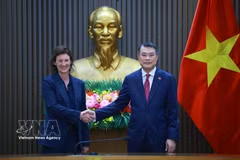
Bui Hoang Hai, Vice Chairman of the State Securities Commission, welcomed Vietnam's recent promotion by FTSE Russell to the Secondary Emerging Market category, describing it as recognition of sustained reform efforts by regulators and market participants. He stressed, however, that the upgrade marked the beginning rather than the culmination of the country's market development.
According to Hai, the principle most valued by international index providers such as FTSE Russell is accessibility. This means not only making it easier for foreign investors to enter Vietnam but also enabling Vietnamese enterprises to reach long-term global capital markets.
He noted that international capital follows confidence, which is built on transparency, sound corporate governance and business performance. Ongoing reforms include the rollout of the KRX trading system, the development of a global brokerage model and the establishment of a central counterparty clearing (CCP) mechanism. These are intended to align Vietnam's market with international standards and facilitate safer, more efficient capital flows.
Sharing this perspective, Daniel Clark, Global Head of Depositary Receipts at Deutsche Bank, highlighted the growing importance of investment flows from North America and Europe into Asia. He said the focus should now shift from technical discussions to helping businesses prepare for international capital markets.
Clark urged Vietnamese companies to rethink traditional assumptions and strengthen governance, financial reporting, investor relations and long-term growth strategies in order to compete successfully for global capital.
Building internationally competitive ecosystem
A panel discussion featuring representatives from the London Stock Exchange, Deutsche Bank and Ernst & Young Vietnam examined the practical aspects of dual listings.
Speakers noted that overseas listings are not merely fundraising exercises but rigorous processes requiring companies to comply with demanding disclosure and governance standards. Successfully listing on an international exchange serves as a strong endorsement of corporate quality and strengthens long-term fundraising capacity.
Among the financing options discussed, Depositary Receipts (DRs) were viewed as a practical solution for Vietnamese firms. Experts from Deutsche Bank and A&O Shearman described DRs as an effective bridge allowing companies to expand international market access without immediately restructuring their domestic listings.
DRs enable overseas investors to access Vietnamese equities through familiar international market infrastructure while helping issuers build credibility with fewer technical barriers.
Hai cautioned, however, that instruments such as American Depositary Receipts (ADRs) and Global Depositary Receipts (GDRs) are not shortcuts. They require robust accounting standards, transparent capital use and strong governance. While Decree No. 155/2020/ND-CP provides the legal foundation for these products, their success ultimately depends on companies' preparedness.
He stressed that international fundraising should complement, rather than replace, a strong domestic market presence. Companies with solid domestic listings and strong shareholder engagement are better positioned to attract global investors, while international participation can in turn help raise governance standards across Vietnam's capital market.
The seminar also highlighted the importance of developing an International Financial Centre (IFC) in Vietnam. Panelists agreed that an internationally competitive financial hub requires a comprehensive ecosystem, including a robust legal framework, high disclosure standards, capable financial intermediaries and credible credit-rating agencies.
Representatives from Nasdaq shared international experience, emphasising that early investment in corporate governance, English-language communications and Environmental, Social and Governance (ESG) reporting will be key to attracting institutional investors.
Participants agreed that Vietnam's long-term objectives extend beyond helping companies raise capital overseas. The broader goal is to build a world-class financial ecosystem where internationally competitive enterprises reinforce the depth, resilience and attractiveness of the domestic capital market./.