Vietnamese Party chief attends seminar on AI, technology in London

With its aspiration to become a pioneer in digital economy, Vietnam seeks to learn from the UK - the cradle of the Industrial Revolution and the homeland of great minds such as Isaac Newton, John Locke, Adam Smith, Alan Turing, William Shakespeare, and Charles Dickens - to build an innovative, human-centred, and sustainable technological ecosystem.

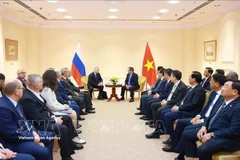
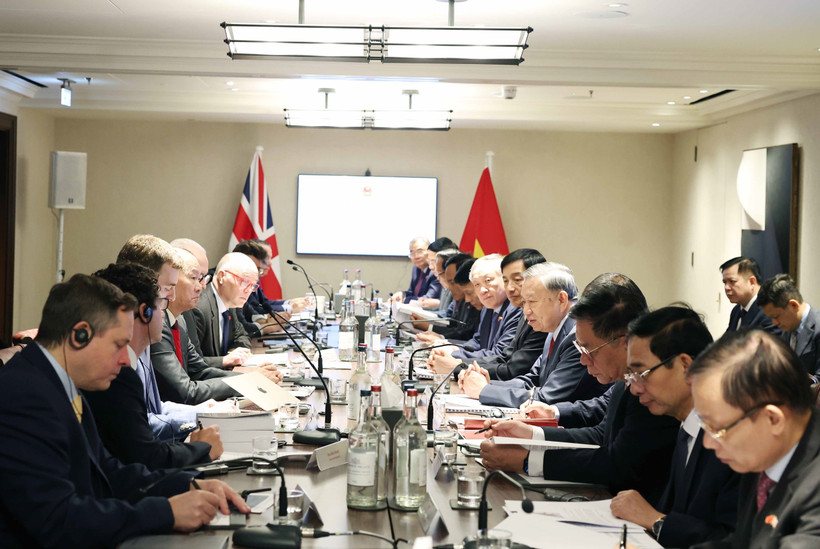
The seminar held in London on October 28 between Party General Secretary To Lam and leading strategists on AI and technology in the UK and the world. (Photo: VNA)

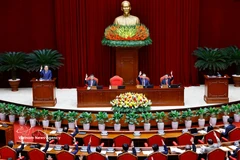
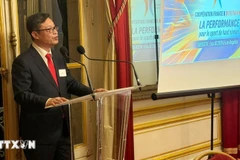
London (VNA) – Party General Secretary To Lam and a high-ranking Vietnamese delegation attended a seminar with leading strategists on artificial intelligence (AI) and technology in the UK and the world, which was held in London on October 28, within the framework of their official visit to the UK.

The seminar, co-organised by the Boston Global Forum (BGF), is a strategic step to promote cooperation between Vietnam and technology powers in the AI era, while affirming the country's position in global digital transformation.

With its aspiration to become a pioneer in digital economy, Vietnam seeks to learn from the UK – the cradle of the Industrial Revolution and the homeland of great minds such as Isaac Newton, John Locke, Adam Smith, Alan Turing, William Shakespeare, and Charles Dickens – to build an innovative, human-centred, and sustainable technological ecosystem.

In his opening remarks, General Secretary Lam expressed his pleasure at meeting and listening to the insightful and practical ideas of experts and strategists in London. He emphasised that the world is witnessing remarkable advancements in science and technology, with AI emerging as a key driver of economic growth and innovation.

Vietnam has identified science, technology, and digital transformation as top breakthroughs to achieve rapid and sustainable development, and rise in the global value chain. Therefore, the country wants to work with advanced nations to share common visions and values, building a better world where AI serves humanity and promotes creativity, compassion, peace, and prosperity, he said, affirming that Vietnam is ready to embrace and experiment with pioneering ideas.

At the event, technology experts praised Vietnam’s dynamic development, given that within just one generation, Vietnam has lifted millions out of poverty, built one of Asia’s most competitive manufacturing economies, and developed a young, digitally skilled workforce. In particular, Vietnam’s progress in administrative reform and its openness to international cooperation have positioned it as a key partner in the global network of trusted digital nations.

Some also suggested that, for AI to truly serve socio-economic development and improve people’s lives, governments must focus on building reliable digital infrastructure and developing responsible AI standards that safeguard privacy, fairness, and transparency. Concluding the seminar, General Secretary Lam said he was impressed by the insights and ideas shared by the leading experts and managers with extensive AI-related experience.

The proposed solutions and recommendations presented at the event highly match Vietnam’s development orientations and goals, the leader said, adding that relevant Vietnamese agencies will study the proposals in detail and engage in joint work to translate them into projects and programmes in Vietnam.

The Party chief stressed that the seminar marks a meaningful beginning, paving the way for long-term and substantive cooperation between Vietnam and the foremost thinkers and institutions of the UK and the world.

General Secretary Lam expressed his hope that in the time ahead, the experts will continue accompanying and supporting Vietnam’s efforts in AI and science – technology development. He identified three priority areas for collaboration, including knowledge and experience sharing in formulating a national AI strategy and developing digital infrastructure and an innovation ecosystem; the promotion of investment, technology transfer, and AI application in key sectors such as health care, smart agriculture, and digital education; and the joint implementation of major science and technology programmes, especially in emerging and pioneering fields, to help Vietnam build a creative and self-reliant economy.

He also extended an invitation to the experienced scientists and experts in science, technology, and AI to visit Vietnam for exchanges and direct collaboration with local policymakers and research institutions. Through such engagement, the ideas discussed at the roundtable will be transformed into reality, bringing about new values, models, and confidence for humanity in the age of AI./.

VNA
See more

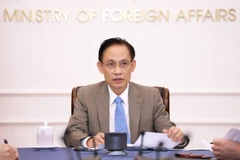
Vietnamese Minister of Foreign Affairs Le Hoai Trung (left) and DPRK Minister of Foreign Affairs Choe Son Hui. (Photo: VNA)

Vietnamese FM, DPRK officials discuss ways to boost bilateral ties

Trung reiterated that Vietnam places strong emphasis on strengthening and advancing its ties with the DPRK in a more practical and effective way, in line with the aspirations of the two nation’s people, while contributing to peace, stability, cooperation and development in the region and the world.

Politburo member, Secretary of the Party Central Committee and Chairman of its Organisation Commission Nguyen Duy Ngoc chairs the first meeting of the steering committee for digital transformation in the Party organisation and personnel sector in Hanoi on May 13, 2026. (Photo: VNA)

Party building work prioritises clean, shared data in digital transformation push

Politburo member, Secretary of the Party Central Committee and Chairman of its Organisation Commission Nguyen Duy Ngoc urged provinces and cities to review legal frameworks, decentralisation mechanisms, assigned tasks and administrative procedures, while ensuring synchronisation between local infrastructure systems and the central platform, including equipment, cybersecurity solutions and resource allocation.

General Secretary of the Communist Party of Vietnam Central Committee and State President To Lam speaks at the working session in Hanoi on May 13, 2026. (Photo: VNA)

Party, State leader calls for consolidation of central steering committees on legal, judicial reform

Consolidating the central steering committees for institutional and legal reform and for judicial reform is necessary in order to streamline organisational structures without reducing responsibilities, while ensuring clear accountability, measurable outputs and concrete results. Following the restructuring, the body will be renamed the central steering committee for institutional improvement and law enforcement, with the Party General Secretary and State President serving as its head.

Civil servants provides administrative services for citizens in Son Hai commune of Bac Ninh province. (Photo: VNA)

Reform drive expected to remove barriers, unlock growth momentum

Prime Minister Le Minh Hung recently ordered ministries and agencies to immediately cut at least 30% of administrative procedures, 50% of processing time, 50% of compliance costs and 30% of business conditions, while eliminating all unnecessary procedures.

Ambassador Do Hung Viet, Permanent Representative of Vietnam to the United Nations (UN), meets with Annalena Baerbock, President of the 80th session of the UN General Assembly (UNGA). (Photo: VNA)

Vietnam strives for substantive outcome at NPT review conference

At the meeting this week, Ambassador Viet briefed the UNGA President on developments during the first two weeks of the conference. He stressed that the current international geopolitical landscape poses numerous complex challenges, while reaffirming Vietnam’s determination, together with other member states, to promote substantive and balanced outcomes at the conference.

General Secretary of the Communist Party of Vietnam Central Committee and President of Vietnam To Lam (R) receives Athsaphangthong Siphandone, member of the Lao People’s Revolutionary Party Central Committee, Secretary of the Vientiane Party Committee and Chairman of the municipal People’s Council, in Hanoi on May 12, 2026. (Photo: VNA)

Top leader of Vietnam receives Vientiane official in Hanoi

The host leader stressed that cooperation between localities, particularly between the capitals of Hanoi and Vientiane, plays an especially important role as a pioneering force in effectively implementing the foreign polices of the two Parties and States, while also serving as a bridge between politics and development, as well as between strategy and concrete action.

Prime Minister Le Minh Hung receives Chinese Ambassador to Vietnam He Wei in Hanoi on May 12. Photo: VNA

Prime Minister receives Chinese Ambassador

The Party and State of Vietnam always value the assistance China has provided to Vietnam during its past struggle for national independence as well as in national development today. Vietnam consistently regards the development of relations with China as a steadfast policy, an objective requirement, a strategic choice, and a top priority in its foreign policy of independence, self-reliance, multilateralisation and diversification.

Secretary of the Hanoi Party Committee Tran Duc Thang and Secretary of the Vientiane Party Committee Atsaphangthong Siphandone witness the signing of a memorandum of understanding on cooperation between the Women’s Unions of Hanoi and Vientiane for 2026–2030, as well as a memorandum on enhanced cooperation between the Ho Chi Minh Communist Youth Union of Hanoi and the Lao People’s Revolutionary Youth Union of Vientiane for the same period. (Photo: VNA)

Hanoi, Vientiane promote comprehensive cooperation in new phase

The capitals of Vietnam and Laos signed memoranda of understanding on joint work in the fields of public communication and mass mobilisation, women and youth affairs, foreign relations, industry and trade, education and health care. These are expected to provide an important basis for implementing their cooperation priorities for 2026–2030.