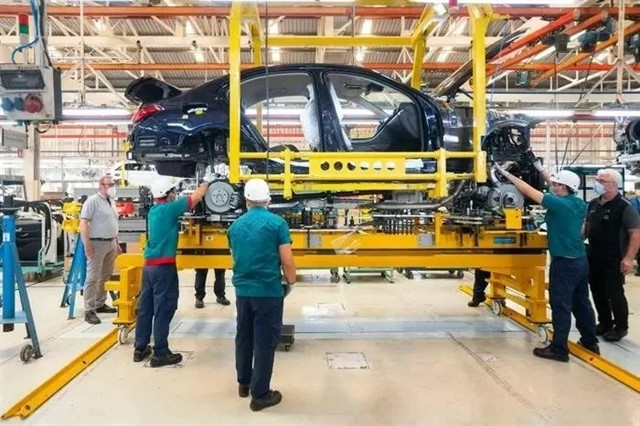
Hanoi (VNS/VNA) - The Vietnamese auto industry has demonstrated significant progress in integrating into the global supply chain, reflecting its potential to contribute to economic growth, according to local car experts.
Historically reliant on importing complete cars to access advanced technology, Vietnam has shifted towards domestic production and even exportation of high-standard vehicles to international markets, including the US, Europe and other parts of Southeast Asia.
One landmark achievement came at the end of 2022, with VinFast exporting its first batch of 999 VF8 electric cars to the US. The US, with its stringent quality and safety requirements, accepted these vehicles, signalling that Vietnamese-made products meet global standards. Subsequently, VinFast expanded its exports to Europe and other countries in Southeast Asia. By 2024, VinFast was ranked 28th globally in terms of battery-powered electric car sales, with 44,260 vehicles sold, outperforming major brands like Honda and Subaru.
The country's appeal as a manufacturing hub extends beyond domestic brands. Foreign automakers are increasingly utilising Vietnam as a production base. For instance, the Hyundai Thanh Cong joint venture recently exported Hyundai Palisade SUVs to Thailand, leveraging the zero% import tax incentive under the ASEAN Trade in Goods Agreement (ATIGA) thanks to a localisation rate exceeding 40%. This highlights the development of the domestic auto support industry, which provides essential components and enhances pricing competitiveness.
In the domestic market, manufacturers are also emphasising locally assembled products. Mercedes-Benz Vietnam, for example, has achieved notable success with vehicles like the C-Class, E-Class, and GLC 200, assembled in its HCM City facility since 1995.
Recent developments in Vietnam's auto industry reflect a dynamic and promising growth trajectory. The extension of Mercedes-Benz's operational period for another five years ensures stability in its production lines and provides room to adapt to leadership transitions and evolving market demands. While modest, the duration effectively mitigates disruptions and sets the stage for strategic adjustments.
The industry’s diversity is highlighted by the trend of new manufacturers favouring domestic production upon entering the Vietnamese market. For instance, the joint venture between GM (USA) and SAIC-WULING (China) partnered with TMT Motors to exclusively manufacture, assemble and distribute Wuling electric cars in Vietnam. TMT Motors' facility in Hung Yen province is now producing two new models: the Wuling Mini EV and Wuling Bingo, underscoring the shift toward localised production and assembly.
Building on this momentum, Geleximco Group announced ambitions to make Vietnam a regional hub for Chery car production. With a planned capacity of 200,000 cars annually, the factory in Thái Bình Province aims to supply both domestic and international markets. Beyond production, the venture will establish a design and manufacturing centre to facilitate technology transfer from Chery.
Domestically produced vehicles continue to gain consumer trust, thanks to their cost advantages and the ready availability of spare parts. Furthermore, government policies, such as the 50% reduction in registration fees for locally assembled cars, have bolstered demand, signalling sustained growth in the sector.
The local auto industry is showing remarkable progress, as evidenced by a record-setting car sales volume of 38,761 units in October, according to the Vietnam Automobile Manufacturers Association (VAMA). This growth reflects improvements in product quality, supportive policies and a proactive approach to meeting consumer trends.
Strategic development goals
A draft strategy for Vietnam's automobile industry envisions significant growth by 2030, with production reaching over 1.5 million vehicles by 2035.
Domestically assembled vehicles are projected to fulfil 78% of the local demand, and exports could climb to 90,000 units annually by 2035.
The success of the Vietnamese auto sector stems from well-directed policies, perseverance, and the emergence of financially strong, visionary entrepreneurs.
The shift in focus from basic components to internationally competitive standards has fostered industry credibility and attracted global investors.
Emphasis on low-emission and electric vehicles (EVs) aligns with global environmental priorities.
Rising income levels and improved living standards in Vietnam are bolstering demand for automobiles, further driving industry growth.
Associate Professor Dr Nguyen Thuong Lang from the National Economics University emphasises the importance of a stable market, attractive profit margins, and supportive policies, such as tax reductions and infrastructure upgrades, for the industry's long-term growth.
In addition, innovation in technologies like AI and green solutions is crucial. These advancements not only reduce costs but also position Vietnam competitively in the evolving global automotive landscape./.

Vietnamese automobile market continues to see growth in sales
After a strong surge in sales in September when the Vietnamese automobile market saw a 45% increase, an increase was still recorded in October, though at a more modest rate.