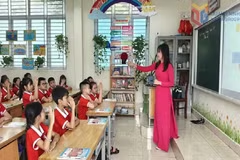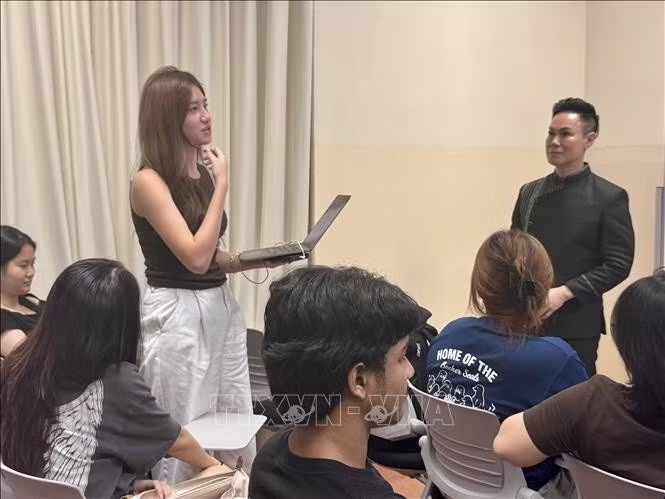
Singapore (VNA) – Promoting history and culture is increasingly serving as an important bridge to enhance mutual understanding and connection among nations, including Vietnam and Singapore. At the National University of Singapore (NUS), the course Introducing Vietnam brings Vietnamese history and culture closer to international students through a modern and experiential approach.
Associate Professor Dr Duong Minh Hai began another lecture on Vietnamese history on the evening of April 1 at The Shaw Foundation Building, marking what he described as a meaningful mission to share Vietnam’s story with international students.
The course is structured around three main pillars: the pre-colonial heritage shaped by Confucian influence, village traditions and spiritual beliefs; the dramatic changes of the 20th century, including wars that shaped the nation’s identity; and modern Vietnam, where tradition and innovation coexist. This framework helps students understand that Vietnam is not only defined by memories of war but also by a long-standing culture rich in identity and adaptability.
Dr Mohamed Effendy B Abdul Hamid, from the Department of Southeast Asian Studies at the Faculty of Arts and Social Sciences (FASS), said the course is part of the Southeast Asian Friendship Initiative (SFI), which aims to introduce the region to university students and explain its growing importance.
Statistics from the faculty show that increasing numbers of students are eager to learn more about Vietnam’s history, culture and society, as well as its economic development potential. According to Effendy, many students are surprised after taking the course to discover Vietnam’s rich heritage, strong cultural identity and vast opportunities for exploration and development.
Despite his primary research and teaching focus in engineering and advanced materials, Hai regards introducing Vietnam to the world as a meaningful mission, especially at a time when Vietnam–Singapore relations are developing well.
However, teaching Vietnamese history to international students also comes with challenges. Hai noted that many students initially have limited knowledge of Vietnam, and sometimes hold preconceived notions. To address this, the lectures are designed to encourage open discussion and real-life connections, gradually helping students build a more comprehensive understanding of the country.
Second-year student Li Jiaxin shared that she previously knew Vietnam only through textbook images of rice fields. However, a field visit to Hoa Lo Prison in Hanoi became a life-changing experience. Seeing historical artefacts such as the guillotine and learning about the resilience of Vietnamese revolutionaries left her deeply impressed by the courage and hospitality of the Vietnamese people despite the nation’s turbulent history.
Experiential learning in Vietnam is, therefore, something many Generation Z students are eagerly anticipating. In May 2026, Hai is expected to lead around 50 NUS students on a field trip to Vietnam under the SFI programme. The trip aims to provide immersive learning experiences, allowing students to explore Vietnam’s culture, daily life and development firsthand while gaining deeper insights into the country’s dynamism within a rapidly transforming Southeast Asia.
According to Hai, teaching Vietnamese history and culture to international students goes beyond education and represents an important form of “soft power”. Through such initiatives, core values such as resilience, community spirit and a strong tradition of learning are shared with the world, helping international audiences better understand and appreciate Vietnam.
He also encouraged Vietnamese students studying abroad to see themselves as cultural ambassadors. By actively sharing Vietnam’s story, preserving national identity and combining it with a global mindset, young people can help enhance the country’s image on the international stage.
Courses such as Introducing Vietnam, therefore, not only provide knowledge but also create spaces for dialogue and cultural connection, strengthening the foundation of understanding and cooperation between Vietnam and Singapore, as well as with other countries in an increasingly integrated world./.