Binh Dinh approves 62 investment projects worth over 9 billion USD

With a sound investment climate, Binh Dinh has become an attractive destination for investors, positioning itself as one of the most dynamic economic hubs in the country, and a leading development province in the region.
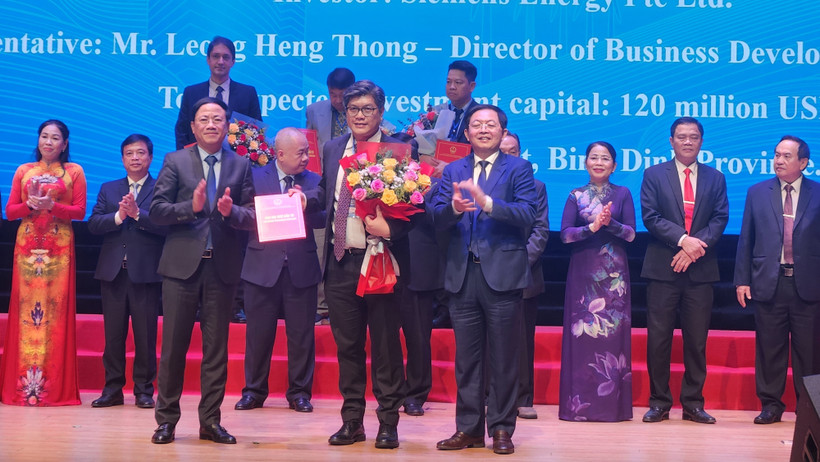
Investment certificates handed over to investors (Photo: VNA)

Binh Dinh (VNA) – The south central province of Binh Dinh handed over investment policy decisions and certificates for 62 projects with total registered capital of over 231 trillion VND (more than 9 billion USD) at an investment promotion conference on March 28.

The projects span critical sectors, including high-tech industries, commercial services, tourism, urban economy, port services and logistics. Of the total figure, 16 projects received investment policy approvals and investment certificates with registered capital of more than 17 trillion VND. Meanwhile, memoranda of understanding on investment cooperation were presented to 42 projects, with domestic investment totalling over 75 trillion VND and foreign investment exceeding 1.1 billion USD.

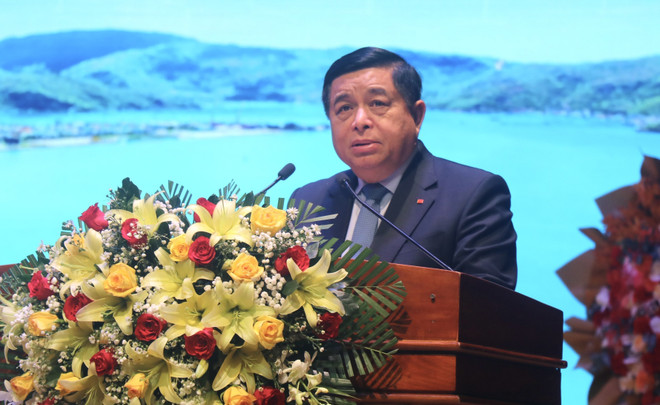
Speaking at the event, Deputy Prime Minister Nguyen Chi Dung highlighted the province’s strategic location as well as its competitive advantages to boost socio-economic development. With a sound investment climate, Binh Dinh has become an attractive destination for investors, positioning itself as one of the most dynamic economic hubs in the country, and a leading development province in the region.

vna-potal-hoi-nghi-xuc-tien-dau-tu-tinh-binh-dinh-nam-2025-7939489.jpg
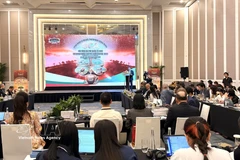
Deputy Prime Minister Nguyen Chi Dung speaks at the investment promotion conference on March 28. (Photo: VNA)

Dung suggested the province focus on three traditional growth motives, namely enhanced investment, export promotion, and consumer spending stimulation, urging Binh Dinh to develop a more transparent, attractive and competitive investment environment.

It is necessary to handle businesses’ challenges in a timely manner while mobilising and effectively utilising resources for harmonious infrastructure development, he said, underscoring the need to train high-quality human resources in tandem with securing investments in science – technology, innovation, and digital transformation, as well as leveraging digital and green economic models.

He went on to say that Binh Dinh should capitalise on its geographical advantages for tourism development, transforming its tourism potential into reality by diversifying products such as sea and island tourism, cultural and historical experiences, and international resort destinations.

Most significantly, the Deputy PM proposed Binh Dinh expeditiously study the establishment of a free trade zone at Phu My port. He noted that Vietnam currently lacks such a facility, with other locations like Hai Phong, Da Nang, and Ba Ria-Vung Tau still in the research phase.

According to Chairman of the provincial People’s Committee Pham Anh Tuan, since 2021, Binh Dinh has already attracted 370 new investment projects worth over 200 trillion VND, including 19 FDI projects valued at 6.4 trillion VND.

Over the recent past, the province has rolled out multiple incentives to lure investment, including administrative reform, establishment of a transparent and favourable investment environment, and investment in infrastructure development.

Tuan called on enterprises to pour investments in such domains as software production, big data centres, semiconductor components, AI, cybersecurity, and high-end tourism infrastructure./.


VNA

See more

Toy production at a Hong Kong-invested factory (Photo: VNA)

Vietnam targets deeper market penetration in Hong Kong in 2026

Vietnam-Hong Kong trade hit 62.3 billion USD in the first 11 months of 2025, soaring 73.1% annually. Vietnamese exports to Hong Kong amounted to 36.8 billion USD, a 90.6% hike, ranking fourth among Hong Kong’s import sources, while imports from Hong Kong stood at 25.5 billion USD, up 52.9% and ranking third.

Vietnam’s start-up market enters restructuring phase

Vietnam’s start-up market enters restructuring phase

In 2026, venture capital inflows into Vietnam’s start-up ecosystem are expected to recover gradually, though in a more selective manner. VinVentures forecasts that capital will focus on start-ups that have survived the rigorous screening of 2024–2025, possess clear business models, strong commercialisation capacity, and the ability to generate real cash flows.

Workers process tra (pangasius) for export (Photo: VNA)

Vietnam–Singapore trade continues to thrive

For the year as a whole, Vietnam retained its position as Singapore’s 10th largest trading partner. Bilateral trade reached a record high of nearly 40 billion SGD, up 26.2% from the previous peak of 31.67 billion SGD recorded in 2024.

Eric Van Vaerenbergh, an energy expert and lecturer at the Brussels Engineering School (ECAM) (Photo: VNA)

Belgian expert optimistic about Vietnam’s economic outlook

Vietnam should move from a growth model based mainly on expanding capital and labour to one driven by productivity improvements. He said that this requires enhancing the quality of the workforce, particularly engineers, technicians, and managers in industrial sectors.

Workers at the VSIP Hai Phong industrial and urban complex, which specialises in producing electronic components for office equipment. (Photo: VNA)

Roadmap aims to improve business climate and boost competitiveness

By the end of 2026, Vietnam aims to rank among the world’s top 50 performers in the United Nations Sustainable Development Goals, advance at least three places in the International Property Rights Index, and climb at least one position in the Global Innovation Index.

Vietnam is strengthening its position in the technology value chain, becoming a major manufacturing hub for complete consumer electronics products. (Photo: VNA)

ESG standards offer opportunities to reposition Vietnam’s electronics firms

The 2025-2027 period will be a critical turning point, as exporters to the European market will be required to strictly comply with ESG standards, including net-zero emissions roadmaps, labour standards, corporate governance and transparency requirements. As a key export sector, the electronics industry is being directly and strongly affected by this shift.

A production line for camera modules and electronic components at the factory of MCNEX VINA Co. Ltd, a Republic of Korean-invested company in Phuc Son Industrial Park, Ninh Binh province. (Photo: VNA)

Science, technology, innovation as engines of economic growth

To ensure that science and technology truly act as a powerful growth engine, experts emphasised the need for the Government to put in place supportive mechanisms and policies that encourage enterprises to invest in research and development, while strengthening cooperation among the State, research institutions and the business sector.