Consultation workshop on Cambodia’s Funan-Techo canal held in Can Tho

The Vietnam National Mekong Committee (VNMC) on April 23 held a consultation workshop on Cambodia’s proposed Funan-Techo canal project which has raised concerns about potential impacts on the Mekong river.
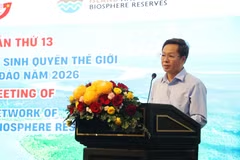
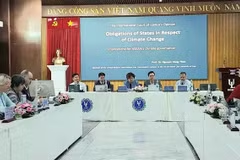
Consultation workshop on Cambodia’s Funan-Techo canal held in Can Tho ảnh 1At the consultation workshop on Cambodia’s proposed Funan-Techo canal project in Can Tho. (Photo: VNA)

Can Tho (VNA) – The VietnamNational Mekong Committee (VNMC) on April 23 held a consultation workshop onCambodia’s proposed Funan-Techo canal project which has raised concerns aboutpotential impacts on the Mekong river. 

Attending the workshop in the Mekong Delta city of Can Tho, domestic stakeholders and international experts discussed Cambodia’s plan to build the FunanTecho canal, a 180km waterway linking Bassac River (called the Hau River in Vietnam, which is one of the two main branches of Mekong River) with Kep port and onto the Gulf of Thailand.

The participants were informed about the International MekongRiver Commission (MRC)’s assessment on impacts of the project, the impacts that Vietnam paysattention to, requirements on the results of impact assessment and measures tominimise and monitor the project’s impacts. 

According to VNMC, Cambodia sent anofficial notification to the MRC about its plan to build the Funan-Technocanal. Because the canal directly uses the watersource of the Bassac River, the main distributary of the Mekong River, theproject has raised many concerns regarding its cross-border impact. The development would impact water resources of the Mekong Delta, especially in thecontext of drought and saltwater intrusion plaguing the region more frequently andmore severely. 

The Funan - Techo canal will transfer waterfrom the Bassac River, a tributary of the Mekong River, to Kep port locatedoutside the basin. This will significantly reduce water resources to the MekongDelta, causing a negative impact on the livelihoods and production of localpeople and natural ecosystems.

Associate Professor, Dr. Le Anh Tuan,advisor to the Institute of Climate Change Research, Can Tho University, saidthat when the Funan-Techo canal is formed, it will have a negative impact on the Mekong Delta. However, the level ofinfluence depends on the canal’s scale and usage.

Participants said they hope Cambodia would early share details about the goals, design and operations of the project and engage in joint research on its impacts with a view to reaching appropriate measures to monitor and minimise the impacts.

Chief of the VNMC Office Nguyen Thi ThuLinh said that the Ministry of Natural Resources and Environment and the VNMC will continue to coordinate closely with the MRC Secretariat, Cambodia and other MRCmember countries to accelerate research over the impacts of the Funan–Techo project and propose mitigation measures and monitor the impact.

The Mekong Delta with an area of about40,000 sq. km is home to more than 17.4 million people. It is considered therice, fruit and aquatic product granary of Vietnam as it contributes 50% of thecountry’s rice production, 65% of aquaculture and 17% of Vietnam's GDP.

The delta has been affected bysevere drought and salinity in 2015-2016, 2019 and currently 2023-2024as El Nino impacts local ocean waters and weather patterns. As the weather is predicted to become increasingly extreme,natural disasters including droughts, floods, and saltwaterintrusion will hit the region more frequently with more ferocity./.
VNA

See more

Delegates at the event (Photo: VNA)

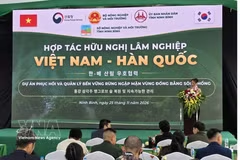
Vietnam, RoK wrap up mangrove restoration project

According to the Forestry Project Management Board under the ministry, the project planted 170 ha of new mangroves and restored or supplemented another 80 ha, meeting its approved targets. It also completed a three-hectare mangrove nursery, handed over to local authorities in 2024 to ensure a steady supply of seedlings.

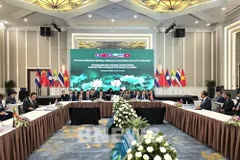
The second Ministerial Meeting of Mekong–Lancang Water Resources Cooperation takes place in Hanoi on November 19, 2026. (Photo: VNA)

Mekong–Lancang Ministerial Meeting promotes water information sharing

Minister of Agriculture and Environment Trinh Viet Hung noted that amid climate change, natural disasters and growing water demand, cooperation among the six Mekong–Lancang countries has become increasingly important. This calls for stronger information sharing, coordinated action and joint efforts towards the sustainable management and use of water resources throughout the basin.

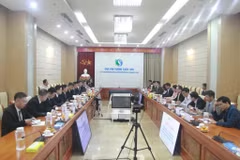
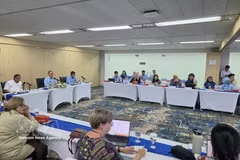
An overview of the working session (Photo: VNMHA)

Vietnam, China step up hydrological information sharing, early disaster warnings

The two sides signed the Minutes of Meeting on an emergency information-sharing mechanism for transboundary rivers. The document formalised key technical agreements reached by experts from the two countries, notably the conditions for activating emergency information provision at two critical locations in the river basins.

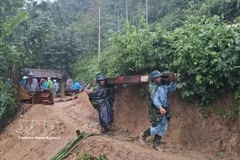
Authorities in Mang But commune, Quang Ngai province, assist residents whose homes have been affected by floods and landslides (Photo: VNA)

Heavy rain causes widespread damage across central Vietnam

According to the Vietnam Disaster and Dyke Management Authority under the Ministry of Agriculture and Environment, as of 5pm on November 11, the downpours injured two people in Hue city, and damaged or unroofed 38 houses in Quang Tri, Hue, Quang Ngai and Dak Lak.

Representatives of the People’s Committee of Ninh Bình province present the decision to establish the Kim Bang Delacour's Langur Species and Habitat Conservation Area. (Photo: VNA)

Ninh Binh establishes world's largest Delacour's langur sanctuary

The establishment of the Kim Bang Delacour's Langur Species and Habitat Conservation Area in Ninh Binh province provides a solid legal and scientific foundation for completing the dossier to seek UNESCO recognition of the Van Long–Kim Bang–Tam Chuc Cultural and Ecological Landscape Complex as a World Heritage Site.

Trees planted along Vo Truong Toan street in Cao Lanh ward, Dong Thap province. Urban tree species capable of reducing fine particulate matter will be planted to reduce air pollution. (Photo: VNA)

Urban trees capable of reducing fine dust to be planted

The Forestry and Forest Protection Department (FFPD) will lead the component on identifying crop and planting structures that help reduce air pollution, while also participating in the design of urban public-space landscapes.

Professor Yucheng Lin, an Assistant Professor at City University of Hong Kong (CityUHK). (Photo: VNA)

Hong Kong expert offers solutions to help Vietnam tackle sea-level rise

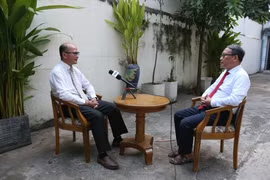
In an interview with the Vietnam News Agency’s correspondents in Hong Kong (China), Lin, an expert specialising in sea-level change and climate risk assessment, said Vietnam shared global drivers of sea-level rise with China’s coastal regions, but local conditions could lead to significant differences in the overall risks.

Typhoon Yagi caused severe losses in many provinces in Vietnam in 2024. (Photo: VNA)

Vietnam could face super typhoon like Yagi every seven years

If global average temperatures rise by two degrees Celsius, Vietnam could experience such a super typhoon once every 13 years on average. The frequency would increase to once every nine years under the three-degree warming scenario and once every seven years if temperatures rise by four degrees.

Six of the newly recorded species are of conservation significance, representing four orders and five families. (Photo published by VNA)

Dakrong Nature Reserve records 35 new bird species

Dakrong Nature Reserve in the central province of Quang Tri has recorded 35 bird species not previously documented, including several endangered and rare species listed on the International Union for Conservation of Nature (IUCN) Red List.

An overview of Soc Son waste-to-energy plant in the Nam Son Waste Treatment Complex, in Hanoi (Photo: VNA)

Hanoi targets collection and treatment of all industrial solid waste

Hanoi aims to ensure that all industrial solid waste from its hi-tech parks, industrial parks and industrial clusters is collected and treated in line with regulations under a new plan to strengthen waste management and tighten control on scrap collection, storage and recycling facilities across the capital.